|
BMW Motorcycle History
80 Years of BMW Motorcycles.
The first BMW motorcycle, the R 32 is a big
surprise. BMW, a company rooted in the production
of aircraft engines, was not even two years
old when the Peace Treaty of Versailles banned
the production of aircraft engines in Germany
in June 1919. The company was no longer permitted
to produce its six-cylinder, 226 bhp, 19-litre
engines and was restricted in 1920 to producing
500cc power units developing 6.5 bhp. The horizontally-opposed
cylinder layout became known as a Boxer and
was supplied to motorcycle manufacturer, Victoria,
in Nuremberg in 1921 and Bayerische Flugzeug
Werke, who fitted the BMW engine and transmission
into their Helios model.
BMW's General Manager Franz-Josef Popp and
his engineering colleagues decided that the
best way to support and safeguard BMW's reputation
as an engine manufacturer would be for the company
to build its own motorcycles. Max Friz turns
around the Boxer engine.
Max Friz (who had made a name for himself as
an outstanding engineer even before the first
World War) was given the task of building BMW's
first motorcycle. He had joined BMW in 1917
after having worked on Mercedes sensational
Grand Prix winning, four-valve ohc. Friz also
designed the Type IIIa aircraft engine, the
most progressive power unit of its day. While
the small M 2 B 15 motorcycle engine developed
by colleague Martin Stolle was no particular
challenge to him, the job of building an entirely
new motorcycle around the Boxer certainly gave
him something to think about.
Relishing the challenge, Friz had a large
drawing board and stove installed in the guest
room of his house opposite the factory. By
December 1922, he had produced a full-size,
concept machine. His idea was to fit the engine
at 90 degrees to the direction of travel,
so that the crankshaft would run lengthwise
on the motorcycle. The gearbox (also with
lengthwise shafts) would be driven directly
by a friction clutch and a drive shaft would
provide the drive train between the gearbox
and the rear wheel. Although there were already
several horizontally opposed engines on the
mar-ket (the British ABC motorcycle featured
an engine with transverse configuration, and
both the Belgian FN and American Pierce motorcycle
were equipped with a drive shaft) Max Friz
was the first engineer to combine all these
features on the BMW R 32.
Making its debut in Berlin.
BMW proudly presented its first motorcycle
on 28 September 1923 at the German Motor Show
in the Kaiserdamm Fair Halls in Berlin. This
pitched the Munich Company against no less than
132 other motorcycle manufacturers in Germany
alone. The BMW received great praise for its
unique technical concept as well as the aesthetic
appeal of the new machine.
The BMW R 32 entered series production before
the end of 1923 and the first motorcycles
were sold to customers for 2,200 reichsmarks
following the end of a period of rocketing
inflation in Germany. Although the R 32 was
one of the most expensive motorcycles on the
market, sales were positive.
Setting new standards of quality.
BMW's new motorcycle stood out from its contemporaries
not only because of the engine and gearbox configuration
but also because of its frame structure. This
consisting of two, fully enclosed steel tube
hoops running parallel with each other. Fitted
low in the machine's frame, the Boxer engine
lowered the centre of gravity and helped to
significantly improve the handling and riding
characteristics. Although the front wheel fork
allowed a small amount of spring travel, the
use of leaf springs provided a certain inherent
damping effect.
BMW riders began to reap the benefits of BMW's
experience as an aircraft engine manufacturer
and because of the company's choice of material
light alloy which was used on the pistons for
the first time. Another factor was the high
standard of construction and reliability, something
that had hardly ever seen before in a motorcycle.
There was no chain drive between the engine
and gearbox and no chain or belt leading to
the rear wheel. The valve shafts, as well as
the springs, were sealed off and were dust and
oil-tight at the tops on the cylinders. In conjunction
with the fully enclosed lubricant circuit, this
served to keep the motorcycle clean and to facilitate
mainte-nance at all times. Jet-black, burnt-in
paintwork and elaborate white decal lines set
new standards in the quality of a motorcycle's
finish.
Success in motorsport.
Success on the racetrack is the best way to
promote a new motorcycle especially a new brand
about to enter the market. Rudolf Schleicher,
a young BMW engineer was aware of this important
factor. After finishing the detailed design
and engineering work on the R 32, Rudolf entered
the Mittenwalder Steig Hill-Climb race on 2
February 1924 and set a record time on his BM.
He also became the first winner in the long
motorsport history of Bayerische Motoren Werke.
Using a machine with cast, light-alloy cylinder
head designed and built by Rudolf Schleicher,
with overhead valves encapsulated beneath
a cover hood, three BMW works riders entered
the Stuttgart Solitude race on 18 May 1924,
each of them winning individual categories.
Winning other signi-fi-cant races throughout
Germany and with Franz Bieber bringing home
the first championship, BMW becomes a leading
manufacturer on the racetrack in its first
year of motorcycle production. Works and private
mo-tor-cycle riders from Munich were to dominate
the German motorcycle racing scene in the
years to come.
BMW's unique shaft-driven Boxers also hit the
headlines in Great Britain at the 1926 International
Six Day Trial, causing a sensation in the country
that was the home of motorcycle racing. Then,
Paul Köppen and Ernst Henne won the Targa
Florio in Sicily and the Italian press and public
started to take a closer interest in BMW.
Continuous development and innovation.
Because of a growing demand in the market BMW
soon expanded its range. Touring models still
equipped with side-valve power units were supplemented
by high performance, expensive, and exclusive
sports machines that were powered by OHV engines.
Despite Germany's economic crisis, BMW successfully
gained a strong foothold in the 200cc entry-level
class in 1931 with the R2. The single-cylinder
model also featured shaft drive and many other
components and qualities made famous by BMW's
larger models.
Development continued with stable, pressed-steel
frames replacing the former tubular frame technology.
A 400cc single-cylinder engine was introduced
into the range that also included the Boxers
(now enlarged to 750cc) and the small 200cc,
entry-level single-cylinder. All models benefited
from regular improvements each year and BMW
was the first manufacturer to produce a telescopic
front wheel fork with hydraulic damping. This
was a milestone in motorcycle construction and
first appeared on the R12 and R17 in 1935.
One year later an entirely new model entered
the market, the R5. On the new model, conically-drawn
steel tubes with an elliptical cross-section
were connected to each other by protective gas
welding. The tele-scopic fork came complete
with adjustable dampers, while the new 500cc
power unit featured two camshafts and a single-piece
tunnel/engine housing.
The new BMW could now keep up with the fastest
British bikes, yet was far superior in riding
comfort, especially when the R51, with straight-travel
rear-wheel suspension, entered the market in
1938.
The German world of motorcycle construction.
Although tubular frame models served to modernise
BMW's range of machines, the police, postal
office and military authorities still preferred
pressed-steel frame models. This helped to maintain
a great demand for the R12 Boxer and the R 35
single-cylinder models.
BMW motorcycles were acknowledged as outstanding
representatives of the German world of motorcycle
construction and gained increasing popularity
abroad. Particular assets were the motorcycles
excellent quality and reliability, as well as
their progressive, and in some cases quite unique,
technical solu-tions. The telescopic fork and
rear-wheel suspension, fully-enclosed light-alloy
cylinder heads and torsionally stiff, large
brake anchor plates made of the same cast material,
smooth-surface engine blocks, wide mudguards
and enhanced rider comfort became increasingly
significant. Other manufacturers soon followed
suit.
World records and championships.
The idea came from Ernst Henne, who was also
the man in the saddle for a challenge to set
the world speed record for motorcycles. The
story started in 1929 with a new speed record
of 216.75 km/h or 134.39 mph. This involved
no less than 76 world records on the way to
a phenomenal 279.5 km/h or 173.29 mph on 28
November 1937. It was a record destined to
remain intact for the next 14 years and win
BMW universal acclaim as a motorcycle manufacturer.
The use of compressors (superchargers) in series
production ohv racing engines had already helped
ensure continuous success in motorsport and
in world speed record attempts. In 1935, BMW
racing machines also boasted two overhead camshafts
per cylinder (driven by side shafts) and were
able to successfully hold their own against
British and Italian competitors. BMW's first
Grand Prix victories in 1936 and 1937 were followed
by entry in the European Cham-pion-ship in 1938
comparable to todays world championships. Former
off-road rider Schorsch Meier, made the compressor
BMW almost unbeatable, winning the Senior TT
in 1939 and bringing home BMW's greatest racing
victory so far the Isle of Man TT, which was
acknowledged as the greatest challenge in motorcycle
racing.
From 1933-1935 BMW works riders won the International
Six Days (the most significant reliability and
off-road trial) three times. Amazed by this
outstanding success, some specialists start
to wax lyrical about the best motorcycle in
the world with reference to the BMW Boxer.
A three-wheel, off-road motorcycle
Because they bought a large quantity of motorcycles,
the military authorities were important customers
for BMW in the Thirties. Single-cylinder R4
and R35 machines were used for training and
messenger services, while the R11 and R12 served
as sidecar machines for rapid transportation
of soldiers or urgent supplies. In their preparations
for war, the German Wehrmacht saw the need to
replace the cavalry by sidecar motorcycles able
to handle off-road conditions effectively, motorcycle
riders took the place of horse riders. The Supreme
Command of the German Army specified design
concepts and construction require-ments, calling
for a driven sidecar wheel, a reverse gear and
a reduction gearbox for off-road purposes.
Consequently, the R 75 was an all-new machine
featuring a 750cc OHV power unit, a frame made
of combined modules complete with a central
profile segment and bolted-on tube connections,
a telescopic fork with double-action hydraulic
damping, and the drive technology required by
the military. Even a limited-slip differential
was added to the sidecar drive and with its
trans-verse shaft the 420 kilo sidecar machine
was able to tow a required load of more than
400 kilos or 880 lb. Benefiting from the driven
sidecar wheel, the machines set entirely new
standards in off-road qualities, easily outperforming
all-wheel-drive cars. From 1941-1944, BMW built
more than 18,000 units of the R 75 Wehr-macht
sidecar motorcycle. However, production moved
in October 1942 to the BMW car plant in Eisenach.
Making a new start with one-cylinder.
Motorcycle components and production facilities
were located at the Eisenach car plant, which
was taken over by BMW in 1928 and became unavailable
from 1947 when it was in the Soviet zone of
Germany. Production continued but in Munich
all the facilities were dismantled and the construction
drawings confiscated. The individual parts and
components used by Alfred Böning as specimens
for developing a new motorcycle thus came from
BMW dealers. The 250cc single-cylinder R24 made
its debut in 1948.
For the next six years German motorcycle manufacturers
achieved unprecedented sales. In 1950, BMW reintroduced
a two-cylinder Boxer but the single-cylinder
models still accounted for the majority of sales.
In just four years, production of the R25/3
amounted to 47,700 units. The image of the brand
was further strengthened by outstanding success
in racing. Hundreds of thousands watching Schorsch
Meier and Walter Zeller dominate on their BMW
racing machines. In sidecar racing, BMW's RS
racing Boxers with side-shaft control and two
overhead camshafts per cylinder scored an unprecedented
series of victories and achieved 19 World Cham-pionships
from 1945-1974, with Klaus Enders claiming the
title six times.
Unique technology.
By introducing the R51/3, BMW launched a new
generation of Boxer engines in 1951, placing
even greater emphasis on reliability and supreme
running smoothness. The R68 followed in 1952
and became BMW's first 100 mph ma-chine when
it offered a top speed of 160 km/h or 100 mph
and stood out as a thoroughbred sports machine
for the road. Newly developed suspension made
headlines in 1955 by offering unprecedented
directional stability and suspension comfort,
full-swinging arm.
BMW suspension technology (front and rear)
and established a new benchmark in motorcycle
construction. Indeed, the entire model range,
from the R26 single-cylinder through to the
R50 and R60 touring, Boxers and high-performance
R69 sports tourers now featured these technical
fea-tures. Worldwide, BMW motorcycles became
known as the epitome of supreme technical refinement
with the emphasis on quality, handling and riding
characteristics. They are dependable, easy to
service, reliable and enduring even under the
toughest conditions.
By the early Sixties, the motorcycle boom
in Germany came to an end.
Continuous demand from authorities and foreign
markets still justified BMW motorcycle production,
albeit reduced by two-thirds. At the same time
BMW car production took on greater significance.
BMW Director Helmut Werner Bönsch nevertheless
stuck to the motorcycle, emphasizing that building
a motorcycle called for passion It is a particular
skill for the engineer that remains young at
heart.
Modern motorcycles for global success.
With motorcycling reaching the end of the road
in Europe, as a means of transport, it was increasingly
developing into a popular leisure and sports
activity in the USA (in the mid-Sixties). Indeed,
it was for this lucrative market that new trends
were seen in technology and design. To the great
surprise of its contemporaries and the public,
BMW launched an all-new range of motorcycles
in the autumn of 1969 motorcycles developed
from scratch during the market's worst years.
However, the timing was perfect. All major manufacturers
introduced new and large-capacity machines in
Britain, Italy and Japan. In Europe, BMW's new
machines again met with growing interest.
Retaining the two-cylinder Boxer principle,
BMW produced everything else from brand-new
designs. The 500cc and 600cc models were supplemented
by the top-of-the-range R75/5, which fitted
perfectly into the 750cc category that had become
so popular. It was not only the engines that
were new with constant-pressure carburettors
and an electrical starter on the R75/5 but the
lighter, more advanced chassis and suspension
ensured significant handling benefits.
From September 1969, BMW's new motorcycles
no longer came from Munich but were built in
Berlin-Spandau at a former BMW aircraft engine
plant. The move reflected the significant expansion
of car production at BMW's original plant, although
BMW motorcycles were still designed, constructed
and developed in Munich.
Continuous development along proven lines.
With demand for BMW motorcycles consistently
increasing, more than 20,000 machines were leaving
the factory in Berlin. In 1973 the company celebrated
the 50th anniversary of BMW motorcycles and
completed 500,000 units. In the same year the
R90 S received an upgrade in engine capacity
and a significant increase in power. The sporting
character of the new machine was emphasised
by the first cockpit fairing ever featured on
a pro-duc-tion machine. Reg Pridmore subsequently
won the US Superbike Championship in 1976 on
a modified R90 S.
The R100 RS sports tourer launched in 1976
again boasted an even larger engine. More significant
though, was the first full fairing on a large
capacity production machine, developed as an
integral part of the motorcycle and tested in
a wind tunnel. Not surprisingly, the machine
set new standards for long distance riding comfort
and realistic road performance.
By introducing the R45 and R65 in 1978 the
company expanded its range with the addition
of the smaller Boxer models. BMW had eight motorcycles
on the market with respective capacities of
473, 599, 649, 797, and 980cc.
Racing through the desert.
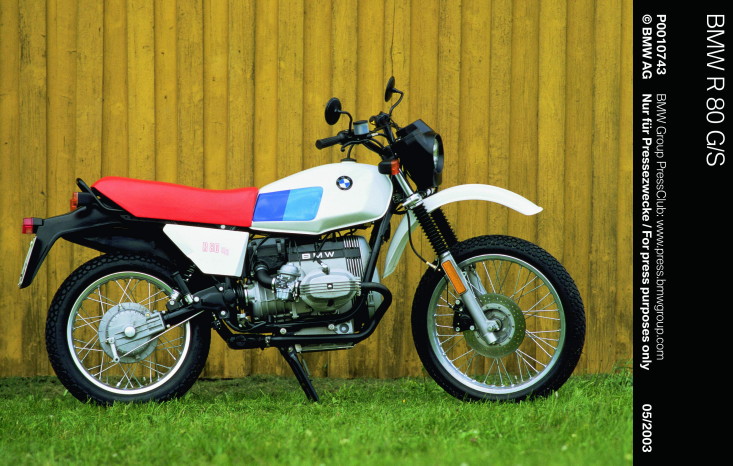
In 1980, the R80 G/S production model took
up the successful achieve-ments of the BMW factory
team in off-road racing. The biggest endurance
mo-torcycle at the time, the R80 G/S was ideally
suited for road use and for tackling rough terrain.
BMW thus paved the way in an entire-ly new mar-ket
segment for large-displacement touring enduros.
Its most important innovation was the BMW Monolever
single swinging-arm on the rear wheel.
BMW off-road machines participated from the
start in the long-distance Paris Dakar Rally
to the West African country of Senegal. In just
three attempts the Boxer with its reliable cooling,
low centre of gravity, and ease of maintenance
offered by the shaft drive made its way to success
in 1981. French desert specialist Hubert Auriol
won the mo-tor-cycle category and was able to
repeat the success in 1983.
The 1,000-cc twin-cylinder machines based on
the original series models also won the title
in 1984 and 1985. Former Motocross world champion
Gaston Rahier of Belgium was able to leave the
competition far behind. The R 80 G/S and its
successor, the R 100 GS, quickly became remarkably
successful machines in the BMW range. In particular,
serious motorcyclists the world over regularly
covered global distances and preferred BMW's
enduro machines when riding through the desert
terrain.
As a new symbol of the brand, the single swing-ing-arm
was soon fitted to other BMW machines. Another
BMW entirely different yet typical of the brand.
In 1983 four cylinders and a liquid-cooling
system were already state of the art technology
for modern high-performance motorcycle engines.
But just like his col-league Max Friz sixty
years earlier, BMW engineer Josef Fritzenwenger
suc-ceeded in creating a new technical concept
using the system as a basis. Referred to as
BMW Compact Drive, the engine crankshaft was
fitted lengthwise and connected directly to
the gearbox by means of a counter-rotating interim
shaft, with shaft drive to the rear wheel. The
drive maintained BMW's existing philosophy and
at the same time set a new standard. The 987-cc
straight-four power unit was fitted flat in
a lengthwise arrangement the crankshaft was
on the right side, in the direction of travel,
and the cylinder head with two overhead camshafts
on the left.
Featuring electronic fuel-injection, the BMW
K100 entered the market with a maximum output
of 90 bhp. The complete drive unit was mounted
in an extra-light space frame in bridge configuration.
The basic model was quickly joined by the K100
RS sports tourer, with its innovative and highly
effective fairing, and the K100 RT touring model
with an even larger fairing. Two years after
the launch of the K Series a 740cc three-cylinder
version rounded off the range of in-line engine
machines. The new model, the K 75, was also
available in different variants, with its own
range of fairings.
Safety for the rider, protection for the
environment.
Ever since the Seventies, BMW had been the
only motorcycle manufacturer to develop riderwear
and equipment, and motorcycle helmets. Indeed,
BMW helmets, with a pivoting front section,
set new standards in the motorcycle world and
were very popular with riders of other machines.
Safe riding, assured by good running gear and
brakes, has always been one of the special merits
of BMW motorcycles. A particular milestone came
in 1988 with the introduction of the world's
first anti-lock brake system (ABS) on a motorcycle:
This meant that, after thorough research and
testing, BMW was able to pre-vent the motorcycle's
wheels from locking and also save the rider
the risk of a fall. Realising that ABS was a
significant improvement in safety design, serious
riders took appropriate action and showed an
even greater preference for BMW machines.
Various concepts for reducing exhaust emissions
on BMW motorcycles proved equally popular. This
kind of environmentally friendly technology
was introduced throughout the entire BMW model
range in 1991. The Boxer models featured SAS
(Secondary Air System) exhaust gas combustion,
and the K75 and the K100 en-tered the market
with catalytic converters. As the top model
in the range, with aerodynamic bodywork including
the front-wheel and rear fairing, the K 1 was
the first motorcycle in the world to feature
a fully controlled three-way catalytic converter.
Its 16-valve four-cylinder power unit, with
digitally controlled electronic engine manage-ment,
provided an ideal configuration for this superior
technology.
One million BMW motorcycles.
The production of motorcycles in BMW's first
full year 1924 amounted to slightly more than
1,500 units. By 1935 the output had increased
to 10,005, and in 1939 production was double
this amount. The record pro-duction volume of
29,699 units, recorded in 1954, wasd not seen
again until 1977, after which production figures
then fluctuate for a number of years.
Expansion of the plant with new facilities
for the production of the K Series served to
increase production volume in Berlin. BMW was
therefore well prepared for the rapid increase
in demand in the '90s. On 18 March 1991 a K75
RT came off the production line and was recorded
as the millionth BMW motorcycle. Then, just
ten years later, production in Berlin alone
reached the one million mark the two-valve Boxer
machines built from 1969-1996 accounted for
the largest share at 512,644 units. But the
four-valve models were quickly catching up.
The new Boxer generation.
The basic principle of the Boxer has remained
unchanged two air-cooled cylinders, horizontally
opposed at the right and left, a gearbox directly
connected to the en-gine, and a drive shaft
leading to the rear wheel. Apart from these
principles everything else was new on the BMW
R1100 RS when it was launched in 1993. There
were now four valves in the cylinder heads,
operated by short tappets from the camshafts,
ar-ranged slightly lower down. Digital Motor
Electronics provided a maximum out-put of 90
bhp from 1,085cc and, together with a fully
controlled catalytic converter, helped to keep
the environment clean.
The drive unit formed a load-bearing element
and there was no longer a frame in the conventional
sense of the word. The front wheel was dependent
on the Telelever an innovative combination of
a triangular swinging arm and a tele-scopic
fork resting on the engine block which offered
advantages in terms of extra comfort and safety
on the road. Safety was also ensured by the
sophisticated braking system available as an
option with BMW's second-generation ABS.
The rear wheel ran on the Para-lever double-joint
single swinging-arm, carried over from the K1
and the R100 GS, and employed a spring strut
resting on a subframe at the rear of the machine.
The body design of BMW's new sports tourer,
in turn, was part of the overall technical concept,
placing particular emphasis on the Boxer en-gine.
This acknowledgement of the traditional and
still unique BMW motorcycle concept was warmly
welcomed the world over. The new model won numerous
awards and quickly provided a significant increase
in sales.
A new one-cylinder BMW.
BMW built single-cylinder motorcycles form
1925-1966. The half-Boxers had the same drive
concept with a crankshaft running length-wise,
a directly connected gearbox and the drive shaft
leading to the rear wheel but only one cylinder
stood upright on the engine housing. Serving
as entry-level models they were very popular,
particularly on the German market. This became
clear to the decision-makers in Munich in the
Nineties when considering various options for
expanding the range. This time, however, the
unconventional aspect was not so much the technol-ogy
used but the approach taken in development and
production. Under the guidance of BMW, a European
joint venture was estab-lished with Italian
motorcycle manufacturer Aprilia and Austrian
engine supplier Bombardier-Rotax to create the
BMW F650 Funduro.
Launched in 1993, the new single-cylinder machine
was an appealing model in many respects, and
helped BMW to quickly win new customer types,
including many female riders. The F650 proudly
displayed the white-and-blue logo of the brand
and naturally lived up to all BMW's quality
standards. This was confirmed by outstanding
sales success.
Continuing success of the Boxer.
BMW quickly and successfully expanded the new
R Series. In September 1993 the R1100 GS enduro
model hit the headlines at the Frankfurt Motor
Show. BMW equipped the big enduro model with
Telelever front-wheel suspension, a large 25-litre
fuel tank and comfortable two-piece saddle.
It was a motorcycle that invited riders to enjoy
the thrill of long adventures and motorcycle
tours tours that took place off the beaten track.
BMW even offered a new practice area for the
purpose in 1994 the BMW Hechlingen Enduro Park,
where experienced instructors provided helpful
off-road safety tips and techniques.
The R1100 R roadster, without fairing, joined
the range in autumn 1994 and along with the
smaller R850 R, represented a new generation
of Boxers. One year later, the R1100 RT tourer
with its all-new, comprehensive, full fairing
was launched. The increase in the Boxers momentum
was maintained with the R1100 GS and R 1100
RT battling it out for top position and ensuring
new sales records for a number of consecutive
years.
Starting in spring 1995, production at BMW's
motorcycle plant in Berlin was expanded to two
shifts and produced a daily output of 230 motorcycles.
This was the first year in which BMW sold more
than 50,000 units on the global market. In the
light of its success the company had no doubts
in allowing the old two-valve Boxer generation
to retire a year later. The last R80 GS Basic
was built on 19 December 1996. In the following
summer, the 100,000th new Boxer, a R850 R, was
ridden on the road by a lady rider from Italy.
The four-cylinder takes on new challenges.
In summer 1996 BMW bid farewell to the three-cylinder
models. This was despite sales of the K75 variants
amounting to 68,011 units in 11 years. Also
in 1996 BMW launched a new four-cylinder model,
the K 1200 RS with an engine that displaced
1,171cc and developed maximum output of 130
bhp.
The most powerful BMW motorcycle was convincing,
not only in power output, but also through its
suspension and running gear. This gave the new
sports tourer superior performance in most riding
situations. The drive unit, which was suspended
in a cast light-alloy, bridge frame, served
to minimise vibrations while the front wheel
employed the unique BMW Telelever for added
stability. The powerful four-cylinder machine
was the first K mo--del to incorporate BMW's
innovative suspension technology setting new
standards for the sports tourer segment of the
market.
Cruiser, athlete, luxury tourer
Until 1997 a large-capacity V2 power unit was
regarded as the only choice for powering an
authentic cruiser. But BMW tore up the blueprints
and presents the motorcycle world with an entirely
new and different interpretation that was based
on the Boxer philosophy and proven on the highways
of Arizona in the USA. The R1200 C combined
the progressive technology of BMW motorcycles
with Digital Motor Electronics, Telelever suspension,
highly effective brakes featuring ABS as an
option, as well as a new design language. BMW
simply took the typical qualities shown by a
cruiser when it was gliding along supreme engine
torque and a relaxed seating position and enhanced
them.
The complete opposite happened with the R1100
S in 1998. A sporting, crouched riding position
with the footrests mounted not at the front
but further back and higher, together with a
high-performance, spontaneous power unit running
on agile suspension represented exactly the
opposite concept precisely what the most dynamic
Boxer R1100 S had to offer. An increase in engine
output to 98 bhp and, for the first time, a
six-speed gearbox ensured superior performance
on the road. The powerful and sporting design
with exhaust pipes fitted beneath the rear of
the seat was typical BMW-style and it ap-pealed
to the BMW customer in every way.
In September 1998 BMW launched the K1200 LT
at the Intermot Motorcycle Show in Munich. The
new luxury tourer was conceived and built for
optimum motorcycle safety and comfort the same
consideration also being given to passenger
ergonomics. Driven by a four-cylinder engine
built for supreme torque at low engine speeds,
the K1200 LT with its light-alloy frame and
Telelever suspension was, by luxury cruiser
standards, quick, agile and dynamic. These were
surprising characteristics because of the machine's
not-inconsiderable weight, a consequence of
the number of features and diverse range of
original equipment. On the contrary, the luxury
tourer excelled because of its outstanding handing
qualities.
The LT's maximised protection from wind and
adverse weather was ensured by bodywork opti-mis-ed
in BMW's wind tunnel. A reverse gear provided
superior parking manoeuvrability and integrated
luggage cases and a top-case afforded ample
carrying capacity all as standard. The music
system, cruise control and heated seat are just
some of the many options available.
Big surprises in the Paris-Dakar Rally.
The Funduro was not a serious, competitive
off-road machine and this was clear following
a test run through the desert in 1998. However,
it did not prevent four BMW works riders from
entering the 1999 Paris Dakar Rally (starting
in Granada). After 18 days and 9,022 kilometres,
the winner was Richard Sainct, a French rider
from St Affrique riding the 75 bhp rally version
of the BMW F 650.
In the year 2000, BMW again entered the rally,
which was run from Dakar to Cairo in Egypt.
The company entered four, further im-proved
F650 RR machines, but also sprang a big surprise
with two R 900 RR models. The newly developed
rally version of the 8-valve Boxer crossed the
finishing line with Jimmy Lewis in the saddle
in third place in its very first competition.
It completed the course right in the middle
of a group of F650 RR riders and ensured that
BMW filled the top four places. Richard Sainct
achieved a second successive victory with Oscar
Gallardo in second and Jean Brucy fourth.
This one-two victory by BMW's single-cylinder
machine was the perfect prelude for the market
launch of the new F650 GS which followed two
months later. The new model retained the supreme
standard of on-road riding qualities but this
was supplemented by a significant improvement
in the model's off-road capability.
The 2000 one-four result beneath the pyramids
did not repeat itself in 2001. Lady Luck deserted
the riders and a series of accidents put paid
to the BMW R900 RR's attempt at successive victories.
However, Andrea Mayer once again on an F650
RR did make it all the way and won the Paris
Dakar Rally, Ladies Cup for the third time in
a row.
Entering the new millennium with a new name
The year 2000 meant, not only victory in the
Paris Dakar Rally, but new models and innovations
right through the year. It was also a year of
change for BMW's Sparte Motorrad Motorcycle
Division despite operating with increasing success
from one year to the next. The motorcycle division
of the BMW Group was renamed worldwide as BMW
Motorrad. The newly named company would offer,
not only motorcycles and rider equipment, but
a growing range of services, and motorcycle
skills and leisure programmes for BMW enthusiasts.
The BMW C1 - a truly innovative concept
The concept was to combine the benefits of
a motorised two-wheeler with all the safety
features of an auto-mobile agility, compact
dimensions (on the road and when parking), carefully
designed safety cell with deformation units,
shoulder bars and two seat belts. It became
the all-new, motorcycle philosophy of the BMW
C1.
Far more than just a motorcycle with a roof,
the BMW C1 is a highly developed and truly
sophisticated two-wheeler with elaborate technology
that allows the rider to drive without a helmet
or protective clothing. The design began with
the powerful 125-cc four-stroke engine featuring
four-valve technology, electronic engine management
with fuel injection, and a fully controlled
three-way catalytic converter. The high technological
approach extended to the Telelever front wheel
forks, ABS braking system, frame and body
safety confi-guration, and wide range of comfort
features and model fitments.
The BMW C1 entered the market in the spring
of 2000 and soon became an everyday sight
in European cities as a means of fast urban
transport and as an entry-level model for
the teenage, novice motorcyclist.
Berlin operating all-out.
BMW motorcycles are more popular than ever
before and production capacities are being increased
all the time. Apart from the Boxers and four-cylinder
machines, BMW single-cylinder models are now
being produced in Berlin. The new F650 GS entered
the market in spring 2000 as successor to the
BMW Funduro. The first version of the F650 GS
achieved a production run of no less than 64,339
units. It boasted a 50 bhp single-cylinder engine
with fuel-injection which were unprecedented
features in its market segment. A further unique
feature, designated BMS-C is BMW's Compact Engine
Management system developed completely in-house.
A lamb-da probe oxygen sensor and G-type catalyst
round off the wide range of standard equipment.
The F 650 GS has now been rede-sign-ed, not
only visually but to give an even greater off-road
experience. ABS has been made available as an
option. In addition, there is a special Paris
Dakar version with longer spring travel, off--road
tyres and the same decal trim as BMW's victorious
works machines.
The F650 GS is built in Berlin on a new assembly
line. Indeed, the expansion of capacity at BMW's
motorcycle plant was made possible through close
co-operation with the company's suppliers and
boosted daily pro-duction in 2001 to 440 motorcycles.
BMW's annual production, in the same year, was
90,478 machines.
All models with catalytic converter and
ABS
BMW's Boxer machines are in great demand, the
various models having set new standards in their
respective market segments. But even this is
not sufficient for BMW's development engineers
in their commitment to create new variants and
new developments over and above the regular
model update process. Benefiting from an increase
in engine capacity, the R1150 GS offers an even
better torque curve and the new gearbox comes
with a sixth gear to reduce engine speed through
its overdrive function. The cruiser range has
been supplemented by the R850 C, with a somewhat
smaller engine, and by the new R1200 C Avant-garde
and R1200 C Independent versions. Another new
model that made its appearance in 2001 was the
R1150 R naked bike, referred to by BMW Motor-rad
as the Roadster because to its fresh, innovative
design and no frills riding approach.
The touring Boxer also became the R 1150 RT
by increasing engine capacity to 1130cc and
incorporating a six-speed gearbox. Identical
improvements were also introduced on the R 1150
RS. The robust and versatile R 1150 GS has also
been complemented by the introduction of a variant
called the Adventure which has been equipped
with a comprehensive range of long-distance
touring equipment. And last but most certainly
not least, all BMW motorcycles, including the
C1, came as standard with injection engines
boasting a G-type catalytic converter and ABS
brakes features no other manufacturer could
offer.
In 2001, BMW Motorrad introduced third generation
ABS technology, called BMW Integral ABS, with
two important additional functions. Firstly,
it used an all-new electro-hydraulic brake
servo and an integral braking system. The
handbrake or footbrake lever acted simultaneously
on the front and rear-wheel brakes thus ensuring
adaptive brake force distribution, depending
on the load the motorcycle is carrying. The
big safety benefits offered by the global
innovation are the reduction of brake operating
forces and an even shorter stopping distance.
BMW Motorrad BoxerCup.
The idea to stage a racing series with identical
BMW R 1100 S machines originated in France.
After two seasons in France and Belgium the
BMW Motorrad BoxerCup became a truly international
event in 2001. 30 riders from all over Europe
competed in seven races alongside the motorcycle
500cc Grand Prix (now MotoGP) or at the long
distance World Endurance Championship racing
weekends on production-based versions of the
BMW R 1100 S. Participation by famous guest
riders added additional spice to the keenly
fought and exciting races. Ex-Grand Prix star
Randy Mamola was actually hired as the BoxerCup
ambassador but also took to the saddle from
time to time. Stéphane Mertens of Belgium
finally claimed overall victory in the series.
An even larger number of 32 riders from ten
countries enrolled for the eight races of the
2002 season, guaranteeing interest and rivalry
throughout the whole of Europe. This was reflected
not only in the closeness of the races, but
also in results. New faces appeared on the podium
time and again, with a whole series of riders
maintaining their chances for overall victory
up to the final race of the season. The winner's
spoils once again went to Stéphane Mertens
who proudly drove home in a new BMW sports coupé.
In 2003, its third international year, the
BMW Motorrad BoxerCup made its debut in the
USA where the first of nine races took place
at Daytona on 9 March. From there the series
went to Oulton Park (GB), Le Mans (F), Mugello
(I), Barcelona (E), Assen (NL), Spa-Francorchamps
(B), Sachsenring (D), and finally Brno (CZ).
A bigger model range than ever before
When it launched the F650 CS in 2002, BMW introduced
a new type of road machine that followed in
the footsteps of the F650 GS Funduro but shared
only the single-cylinder power unit with its
sister model. The model name Scarver stands
for agile handling and dynamic engine characteristics.
A new technical feature is the low-maintenance,
toothed belt-drive to the rear wheel. Through
its design and accessories, the Scarver intentionally
makes a big departure from conventional motorcycle
concepts. The range of BMW cruisers also grew.
The R1200 CL ranked as a luxury cruiser with
an unmistakable front-end that featured four
headlights in a new tourer fairing. An integrated
luggage system has been fitted as essential
standard equipment, and excellent ergonomics
are employed for same relaxed seating posture
for both rider and passenger.
Comfort was the also a primary feature on the
new K 1200 GT - a developed version of the four-cylinder
sports tourer with a modified fairing, a newly
styled windshield and many interesting details.
The BMW R 1100 S BoxerCup replica goes in another
direction. The attractive road-going version
of the racing machine shared a number of common
fea-tures over and above the special paintwork.
Examples are the sports sus-pen-sion with longer
spring struts allowing the rider to lean at
a sharper angle, the wider rear wheel and of
course the characteristic valve cover made of
carbon-fibre.
The R1150 R Rockster proved to be such a popular
design study when it was shown at the Munich
Intermot Show in September 2002, that BMW decides
to enter pro-duction. The resulting model is
characterised by its particularly extravagant
sporting appearance. Like all other Boxers in
the 2003 model year, the Rockster comes with
BMW's new (twin-spark) dual-ignition serving
to further improve emission control on BMW motorcycles.
BMW Motorrad becomes the largest motorcycle
manufacturer in Europe
BMW Motorrad has developed, in the last decade,
into the largest manufacturer of motorcycles
on the Continent. Motorcycle production at BMW's
Ber-lin plant in 2002 increased again, this
time by 2.8 per cent. A grand total of 93,010
motorcycles clearly confirmed BMW's top position
in Europe.
The year 2002 was also a record year in sales.
92,559 units marked the 10th annual record in
a row and brought the company close to the magic
threshold of 100,000 units per year.BMW Motorrad
is consistently expanding its position in all
markets, achiev-ing particularly impressive
growth once again in Germany, where the company
now ranks second overall in terms of registrations.
Looking into the future, the focus remains on
profitable growth with new models, ongoing investments
in the expansion of the plant, and a highly
efficient dealer and sales organisation.
|