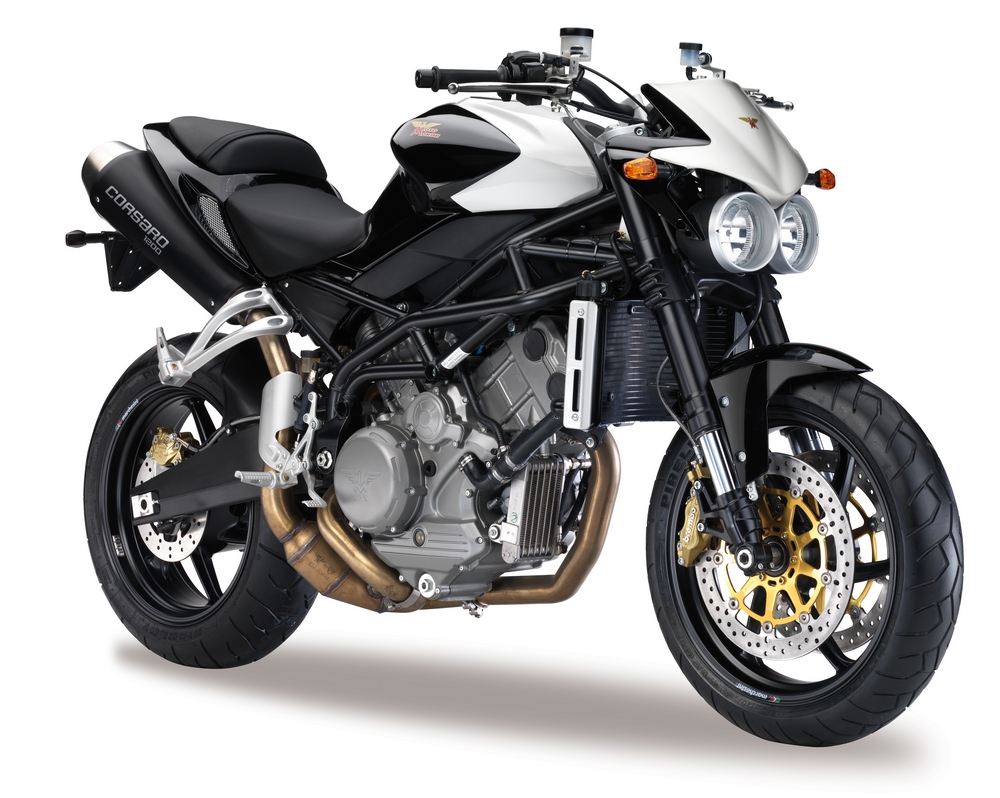
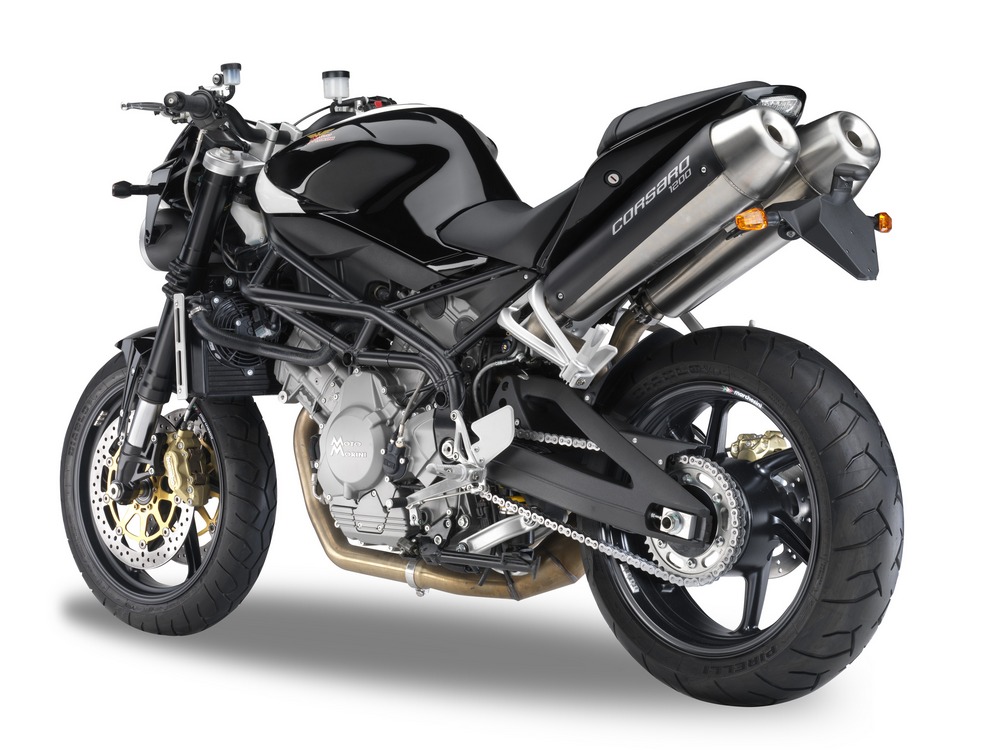
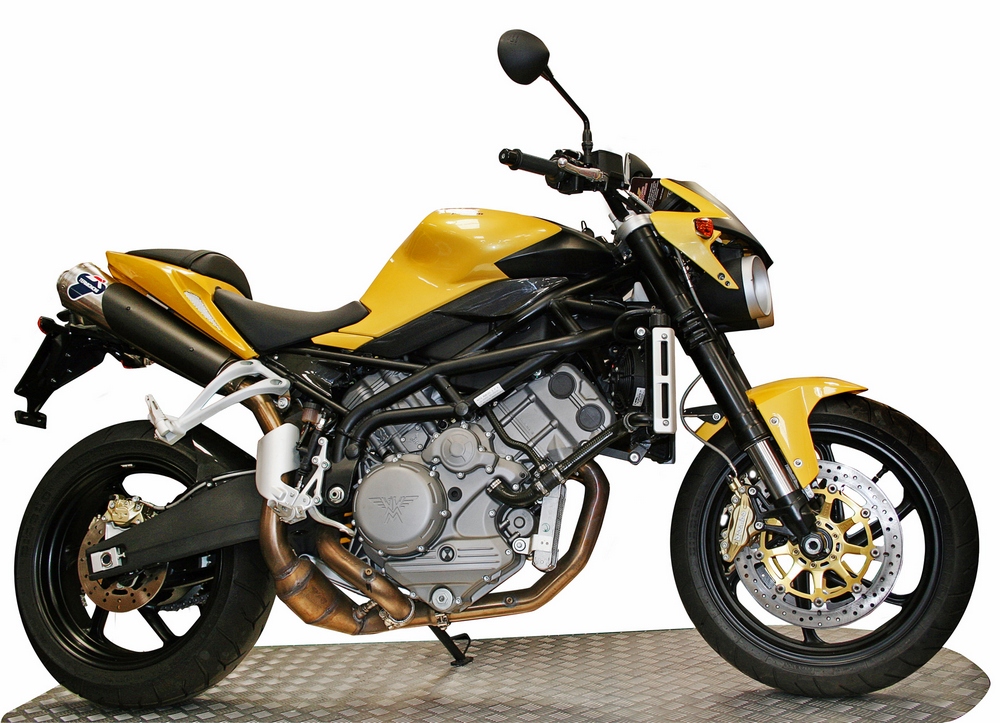
2010 Moto Morini Corsaro 1200
 

The Corsaro 1200 was presented to the
international press in July 2005. It is the first
in a range that the Moto Morini management is betting
on for the brand's rebirth. The motorcycle is intrinsically
Italian: the Bialbero CorsaCorta engine carries the
design of Franco Lambertini, one of the maestros in
engineering twin-cylinder engines; the bike's design
has been the domain of Marabese Design; and the 100%
Italian componentry is top-notch. Corsaro 1200 is
one of the first naked bikes to obtain Euro 3 approval,
an extra feature that required major efforts to preserve
the product's performance and aesthetic features.
The Corsaro project took shape in 2003,
and when the motorcycle was brought out two years
later, the choice to concentrate efforts on a large-displacement
naked road bike turned out a successful one, further
confirmed by growth trends in the segment in Italy
and abroad.
First and foremost, the decision taken
by the Moto Morini management was the result of an
attentive analysis of the market and its foreseeable
prospects. But another, hardly secondary, motivation
was the desire to maintain continuity with the history
of the Moto Morini marque.
The motorcycles that made this marque
so memorable from the years spanning 1936 to 1994
have a very specific identity: they are naked bikes,
with mechanics exposed and perfectly integrated in
a harmonious design and classic graphics. Being measured
according to these concepts today and knowing how
to give them a modern interpretation is the challenge
of the Corsaro 1200 project.
Behind the Corsaro is a project for
a sport bike that is easy to ride. The layout was
studied and designed to house the slim, 87° longitudinal
V twin-cylinder engine, a compact engine that facilitated
the design of a motorcycle with a short wheelbase
of 1440 mm and a distribution of weights with 51%
on the front. Intensive experimentation was reserved
for establishing the ideal centre of gravity to achieve
the maximum handling on combined terrain and the best
stability at the highest speeds. Attaining this goal
was significantly aided by the
shape and size of the aluminium cast swing arm and
progressive linkage.
The design of the Corsaro has been
overseen by Marabese Design with whom Moto Morini
has established a joint collaboration which envisions
the development a whole range.
The motorcycle exudes a sport style.
The trellis frame composed of variable sized tubing
has a compactness and conceals nothing of the Bialbero
CorsaCorta engine, perfectly epitomising the concept
of a naked bike. A perfect balance of curves and tensions
characterise the superstructures; the headlight fairing,
tank, seat and tail display synchronous lines that
reveal Italian aesthetics in all their refinement.
The original and dynamic headlight fairing leaves
the double-lamp headlight in full view. Focus was
also placed on tank, whose form recalls the opening
of the wings of an eagle. It is contoured to achieve
optimum ergonomics and to allow
for the two-tone paint finish in the best Morini tradition.
The seat and tail echo these lines in the profile
of the air scoops. Of particular impact is the swing
arm cast in aluminium alloy featuring original, enveloping
forms, which supports the rear progressive suspension.
The exhaust system is clearly sophisticated and complies
with Euro 3 pollution standards. The original design
of exhaust piping has been designed with 70-mm diameter
tubes, with the catalytic converter intentionally
in view and with two spectacular biconical-shaped
silencers under the seat. Welding points on the whole
exhaust system are clearly visible to accentuate
the whole character of an object that seeks to stand
out.
The lay out of the engine is strongly
characterised by the V layout of the cylinders and
by the timing system which, conceptually speaking,
are reminders of the family of the 3 1/2, but especially
by the innovation of the integral casing.
To reduce the height of the engine
as much as possible, the cylinder heads were lowered
to the degree that the exhaust has been positioned
tangent to the rear connecting point of the engine.
The 4-valve DOHC layout echoes in part
the philosophy of the 250 bialbero of the 1963 GP,
while having an angle between the valves that is decidedly
more modern. All this could have been achieved with
a casing cut parallel to the ground, but the position
where the sprocket came out of the chain would have
been very low and too distant from the centre of the
shaft, resulting in a less than optimum placement
of the engine. The casing cut vertically, instead,
allows an excellent positioning of the sprocket without
the heads having to be
lowered.
The solution of the integral casing
allows the sprocket of the chain to be higher and
closer to the engine axis, with the cylinder heads
lower and layout of the V angle at 87°. The size
of the engine has become extremely compact, contributing
to an optimisation of the vehicle's geometry. The
innovation of the integral casing offers different
advantages with respect to traditional solutions:
- the stiffness of the assembly is such to permit
to the engine to be load bearing, i.e., to greatly
simplify the layout of the chassis;
- the simplicity of assembly and disassembly to
access the engine both during production and when
bike is serviced: for example, the lower part of
the engine can be opened to get to the gearbox and
engine shaft without disassembling the heads of
the casing; and pistons and cylinders can be disassembled
without opening the casing from special side entries;
- there is no need to match up the two semi-casings,
typical of motorcycle engines. This greatly benefits
production, service and cost of spare parts.
The heads have 4 valves at a narrow angle (9.5°
INT.& 12.5° EXH.); the timing is a DOHC; the
intake pipes are vertical; the exhaust pipes are characterised
by split pipe outlet; a single spark plug is at centre.
The valves are FINT. 43.5; FEXH. 35.7. The engine
timing is Aint.20°x58°; Aexh54°x20°,
and the valve return is operated by two springs per
valve.
The engine has a 107 mm forged piston, the largest
ever constructed for a motorcycle of this category.
Its stroke is 66 mm. This decision has made it possible
to make the engine more compact on top without excluding
future development of this displacement.
The shaft is built according to the classic "Scomposto"
(“split”) motorcycling technology. The
great advantage is to use an integral connecting rod
-- i.e., without bolts on the cap -- reflecting a
philosophy that prioritises simplicity.
The gearbox is six speed with quick coupling. Conceptually
it is comparable to the first standard gearbox with
six speeds of the legendary 3 1/2. The clutch features
a radial mastercylinder and anti-skipping device.
Thanks to the compactness of the engine in the upper
section, it was possible to choose a wet casing lubrication,
much simpler and more practical for the layout of
the vehicle as compared to a dry casing lubrication.
The pump is with lobes and is gear-commanded; the
bypass valve is positioned under the filter to avoid
clogging.
The circuit carries out internal passages of the
coolant to the engine, while the pump, which delivers
160 l/min is coaxial to the timing lay shaft
The injection features an integrated system of injection/ignition
supplied by Magneti Marelli, the throttle bodies are
diam.54 with single-jet injector.
Essence of the chassis is the trellis frame in high-strength
steel tubing from Verlicchi designed exclusively for
Moto Morini. The structure is extremely solid and
combines all the stiffness required to harness the
power of the engine with a reduced weight and a muscular
look characterised by the main tubing with a 35 mm
diameter.
Wheelbase, headstock rake, and trail measurements
are highly compact, especially considering that the
bike has a 1200cc engine. Thanks to the harmony achieved
in fine-tuning the various components, the result
of this alchemy is immediately perceptible in the
first few metres of road: the weight, already reduced
to just 198 kg magically disappears when in movement
and the deftness in cornering assures stability even
at top speeds.
The function of the frame is aided by top-notch
suspensions. At front a powerful Marzocchi Magnum
with 50 mm diameter legs, slender due to exclusive
lightweight plates constructed in a cast light alloy,
is compatible with every riding style thanks to different
possibilities for adjustment. The visual solidity
is reflected in a solid and coherent functioning,
ready to conform to minimum unevenness in the road
and to bear the thrust of deceleration during the
hardest braking.
The rear is characterised by an asymmetrical swing
arm that conceals a fully adjustable Sachs shock absorber
with legs increased by 16 mm in diameter, spring adjustable
in preload with single nut and internal counter-spring
to improve riding response.
Even parts apparently of less importance or undervalued
in most bikes on the market have been meticulously
cared for. Some examples: the chain adjustment sliding
shoes have been machined from the solid by milling
a precious light alloy as have the footpegs of the
rider and passenger.
The wheels fit Pirelli Diablo tyres in the classic
sizes of 120/70 at front and 180/55 at back to guarantee
the support and surface necessary for discharging
the enormous torque of the engine, with the assurance
that the situation is always under control.
While braking, the Corsaro 1200 never gives reason
to disappoint: the Brembo systems guarantee powerful
yet progressive deceleration, granting the rider the
sensitivity needed for optimum handling of this difficult
aspect of the riding experience. At front are a pair
of 320 mm discs with radial master-cylinder and four
piston callipers: a solution stemming from a precise
technical input, that of lending safety thanks to
excellent modulability and awesome power. Too often
racing systems that become transferred onto road models
give abrupt reactions that are difficult to control,
especially on roads open to traffic and when roadbeds
offer poor grip. The braking power of the Corsaro
1200 is at everyone’s full grasp.
While the Corsaro 1200 is an example of Italian
mechanics in the most honoured tradition, running
through this machine are state-of-the-art electronics.
The CAN line transfers information between the Magneti
Marelli engine CPU, the fully equipped dashboard featuring
onboard computer and latest-generation sensors placed
throughout the vehicle to keep all sensitive parameters
under control. Among the other functions of the instrument
panel, are two different trip meters reporting average
speed and rpm, but also the ambient temperature, the
gear inserted, clock and maintenance intervals. Starting
is automatic: just a light pressure
on the button will activate the control unit command
to the electric motor allowing the V twincylinder
to come to life. Even the old lever of the starter
is a distant memory thanks to a sophisticated system
of automatic mixture control regulated by the stepper
motor according to the weather conditions. Despite
this, the technology is never invasive, the rider
always has the situation under control and, from a
design viewpoint, the cables disappear from sight
and most components are neatly ordered in the compartment
under the seat. Both the powerful headlight with double
lamps and the led one at the rear automatically turn
on when engine is stared in compliance with the most
recent road rules.
The fuel tank, with a prestigious 2-shade paint
finish like the glorious Moto Morinis of yesteryear,
is constructed in shockproof nylon. It has a capacity
of 18 litres and can be lifted to have access to the
large filter box lying below.
Last, but not least, the exhaust system not only
gives an unmistakable look to the motorcycle thanks
to the Termignoni biconical silencers; not only does
it fill the air with powerful sound, but it is environmentally
friendly thanks to a meticulous design scheme and
to closed loop technology with three-way catalytic
converter and oxygen sensor. The exhaust emissions
measure well under the limits imposed by the stringent
Euro3 standards.
Two-tone finishes for all Corsaro 1200 models, available
in red/silver with red frame,
black/silver with black frame and black/white with
black frame.
|