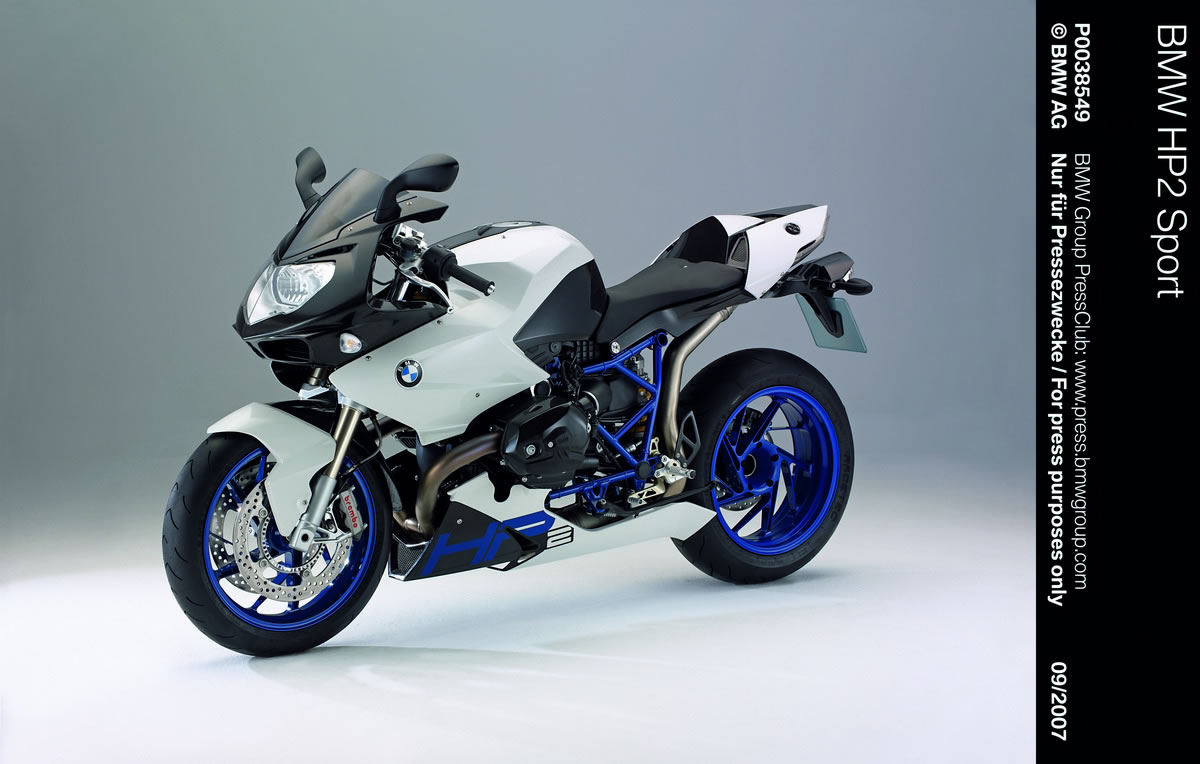
2011 BMW HP2 Sport

Concept, requirements and features
BMW Motorrad has announced details
of its sportiest, most powerful and lightest signature
Boxer series of all time. The third model of the High
Performance HP range has been designed for the ambitious
sports rider and features numerous exclusive details
that were previously restricted to racing –
some making a first appearance on a production motorcycle.
Examples include the self-supporting
and aerodynamically optimised fairings made completely
of CFK; the gear shift ‘assistant’; a
dashboard like that used in MotoGP; forged aluminium
wheels and racing brakes with radially-bolted calipers.
Wherever the eye looks, it sees pure racing technology.
It is unmistakably dynamic and agile – a machine
that will inspire on country roads and race circuits.
BMW Motorrad deliberately decided to
further develop the historic boxer engine for road
racers with racing circuit intent. The key engine
data is extremely good, for example, the engine achieves
more than 96kW / 128bhp at 8750 min–1 –
more than the significantly modified engine of the
BMW R 1200 S. The maximum torque of 115 Nm is achieved
at 6,000 min–1, while the highest engine revs
reach a peak value at 9,500 min–1.
Technically, the BMW HP2 Sport is based
on the BMW R 1200 S. Although customised to meet the
requirements of the ambitious sports rider down to
the last detail, the BMW HP2 Sport is a completely
independent and exceptional motorcycle. Many detailed
solutions are based on the experiences gained in long-distance
races.
The most striking difference of the
BMW HP2 Sport (compared with the endurance racing
boxer) is the all-new cylinder heads: Each of the
double overhead camshafts (DOHC) uses a drag lever
to actuate the valves that are larger those on the
BMW R 1200 S. Further modifications such as the flow-optimised
intake and outlet, new forged pistons and adapted
connecting rod help the engine to achieve the necessary
higher output.
The striking design of the rear silencer
is impressive and the new stainless steel exhaust
system is placed below the engine for the first time.
This keeps the construction of the lower area of the
motorcycle to be kept extremely slim, enabling greater
freedom of movement for riding techniques such as
‘knee-down’ cornering.
The inimitable boxer sound has a new acoustic quality
and is generated by the exhaust system. In addition,
the fitting of a CFK engine spoiler also provides
aerodynamic advantages.
Another exclusive racing feature is
the gearshift assistant. Together with the close ratios
of the 5-speed gearbox it enables fast gear shifts
without having to ease off the throttle and operate
the clutch. This technology is offered for the first
time in a series motorcycle. In order to adapt the
gearshift pattern for the racing, a suitable replacement
pressure sensor is available as special equipment
(if required).
The fully adjustable Öhlins sports chassis also
has a Brembo monoblock brake system with radially-mounted,
four-piston fixed calipers at the front.
Optimum ergonomics are ensured by the
adjustable forged aluminium footrests, adjustable
stock handlebar and the Magura radial manual buttons.
The instrument console is directly
from MotoGP and provides the rider with important
information such as lap times, other racing data and
the usual displays (see chapter 3).
Consistent attention was paid to the
lightweight construction of all components. This included
the self-supporting front fairing, the self-supporting
carbon rear, the weight-optimised forged wheels, and
such hidden details as the lightweight generator.
It was therefore possible to reduce the unladen weight
of the HP2 Sport to DIN standard with a full tank
(90%) to 199 kilos. The dry weight is only 178 kilos.
The interplay of variable ergonomic
design, increased engine output, and the favourable
centre of gravity of the boxer engine guarantees superb
handling and racing potential. Even if racing is clearly
at the forefront of the BMW HP2 Sport, it does not
forego the safety design feature of ABS. The sophisticated
anti-blocking system specially adapted to the HP2
Sport is available as an option and is configured
so that it can be switched off for the racetrack.
The market introduction of the BMW
HP2 Sport is scheduled for 2008.
Model designation and marque
HP is the abbreviation for ‘High
Performance’ and the ‘2’ in the
model designation of the supremely sporty BMW refers
to the two-cylinder boxer engine. The term ‘High
Performance’ stands for sporting performance
and the achievement potential of the entire machine.
‘High Performance’ also reflects the skilful
harmonization of all individual components into a
convincing whole. It is the synonym for a well thought-out
overall design and perfection right down to the last
detail. It embodies the very best driving characteristics
and pure, unadulterated riding pleasure. HP also stands
for the prestige connected with an exceptional high-quality
and exclusive machine.
After the HP2 Enduro and the HP2 Megamoto,
the HP2 Sport is the third model of an independent
motorcycle category equipped with the historic boxer
engine. All HP2 motorcycles use the technical basis
of production machines but are clearly differentiated
by an uncompromising interpretation of their prime
sporting purpose.
These exceptional motorcycles are developed
with great passion by small teams of professionals.
The special team structure guarantees that the many
years of experience of the development engineers;
their essential personal know-how and ‘feel’,
have a direct influence on the product. At the same
time these engineers make use of the most modern development
and simulation tools, plus all the technical facilities
that BMW. This symbiosis of high-technology and professional
skill is what defines the unique appeal of the HP
motorcycles.
High performance motorcycles from BMW
are invariably something special; they are exclusive
and authentic and will remain greatly sought after.
Development, technical highlights
and design
The new HP2 Sport extends the HP model
range of BMW Motorrad and is a descendant of the R
1200 S. Apart from established concepts such as the
BMW Motorrad Telelever, EVO Paralever and the cardan
shaft drive, almost all components were newly developed
or at least extensively modified. Weight saving, increased
performance and the uncompromising sporty configuration
was a top priority in the list of requirements for
the development engineers.
A dedicated specialist team of veteran
racing motorcyclists, engineers and mechanics, developed
the new model for BMW Motorrad. Experience that the
BMW Motorrad motor sport team had acquired with the
boxer racing motorcycle – including a number
of races in the Endurance World Championship of 2007
– was also incorporated.
DOHC cylinder heads, valve
actuated by drag lever
A complete redesign of the cylinder
heads allowed the boxer to reach higher revs. Extensively
tests in endurance events followed in addition to
the usual tests. Double overhead chain driven camshafts
(DOHC) and valves actuated by a very light drag lever
now enable top revs of 9500 min–1. The four
radially arranged valves ensure extremely compact
combustion chambers so that there is no need for the
second spark plugs (as used in the R models). The
compression ratio is 12.5:1.
Super Plus with 98 RON is recommended
as the fuel for optimum performance although the motorcycle
can also run on Super 98 RON.
The horizontal arrangement of the camshafts
introduces two special features: each of the shafts
control an intake and outlet valve and the cams are
conically ground. For a higher gas flow, the valve
plate diameter was increased from 36 to 39 millimetres
(intake) and from 31 to 33 millimetres (outlet). The
intake channels were also machined for optimisation.
The operating technology with drag lever works with
shims sitting on the valves as in the K 1200 engines.
The cylinder head covers are made from carbon and
fitted with easy-to-replace slip pads made from PA6
hard plastic.
High-strength and lightweight
forged piston
The bore and stroke ratio is unchanged
in the HP2 boxer. The high-strength, weight-reduced
forged piston and the corresponding adapted conrod
are new. Interacting with the new intake pipe system,
with its a short intake air funnel, the power plant
develops a top performance of 96kW / 128 bhp at 8,750
min–1 and a maximum torque of over 115Nm at
6,000 min–1.
Flow through two parallel and consecutively
switched oil coolers
So that the sport boxer operates well
under all conditions from the thermal aspect, two
oil coolers positioned one after the other, and with
a parallel flow-through, are deployed. Wind tunnel
optimisation of the BMW ‘kidneys’ in the
front fairing ensures an effective airflow through
the double oil cooler.
Stainless steel exhaust system
with active exhaust gas flap
For the first time the 2-in-1 exhaust
system, made completely from stainless steel, is placed
under the oil sump. This configuration guarantees
optimum angles of tilt when riding. An exhaust flap
in front of the double exhaust pipe silencer at the
rear, and actuated by an electronically controlled
servomotor via cable, produces a fuller torque curve.
A fully-controlled catalytic converter
cuts exhaust gas emissions. Oxygen sensors in the
two header tubes monitor the oxygen level and guarantee
an optimum air-fuel ratio over the entire torque band.
An example of the great attention to detail that characterizes
the development and production of the BMW HP2 Sport
is the exhaust pipe fixtures on the single-piece,
self-supporting carbon rear. These are thermally decoupled
while, at the same time, compensating for the change
in length of the exhaust system during warming and
cooling. The hump also boasts sophisticated ventilation
openings, used to effectively deflect the heat away
from the underseat exhaust. Additional features of
the exhaust system are the highly attractive design
and the impressive boxer sound that emits from the
high-volume silencer.
Close-ratio six-speed gearbox
In contrast to the gearbox of the BMW
R 1200 S, the first and second gear have higher ratios
so that the gear increments are closer. This results
in a lower drop in revs when changing up. This configuration
is also a typical racing feature that benefits the
dynamic driving characteristics.
Straight from the racing world:
the gearshift ‘assistant’
A further racing detail is the standard
gearshift assistant of the BMW HP2 Sport, also described
as an automatic gearshift. The system allows rapid
gear change without shutting the throttle or using
the clutch. If the gear lever is activated, the electronic
engine control throttles back the ignition angle and
reduces the injection. This means the power unit is
at low load for the gearshift so it is possible to
change gear rapidly without needing the clutch.
The gearshift assistant operates under
normal riding conditions and (on request) for racing
with an inverted switching scheme (pressure sensor
as special equipment). However, if the rider operates
the clutch, the system remains inactive. The BMW HP2
Sport therefore always leaves the decision of whether
or not the gearshift assistant is deployed to the
rider.
Modified frame construction
The steel mid-frame tube comes from
the BMW R 1200 S but was adapted to the new single-piece
and self-carrying CFK rear in the area around the
location points.
Telelever with Öhlins
sport spring strut.
The front wheel suspension is provided
by the stable, approved telescopic lever construction.
Its trailing link is supported by a specially tuned
Öhlins sport spring strut with compensating tank,
adjustable in tension and compression stroke damping,
as well as spring pre-tension. The expanded surface
around the slider clamping device in the lower fork
brace allows fine adjustment of the vehicle height.
Quality components made of
milled aluminium
The upper fork brace and the two adjustable
high-quality stock handlebars flange-mounted in the
crankshaft throw are made from fully milled, forged
aluminium parts. The main brake cylinder and the clutch
master cylinder with radial pump coupling, fixed by
quick-release clamping callipers, usually found in
racing are also used.
EVO Paralever with Öhlins
sport spring strut
The Paralever rear wheel suspension
also originates from the BMW R 1200 S, but in the
HP2 Sport it has an Öhlins adjustable sporting
spring strut with compensating tank. Thanks to the
longitudinal adjustment integrated in the spring strut
the vehicle height can also be varied at the rear.
This means the chassis geometry of the BMW HP2 Sport
can be individually optimised for different racing
circuits.
Every BMW HP2 Sport is supplied as
standard with an exclusive toolset, which can be used
to make all settings on the chassis components.
Exclusive forged wheels and
racing tyres
The BMW HP2 Sport runs on specially
developed, weight and stability optimised, surface-milled
forged wheels 3.5 x 17” or 6.0 x 17”.
These are considerably lighter than conventional die-cast
wheels but have comparable high stability. The handling
characteristics benefit enormously from the smaller
rotating masses. The sports boxer is easy to steer
on bends and allows incredibly rapid change of direction.
The forged wheels are fitted with sports
tyres as standard in 120/70 ZR17 format (front) and
190/55 ZR17 (rear). These tyres from renowned manufacturers
– generally used only on the racing circuit
such as the Supersport Championship – are homologated
for use on asphalt road surfaces. The engineers decided
on a 55 series tyre cross-section as this achieved
the best results, when testsing, for the overall characteristics.
Brembo monoblock racing brakes
The braking system of the new BMW HP2
Sport is also uncompromisingly sporty. Single-piece,
radially mounted four-piston brake calipers from Brembo
powerfully hold the two 320-millimetre discs at the
front. The radial screw connection is effected by
a new die-cast foot on the lower part of the Telelever.
A double sliding piston decelerates the rear wheel,
and the hydraulic application of the brake calipers
is activated by high-quality, steel armoured brake
lines.
Modified, switchable BMW Motorrad
ABS (on request)
BMW Motorrad offers ABS adapted for
sporting events as an option. The function of the
system has been optimised to prevent the rear wheel
from lifting. An additional pressure sensor in the
front brake circuit provides sensitive regulation
of the system and the control unit prevents the front
wheel brakes from opening too early when the load
on the rear wheel is greatly reduced. Nevertheless
the ABS can be deactivated for racing events.
Racing ergonomics
Even at the beginning of development,
the engineers focussed on the seat position. Compared
with the BMW R 1200 S, the rider moved closer to the
handlebar resulting in a notably more upright seat
position oriented towards the front wheel and behind
the ‘waistline’ of the fairing. More importantly,
the remarkably slim design of the tank area favours
the rider’s weight displacement (when hanging
off) during races.
The BMW HP2 Sport also benefits from
the experiences gained in long-distance races where
it is not only a question of speed, but also of staying
power. Because the rider finds a suitable, but comparatively
relaxed, riding position for racing, the new BMW Sport
boxer offers genuine endurance qualities.
Adjustable footrest system
The range of high-grade racing components
includes the adjustable footrest system made of milled,
high-strength aluminium. An eccentric cam is used
to adjust the height of the footrests and to move
them forwards or backwards. The stepped setting positioning
of the footrests make sure that identical adjustment
is possible on both sides. At the same time, the fully
adjustable brake and gear lever allow optimal positioning.
Adjustable stock handlebar
and Magura manual fittings
The stock handlebar of milled forged
aluminium is ideally positioned and can be adjusted
by changing the offset. The Magura radial manual controls
allow manual lever width setting of brakes and clutch.
All-CFK fairing
All the fairings of the BMW HP2 Sport
are made from carbon where the single-part rear as
well as the front fairing are realized as self-supporting
elements. The latter has a noticeably slimmer construction
than the R 1200 S and houses lightweight, high-luminosity
halogen twin headlamps with free-formed surface reflectors.
Special details include the number plate carrier of
the BMW HP2 Sport: In just a few easy steps, before
taking part in a race, the carrier can be removed
along with the tail lamp and indicators
.
Refinements in the wind tunnel
The new BMW HP2 Sport was given its
finishing touches in the wind tunnel. Components such
as the windscreen and new rear-view mirror were optimised
aerodynamically. The engineers also paid particular
attention to the airflow for cooling the engine. The
outcome was that the front spoiler guides the air
stream specifically towards the outlet side of the
cylinder heads, while the BMW ‘kidneys’
in the front fairing guarantee an effective flow of
the double-oil cooler. Lastly, elaborate ventilation
openings in the carbon tail ensure that the heat of
the underseat exhaust system is efficiently deflected.
Sports info centre: GP dashboard
from 2D systems
A real highlight for all racing enthusiasts
is the production-line instrument panel in the cockpit
of the BMW HP2 Sport. It was developed in collaboration
with the acclaimed company 2D Systems that also deploys
its systems in GP racing for data recording and analysis.
The system has a large, easily readable digital display
and works in different modes. It is operated by two
switches on the left handlebar.
In road riding mode the rider can view
typical information such as revs, speed, time, kilometres,
remaining distance and driving time on the display
and is shown supporting information during the warm-up
phase of the engine.
In race mode the screen provides data
about circuit times, maximum revs, top speed, or number
of gearshifts. The stored data can also be read with
a laptop. In addition, there are eight freely programmable
LEDs in the upper area of the display that can be
used as a rev read-out or external gearshift light.
Like the other functions, the displays are also freely
programmable.
Finally, the GP dashboard offers a
large number of expansion options.
A lap timer with transmission/receiving
unit, GPS tracking or data logger can be connected
to a free input.
Following the BMW Motorrad motor sport design The
fairing of the new HP2 Sport is realized to a large
extent in carbon-look and follows the style of the
BMW Motorrad motor sport design with white lacquering
on the windscreen, rear mudguard and side cover. The
engine spoiler carries the two-tone HP2 lettering.
The lattice frame and wheels are lacquered in the
BMW Motorrad colour, Motorsport Blue.
Constant refinement for serial
production
The dedication of BMW Motorrad not
only took into account the great many wishes of the
international community of fans. On the contrary,
engineers and technicians also used experiences from
endurance racing to advance engine and chassis technology
for serial production. For example, the DOHC cylinder
head or the CFK fairing components of the racing machine
reappear today in the new BMW HP2 Sport. Today, the
development constantly moves forward.
In 2008 BMW Motorrad will once again
line up at the start with the HP2 racing machine –
not least to put the components for serial production
through their paces and to refine them. Other events
are planned in the long-distance world championship
as well as participation in other prestigious endurance
races.
The long-distance racing machine of
the BMW Motorrad team differs from the serial version
of the BMW HP2 Sport in a number of ways. With the
aim of losing as little time as possible during pit
stops, a quick-change system with swivel upside down
telescope fork (typical of the endurance racing) was
mounted on the front wheel. The clearance between
the production-line stanchion and sliders was increased
for this purpose. Together with the com-bination of
standard swing arm and central nut system from Formula
1 on the rear wheel, this permits faster changeover
of the forged wheels.
The larger aluminium tank with high-speed
filling valve and a capacity of 23.5 litres is also
a must for long-distance racing. Because racing regulations
permit a louder exhaust system, a racing silencer
from Akrapovic is at the rear and contributes to the
higher maximum power output of the thoroughbred racing
machine.
|