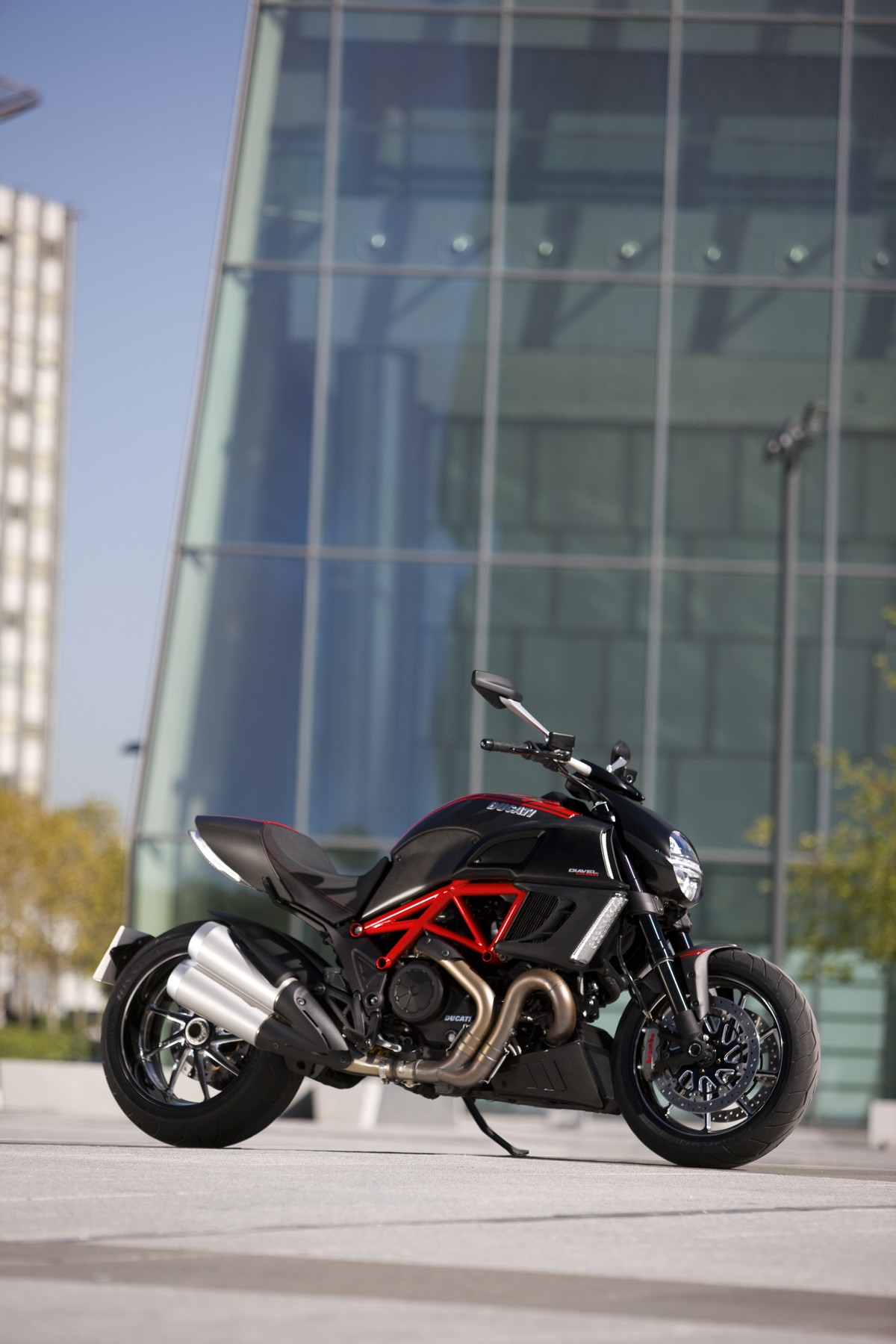
2011 Ducati Diavel
  
Ducati Diavel: The new shape
of power and style
 The
innovative new Ducati Diavel combines decades of twin-cylinder
heritage and Italian style with a bold, The
innovative new Ducati Diavel combines decades of twin-cylinder
heritage and Italian style with a bold,
world-beating technical confidence strong enough to
extend the boundaries of motorcycle design.
Custom shop beauty, state-of-the-art technology, innovative
design and extraordinary riding pleasure are
masterfully blended into the Diavel, a motorcycle
destined to shape the future, a motorcycle built by
people
who have earned the right to change the rules.
 Built
to have a commanding presence, though lightweight
and agile like all Ducatis, the Diavel takes the Built
to have a commanding presence, though lightweight
and agile like all Ducatis, the Diavel takes the
man-motorcycle relationship to the next level in absolute
comfort. For connoisseurs of technology, ABS,
Ducati Traction Control and Ducati Riding Modes deliver
a confidence-inspiring sophistication while stunning
looks, 162hp and 207kg (456lb) of authentic Ducati
performance drives a comfortable sport lifestyle that
could only be dreamt of before.
 Merging
the worlds of power and style has never been achieved
with such convincing precision. A specially Merging
the worlds of power and style has never been achieved
with such convincing precision. A specially
engineered 240 section rear tyre combined with famous
Ducati chassis technology serves up mind-blowing
handling and lean angles which defy the laws of physics,
whether carving through curves on your favourite
road or just riding out for a night on the town.
The latest ground-breaking Ducati is
available in two versions: The brand new Diavel and
the flagship Diavel
Carbon with a character-forming mix of aesthetic and
performance components from carbon fibre bodywork
to forged and specially machined Marchesini wheels.
Basic instincts
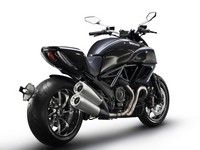 The
Diavel project was born when Ducati designers applied
their wish-list of bike “basic instincts”
to a blank The
Diavel project was born when Ducati designers applied
their wish-list of bike “basic instincts”
to a blank
canvas. With a “what if?” approach to
creating a dream bike, they sketched inspiring shapes
which became
a lower and longer motorcycle.
“The challenge of building a
muscular silhouette over a pure-bred competition motor
had to be met with
determination and a delicate touch, and the result
is a frontal area that looks like a power athlete
on the
starting blocks,” explains the team at Ducati
Design responsible for the project. “With the
front wheel kept
close to the Diavel’s body and using the short
tail of a sport bike, we were able to blend this muscular
design
with a chassis that matched.”
If the stance of a Streetfigher is
that of “anger,” the stance of the Diavel
is that of readiness, dominance, and
confidence bordering on superiority. With lateral
radiators adding muscle to its broad “shoulders,”
which then
taper down across the engine and into the belly-fairing
with oil cooler, the athlete took shape.
A massive 240 section rear tyre was a perfect example
of how Diavel designers used a no-compromise
attitude when applying their wish list of features.
The sheer width of rubber communicates so much power
and style that the R&D team vowed to find a way
to make it handle - even if they knew the image would
send a seismic shock through the industry.
Ducati’s philosophy for innovation
has always been to push the boundaries of design in
the name of exciting
motorcycles. Sometimes “gut feelings”
are what count, and having the strength to commit
to them shows the
kind of bravery that has guided Ducati to World Championships.
The Diavel is a true Ducati, born from a
passion for motorcycling and designed to deliver authentic
Ducati performance in every respect.
“Diavel”
The name “Diavel” was inspired
by the Bolognese dialect word for “devil”.
One day, early in the
development process of the bike, the first prototype
was assembled and wheeled out in front of a group
of
Ducati engineers and technicians who were viewing
the complete motorcycle for the first time. One person
looking from the rear of the bike saw its silhouette
and exclaimed in Bolognese dialect: “Ignurànt
comm’ al
diavel!” Which means: “Evil, just like
the devil!”
Reminiscent of how the “Monster”
was named almost 20 years ago, the Diavel now follows
the same
Bolognese tradition, shaping the future of motorcycling
while staying faithful to its heritage.
Rider and passenger comfort
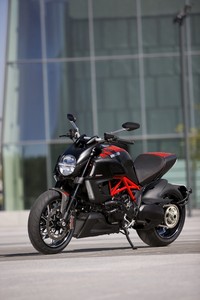 The
Diavel’s twin-level seat is wide, comfortable
and beautifully shaped to fit the flowing lines of
the machine The
Diavel’s twin-level seat is wide, comfortable
and beautifully shaped to fit the flowing lines of
the machine
and at 770mm (30.3in), has one of the lowest seat
heights in the Ducati range. That low seating position,
in
addition to a low slung chassis set-up that weighs
in at just 210kg (463lb) - 207kg (456lb) for the Diavel
Carbon - enables the rider to get both feet on the
ground for a sure-footed and confident stance. The
seat
also comes with a beautifully shaped and easily removable
single seat cover, which is formed in carbon fibre
on the Diavel Carbon.
Passengers on the Diavel will appreciate
the way the slender passenger footpegs ingeniously
fold down
from the rear sub-frame as well as the innovative,
T-bar shaped grab-rail assembly, which slides out
from
the rear of the seat. Deployed from a mechanism under
the seat, the grab-rail provides a comfortable and
confidence-inspiring grip for the passenger, while
the shape perfectly blends into the lines of the tail-piece
when retracted. Both passenger-friendly features are
crafted in forged aluminium and shot-peened for
strength and uniform finish before being black anodised
to become almost invisible when folded away.
Lighting
The Diavel uses two clear vertical
strips of LED lighting to provide tail and brake light
illumination as well as
directional indicators. The strips follow the precise
line of the under-seat panelling, providing great
visibility
of the rear-end while keeping the external lines of
the bike clean. The front directional indicators are
clear
lens LED strips mounted vertically down the leading
edge of the lateral radiator covers.
The headlamp gives the Diavel immediate
Ducati identity and is supported by an aluminium outer
body. The
light uses high and low beam double reflectors to
illuminate the road ahead, in addition to incorporating
a
horizontal strip of LED positioning lights for optimum
visibility.
Innovative number plate mount
Employing the double strip of multi-functional
LEDs for the rear lighting of the Diavel required
an innovative
solution for the mounting of the number plate. The
unique design uses mounts on the rear hub of the singlesided
swingarm to extend an elegant and Ducati
signature Trellis framework around the 240 section
rear
tyre, enabling a central mounting of the plate. The
framework carries a hidden power feed to dedicated
LED
illumination for the number plate, eliminating any
reliance on the main rear lights and creating a clean
feature around the rear of the seat. This design solution
represents the first of its kind and an example of
the
incredible attention to the Diavel’s detail.
Fuel tank and air Intakes
The Diavel’s 17l (4.5 gal US)
fuel tank represents an integral part of the bike’s
overall styling. Its wide, long
lines sweep down from the headlamp assembly into the
seat and rear sub-frame to create a seamless
profile. While the focal point of the tank is the
high resolution display panel, the steel tank skin
and wellsculpted
knee panels add a solid feel to the
Diavel and a high tech composite look to the Diavel
Carbon.
On each side of the front of the tank are massive
air intakes formed in aluminium to feed the engine’s
large
airbox. Their design is completely functional and
contributes to the 162hp produced by the Diavel
Testastretta 11° power plant.
Controls
The Diavel handlebar shape and arrangement
leaves the rider feeling comfortable and in command.
Wide,
tapered section aluminium bars with new custom designed,
integral brake and clutch master-cylinders by
Brembo complete with milled reservoir tops, provide
a clean and minimalist set-up, while stylish, forged
aluminium supported mirrors deliver a generous view
to the rear.
Switchgear control is taken care of
by Ducati’s latest and most minimalist design
with slim-line bodies
housing easy-to-use switches and buttons and a unique
weapons-like “trigger catch” that slides
down to
cover the starter button when activating the kill-switch.
While the indicator cancel button doubles as a scrolland-
select for fast and easy Riding Mode changes, switches
above and below serve to navigate the new high-resolution
display control panel.
Colours
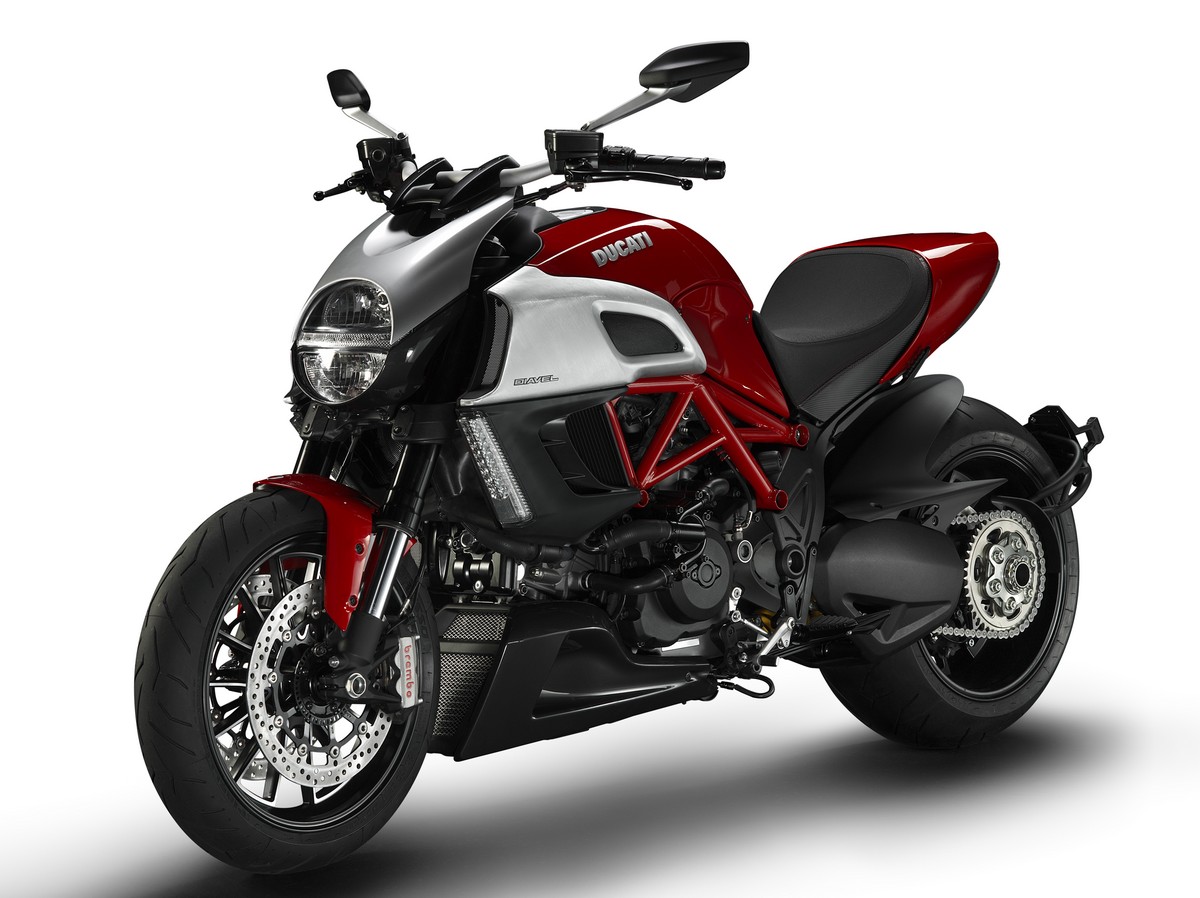
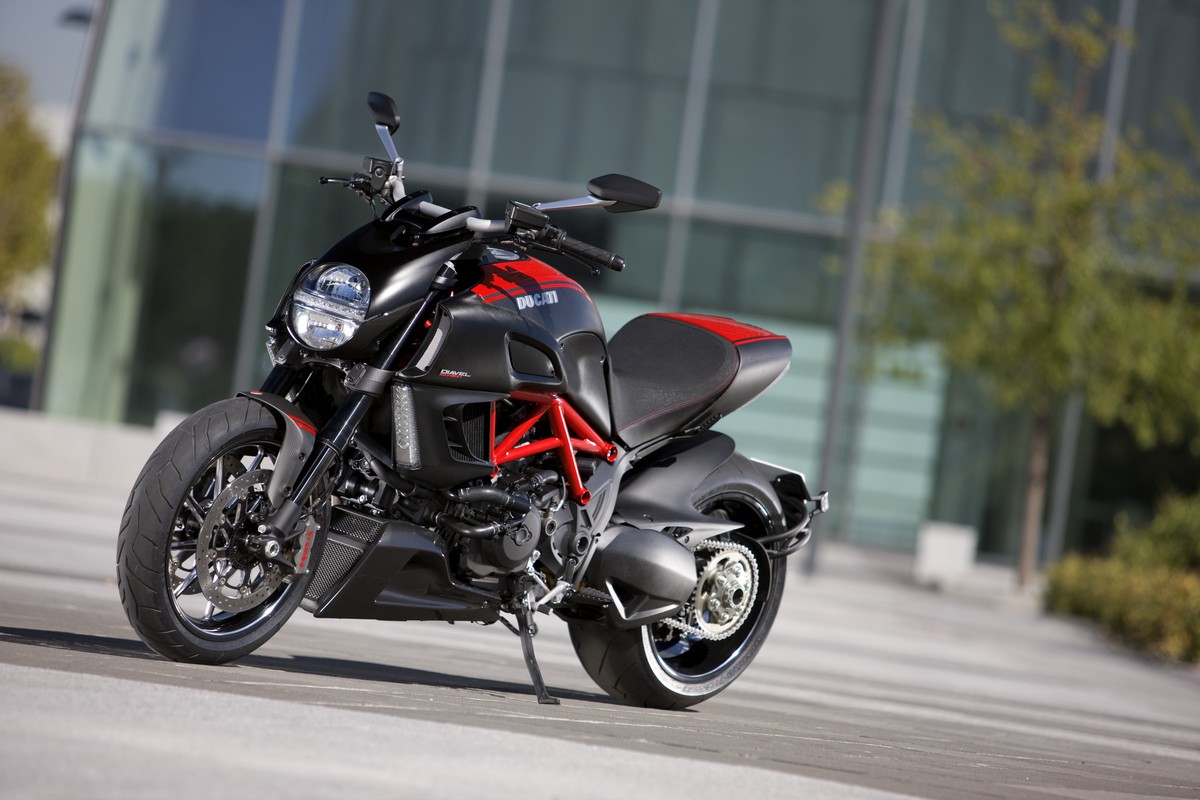
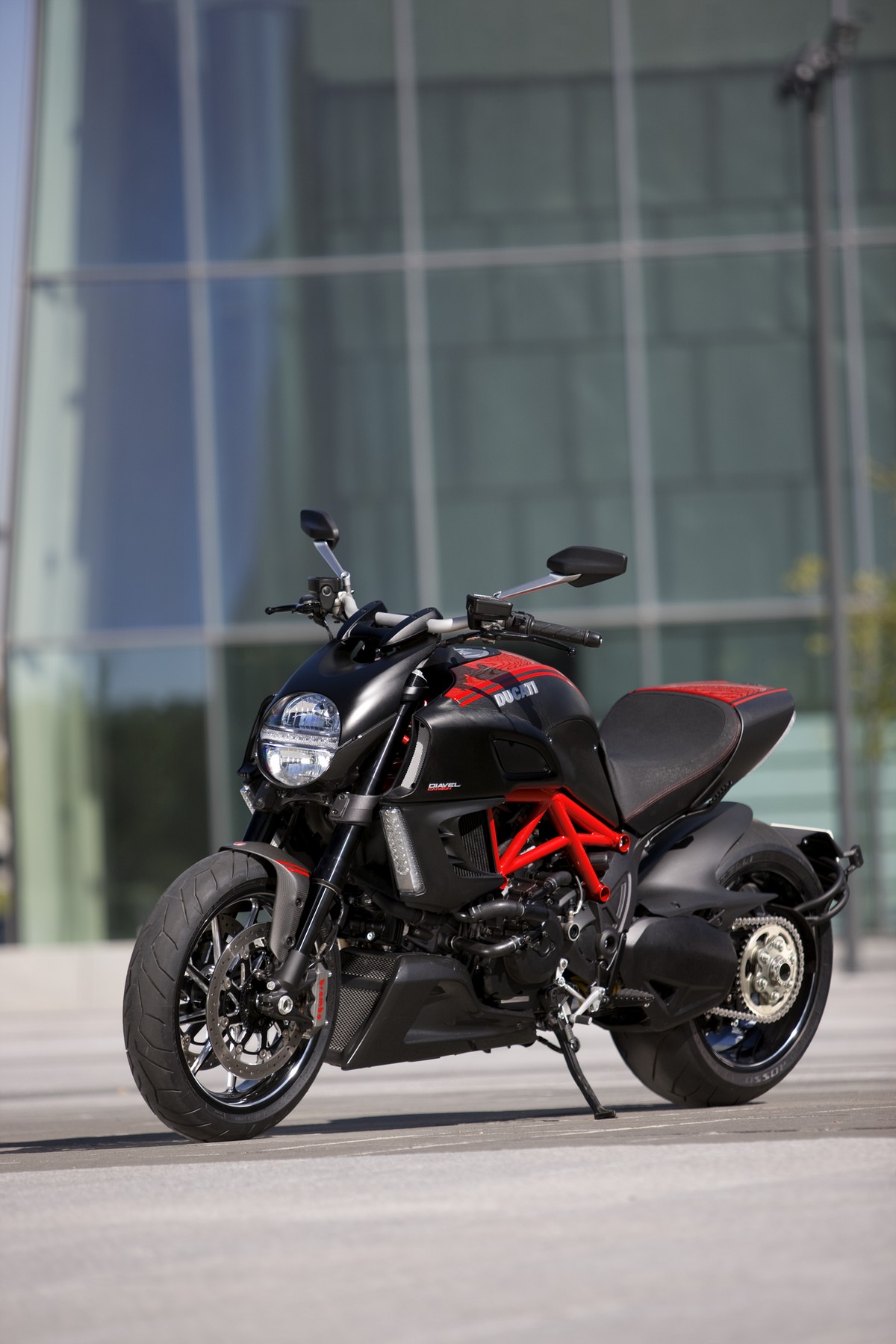
The Diavel comes in traditional Ducati
red with red frame and black wheels or a sophisticated
pearl white
silk and metallic black scheme with black frame and
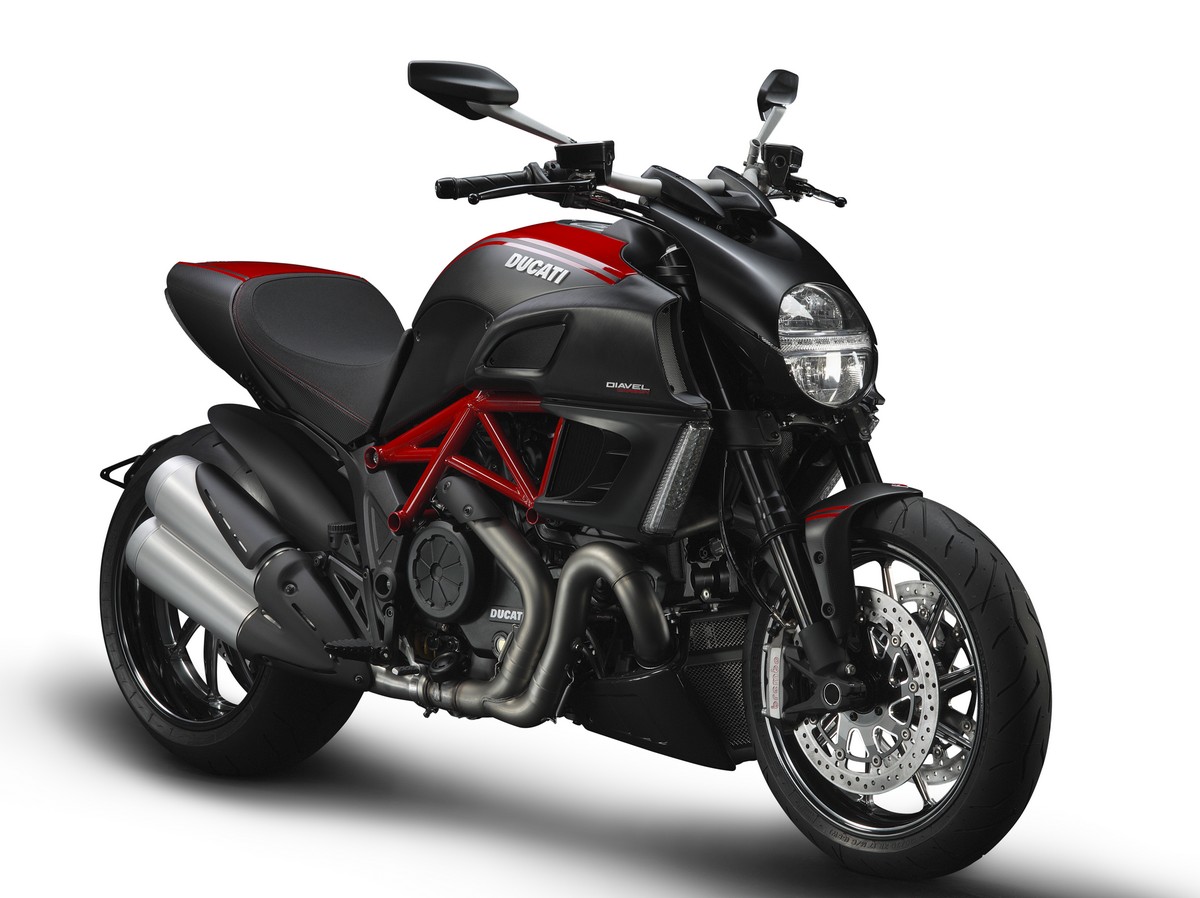
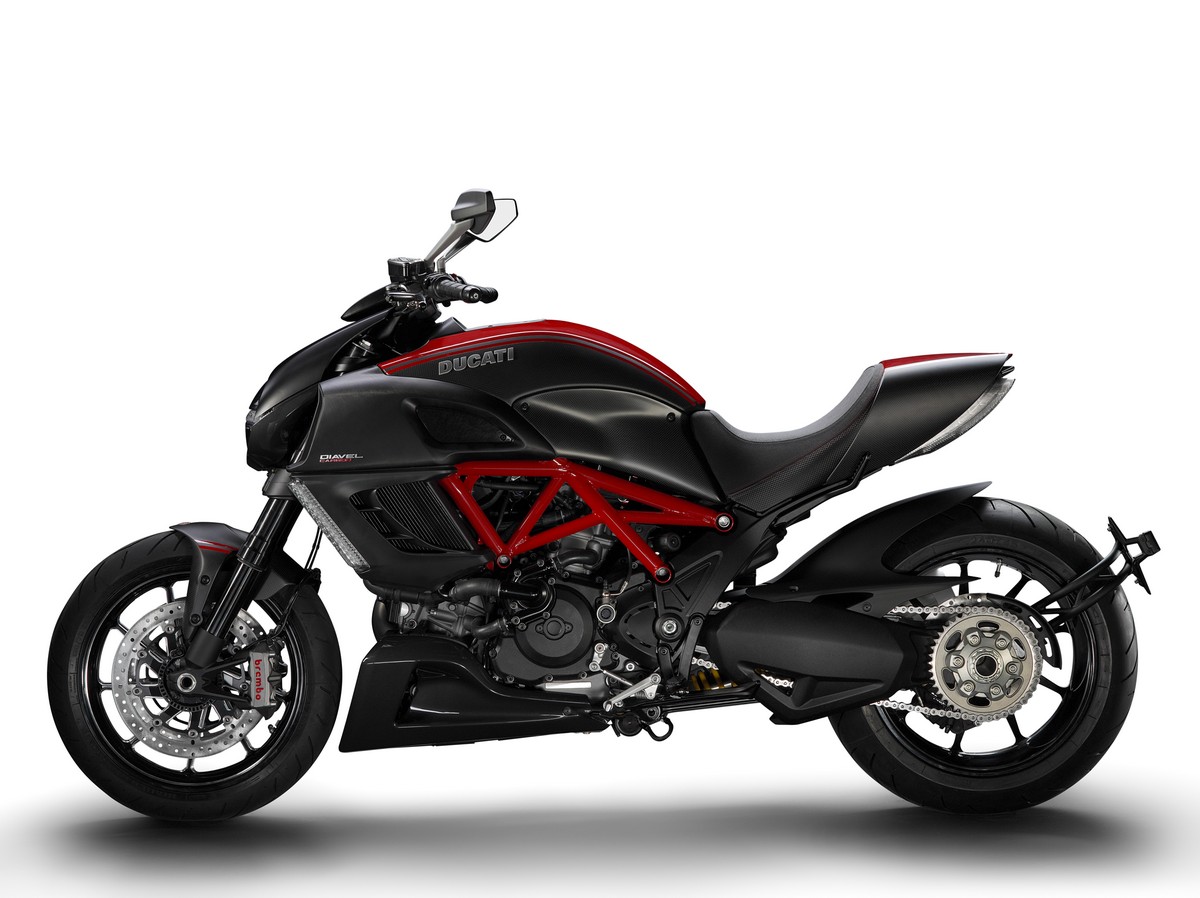
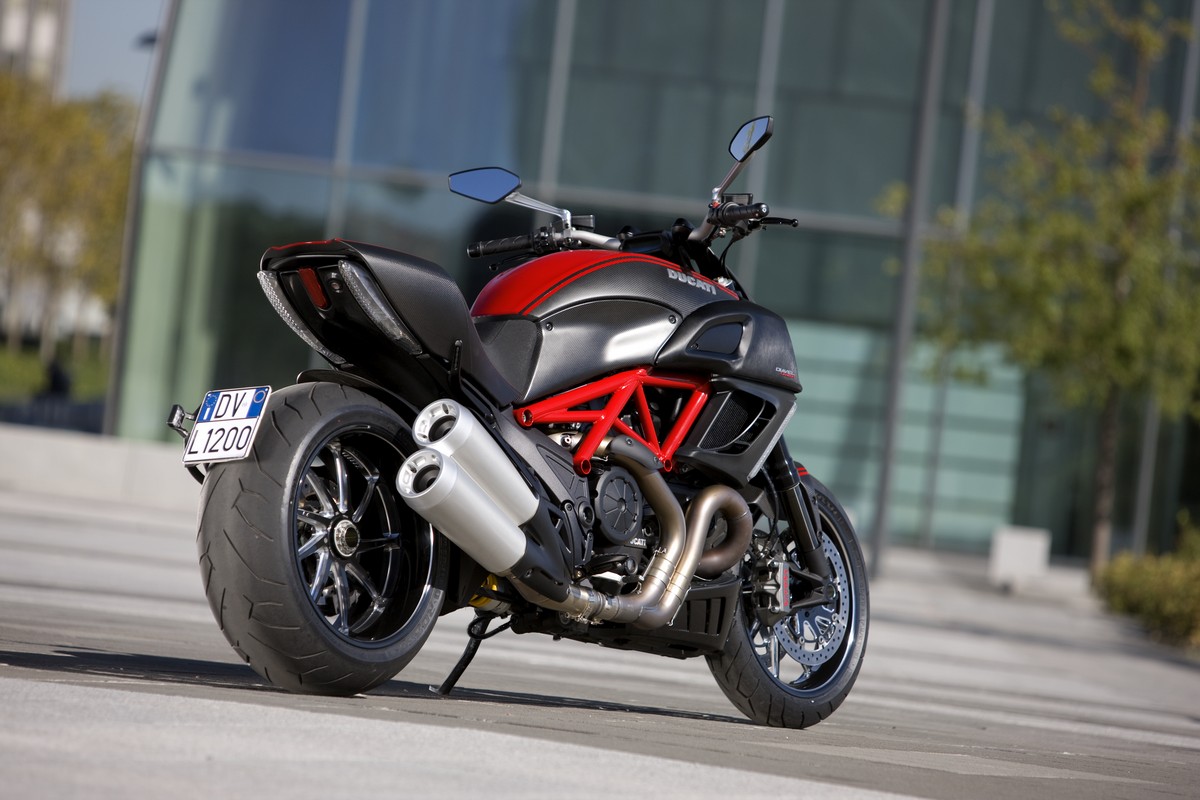
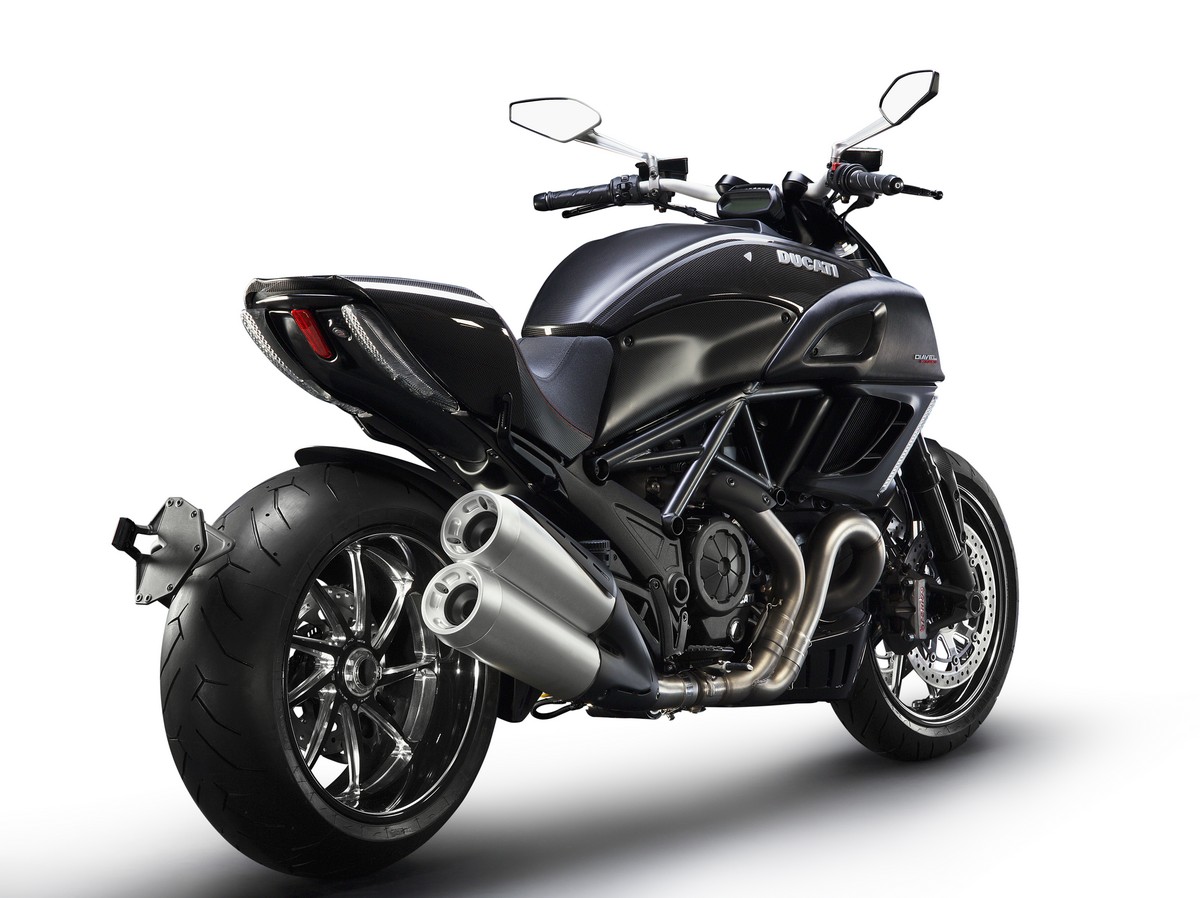
black wheels. The Diavel Carbon comes in stunning
“red carbon” (gloss red over matte carbon
weave) with red frame or “black carbon”
(both gloss and matte
carbon weave) with black frame. Both Diavel Carbon
schemes roll on black wheels, turned and milled to
expose the natural aluminium below.
Diavel Testastretta 11°
- ready for sport and cruise
The heart of the Diavel is the Ducati
Testastretta 11° - developed directly from the
incredibly powerful,
world-beating race engines of Ducati Corse. Ducati’s
Diavel Testastretta 11° harnesses the immense
power
of the Superbike engine and makes it smooth and adaptable,
a massive step forward in balancing high performance
with an enjoyable ride.
With its 162hp and colossal 94lb-ft
(127.5Nm) of torque, the Diavel Testastretta 11°
engine is all about
authentic Ducati Desmodromic performance. The revised
intake and exhaust ports combined with radical
adjustment of the cam timing have enabled Ducati to
achieve a fantastic torque curve at low rpm, which
remains strong through a wider rev-range. The increase
in bottom-end torque is managed by Ducati’s
Rideby- Wire (RbW) system to considerably enhance
the Diavel’s effortless ridability, while ensuring
plenty of power remains on tap for high-rpm riding.
For an engine with brute power on tap
when needed and smooth, user-friendliness available
for an effortless
and comfortable ride, Ducati revised the configuration
of the cam timing with particular focus on the valve
overlap angle. The overlap angle is defined as the
interval of crankshaft rotation, measured in degrees,
during which both the intake and exhaust valves are
open at the same time. This overlap occurs between
the end of the exhaust stroke and the start of the
intake stroke. High performance engines, which are
subject to compromising smoothness for extreme power
delivery, use high values of this parameter in order
to benefit from the pressure waves to improve engine
performance by maximising volumetric efficiency.
On the Testastretta 11° engine, this angle has
been reduced from 41°, used in the Testastretta
Evoluzione
engine which powers the 1198, to 11°. As a result,
the fresh inlet charge flow is less compromised by
the
exiting exhaust gases, resulting in a much smoother
combustion in addition to improved fuel economy and
lower exhaust emissions.
The massive 58mm (2.28in) section exhaust
headers lead the 2-1-2 system through power-enhancing
equal
lengths that enable the Diavel’s efficient power
delivery. The engine management system dedicates a
lambda probe to each header, providing precise fueling
via a large airbox, while the stylish cannon-style,
vertically stacked silencers carry catalytic converters
to provide Euro 3 conformity and electronically
controlled mid-section valve optimises exhaust pressures
throughout the rev-range.
Twin lateral radiators - positioned
on either side of the bike - cool the Diavel Testastretta
11° engine. This
unique feature combines with a new 64mm water pump
impeller to increase flow rate by 35% at high rpm,
enabling highly efficient cooling from the stylish
air ducts.
The Diavel’s gearbox uses high-strength
materials to manage the increased power output and
enhanced
grip generated by the 240 section rear tyre, which
also requires the use of a 16mm longer gearbox output
shaft for drive chain routing.
The transmission features an oil bath
clutch with “slipper” function and super-light
feel at the lever. Its design
uses a progressive self-servo mechanism that presses
the plates together when under drive from the
engine, enabling the reduction of the clutch spring
rates. This results in a much lighter clutch lever
at the
handlebar, ideal in stop-start traffic or during long
journeys. When the drive force is reversed (over-run),
the
same mechanism reduces the pressure on the clutch
plates, enabling them to provide a race-like “slipper”
action, which reduces the destabilizing effect of
the rear-end under aggressive down-shifting and provides
a
much smoother feeling when closing the throttle or
down-shifting under normal riding conditions. The
Diavel’s clutch and alternator covers have been
restyled with enhanced detail and shaping, as have
the cam
belt covers with a new aluminium mid-section.
24,000 kilometres (15,000 miles)
between major services
Constant investment in quality by design,
advanced materials and engineering techniques have
enabled the
distance between major service intervals (valve clearance
check) to be increased to a highly competitive
24,000 kilometres (15,000 miles). This has been achieved
with the introduction of new valve seat materials,
improved combustion efficiency and temperature management
designed into the Testastretta 11° engine.
Frame assembly
The signature Ducati Trellis frame
uses large diameter, light gauge tubing with two lateral
die-cast
aluminium sections that flow into the rear subframe.
This achieves massive torsional rigidity while remaining
lightweight and compact. The two sections form a rear-end
structure by attaching onto either side of a
complex techno-polymer component. The long, die-cast
aluminium, single-sided swingarm provides great
“feel” at the rear-end with a wheelbase
of 1590mm (62.6in) and a stance that provides lean
angles of up to
41°.
Suspension
The Diavel uses black-bodied 50mm Marzocchi
front forks. These forks are fully adjustable for
spring preload, compression and rebound damping. The
forks are gripped by a slash-cut triple-clamp - cast
aluminium for the lower and forged for the upper -
with a rubber-mounted riser to tapered alloy bars.
With a rake of 28°, trail of 130mm (5.12in) and
an offset of 24mm (0.945in), the set-up provides a
sure-footed and agile front-end for incredible handling
and 70° of total steering lock for maximum manoeuvrability.
The Diavel
Carbon uses the same suspension as the Diavel, but
with fork sliders black-finished in super low-friction
diamond-like carbon (DLC).
Both versions of the Diavel have a
Sachs rear suspension unit slung low under the chassis
in a horizontal
position, operated by a progressive pull-rod linkage
from the swingarm. Adjustable in compression and
rebound damping, the unit uses a handy control for
easy spring pre-load adjustment.
Wheels and tyres
The Diavel rolls on stunning, custom
14-spoke wheels with machine-finished detailing. The
front rim is
3.5x17, while the rear, which is “flow-formed”
for enhanced structure and lightness, boasts a massive
8x17
rim. The Diavel Carbon has custom shop-finished, lightweight,
forged, turned and milled rims by Marchesini
that not only score an impressive total weight saving
of 5.5lb (2.5kg), but also look spectacular. These
highly
intricate nine-spoke wheels highlight the delicate
machining in natural aluminium set against a black
finish.
Ducati’s technical partner, Pirelli, worked
with the Diavel’s designers and engineers to
develop the incredible
new Diablo Rosso II tyres. While the front uses a
conventional 120/70x17 section with a new tread pattern
designed for enhanced wet weather performance, the
240/45x17 rear represents the latest innovation in
tyre
design with a sport-oriented profile being applied
to custom-style width.
The massive rear employs bi-compound
technology to enable high grip levels at full lean
angle while
providing high mileage and uses Enhanced Patch Technology
(EPT) to maximise the contact patch at all
angles. The tread pattern and compounds deliver great
performance in all conditions, especially the wet.
This new design of tyre enabled Ducati to achieve
the style they had envisioned for the Diavel without
compromising the authentic Ducati performance of the
chassis. This partnership of parallel development
between chassis and tyre design has contributed massively
to Ducati “changing the rules” in this
segment.
Braking system & ABS
The Diavel front brakes use Brembo’s
incredibly powerful Monobloc callipers, which deliver
outstanding
performance actuated by new integral alloy master
cylinders with unique shape reservoirs sporting milled
tops. The 4-piston, twin radially-mounted callipers
grip 320mm discs, while a single 265mm disc on the
rear
is gripped by a two piston calliper, also by Brembo.
The Diavel Carbon uses specially milled aluminium
disc
carriers which have natural aluminium coloured recesses
machined around the weight saving cut-outs in
contrast to the carrier’s black finish around
the centre. Typical of Ducati, these top-of-the-range
components
provide outstanding levels of braking and set a new
benchmark in this category.
The system is equipped with the latest,
most compact, Ducati Bosch-Brembo ABS system as original
equipment on both versions, providing a major contribution
towards performance control. Top Brembo
components combined with Bosch ABS, the special Diavel
chassis configuration and Pirelli’s Enhanced
Patch Technology (EPT) result in a braking performance
even greater than that of the awesome Ducati
Superbikes.
Lateral radiators
The technical solution employed for
keeping the frontal lines of the Diavel clean was
to place two highly
efficient lateral radiators on both sides of the bike.
These well-ducted units, located beneath the fuel
tank,
use aerodynamics to help draw air flow through the
radiators and are assisted by high-flow electric fans
when required. The design combines form and function
to enhance the muscular shape of the bike.
Split-level instrumentation
Even the Diavel’s instrumentation
is a masterpiece of cutting-edge technology. The upper
LCD display is
mounted on the bar-riser and provides main information
such as speed and rpm, in addition to warning
lights, time and temperature.
The lower, full colour Thin Film Transistor
(TFT) display is styled into the fuel tank and provides
an incredibly clear account of current Riding Mode,
gear selection and DTC setting as well as total mileage
and trips.
Used on mobile phones and computers,
TFT technology is a variant of LCD and displays easy-to-read
high
resolution graphics. The Diavel’s TFT display
goes one step further by using the sensitivity of
its surrounding
light to decide upon black or white background colour.
When stationary, the lower display also doubles as
the latest user-friendly control panel to personalise
DTC and RbW settings within each Riding Mode before
saving.
Hands-free ignition
The Diavel’s ignition is actuated
by an electronic key in the rider’s pocket,
which communicates with the
motorcycle when within a distance of approximately
2 metres (6.5ft). The motorcycle recognises the
dedicated key code and automatically enables the bike’s
systems. Pressing the key-on switch then activates
all systems to “on” and the engine is
ready to be started. The electronic key, which internally
consists of a
radio circuit, externally doubles as a mechanical
flip-key, required to open the seat and fuel tank
cap. When
parking the motorcycle, an electronic lock can be
actuated on the steering simply by applying full steeringlock
and pressing the ignition-off button a second time.
Ride-by-Wire
The Ride-by-Wire (RbW) system is an
electronic interface between the Diavel’s twistgrip
and engine, which
configures an ideal power response depending on the
riding mode selected. The twistgrip no longer has
a
throttle cable connected directly to the throttle
body butterflies, but instead delivers a signal to
a control unit,
which in turn operates the butterfly opening electronically.
The RbW system uses three different mappings
to regulate the power delivery: 162hp with a sports-type
delivery, 162hp with a progressive delivery suitable
for touring, and 100hp with progressive delivery for
city use.
Riding Modes
The Diavel incorporates the very latest
in innovative Ducati technologies, including the recently
introduced
electronic Riding Modes. Selectable from the left-hand
switchgear - even while riding - the choice of three
pre-set modes are programmed to instantly change the
character of the Diavel. The three modes are
enabled by combining class-leading technologies such
as Ride-by-Wire (RbW) and Ducati Traction Control
(DTC).
The RbW system administers different
mappings to regulate power delivery by interpreting
the rider’s throttle
input, while the world-beating DTC uses eight levels
of system interaction to enhance control by reducing
rear wheel-spin under heavy acceleration. Although
each mode has pre-set values of RbW and DTC, each
of these two elements can be finely adjusted within
each of the three Riding Modes and saved to create
a
personalised riding experience.
Sport
The Sport Riding Mode provides the
Diavel rider with an adrenalin-fuelled 162hp ride
and enables the rider
to have full-on throttle response for maximum acceleration.
Ensuring the full Testastretta 11° experience,
the
sport mode also lowers the DTC system intervention
to level 3 for riders who prefer their performance
a little
closer to the traction limit.
Touring
The Touring Riding Mode is also programmed
to produce 162hp, however, with a smoother, more userfriendly
power delivery. Rear end traction is enhanced by increasing
DTC system intervention to level 4,
specifically intended for an enjoyable and relaxing
ride ideal for long distance and ensuring maximum
comfort for both the rider and passenger.
Urban
As riding on city streets can require
more attention to the surroundings than to throttle
inputs, the Urban
Riding Mode instantly changes the Diavel to provide
a manageable and confident ride. Power output is
reduced to 100hp and DTC is further enhanced to level
5 to provide a higher system intervention during the
most chaotic of stop-start traffic.
Ducati Traction Control
The racing-derived Ducati Traction
Control (DTC) is a highly intelligent system which
acts as a filter between
the rider’s right hand and the rear tyre. Within
milliseconds, DTC is able to detect and control rear
wheelspin,
considerably increasing the bike’s active safety
and performance. DTC is an integral part of the preprogrammed
Riding Modes on the Ducati Diavel and enables riders
to fully enjoy the power of the
Testastretta 11° engine.
The system offers eight levels of “sensitivity”,
each programmed with an amount of rear wheel-spin
tolerance. These levels are in line with progressive
levels of riding skills classified from one to eight.
Level
one is programmed to offer the least amount of interaction
for sport-oriented riders, while level eight uses
the most amount of interaction for complete confidence.
DTC levels are factory pre-set in each
of the three Riding Modes, but can be individually
customised and
saved to suit the rider by accessing the new user-friendly
set-up menu. A “default”option is available
to
easily return all settings to factory pre-sets.
DUCATI DIAVEL CARBON
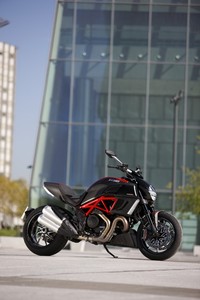 The
207kg (456lb) Diavel Carbon embodies the true nature
of the Diavel concept, where performance The
207kg (456lb) Diavel Carbon embodies the true nature
of the Diavel concept, where performance
combines with style to celebrate Italian engineering
at its best. Lightweight composites and milled aluminium
components meld the two worlds of sport and style
with features that are both visually beautiful and
functionally high-performance.
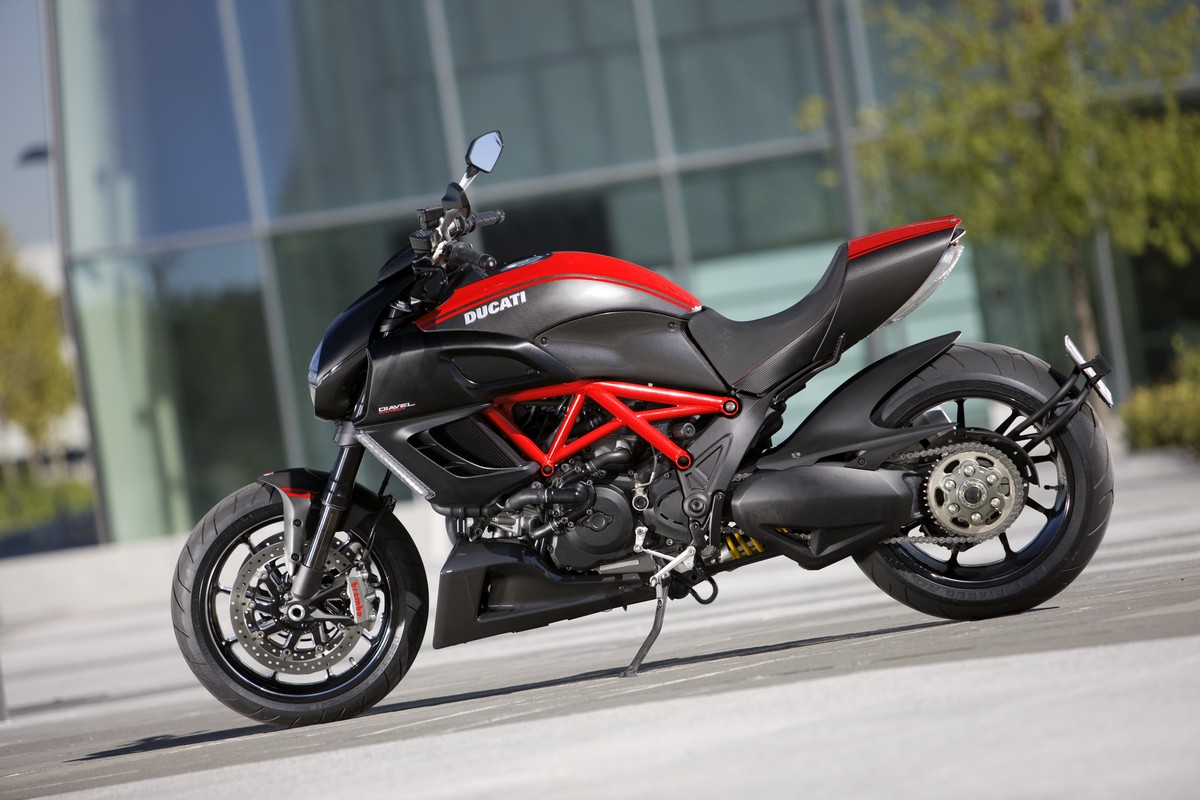
The Diavel Carbon comes in stunning
“red carbon” (gloss red over matte carbon)
with red frame or “black
carbon” (both gloss and matte black carbon weave)
with black frame. Both Diavel Carbon schemes roll
on
black wheels, turned and milled to expose the natural
aluminium below.
While carbon fibre is used for the
tank panels, single-seat cover and front mudguard
to reduce weight and
apply a race-like feature that runs deep in the DNA
of Ducati, a low friction diamond-like carbon finish
gives
the Marzocchi fork sliders a spectacular black finish
as well as performance-enhancing action.
Helping the Diavel Carbon to accelerate
faster, stop sooner and change direction with even
more agility is a
valuable 5.5lb (2.5kg) saving of “unsprung weight”
by using beautifully forged, lightweight Marchesini
wheels. The wheels, which are finished in black, are
machine-turned and milled for maximum weight
reduction and intricately engineered decoration. The
black disc carriers undergo a similar milling process
to
enhance the recess around the weight saving cut-outs,
the natural aluminium colour contrasting effectively
against the original black carrier.
|