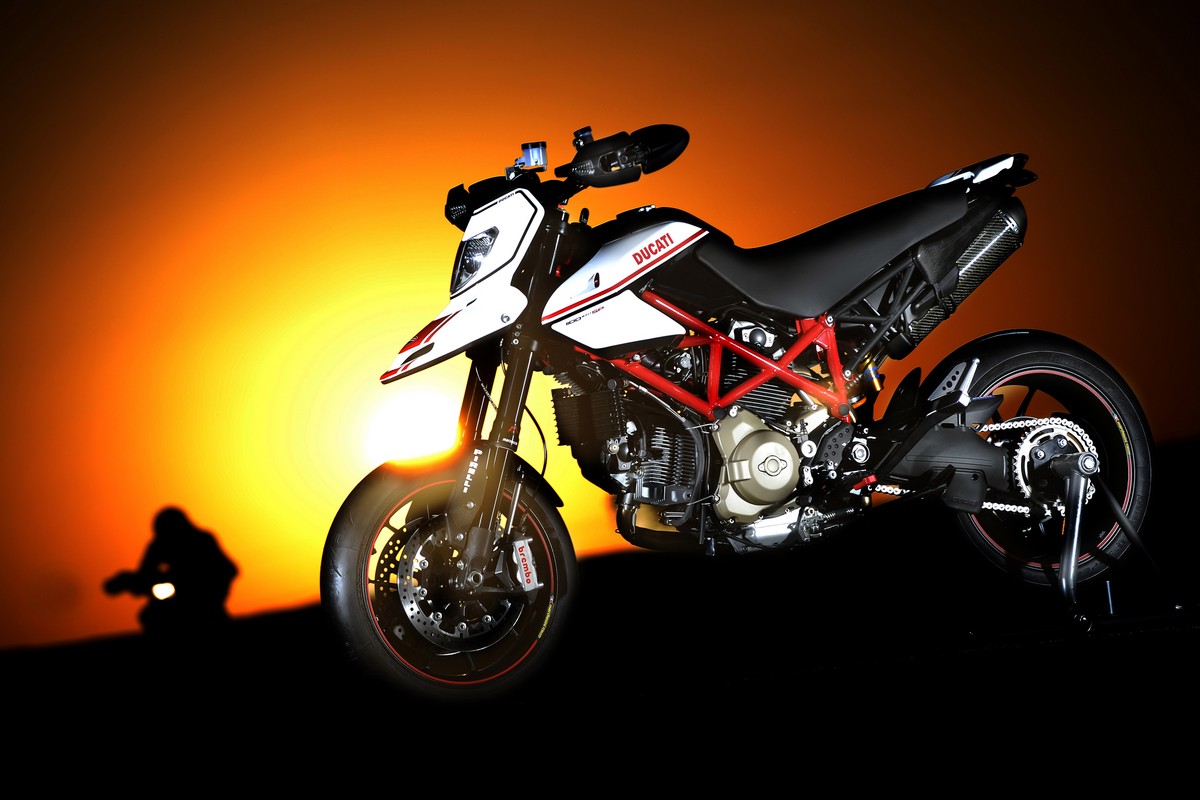
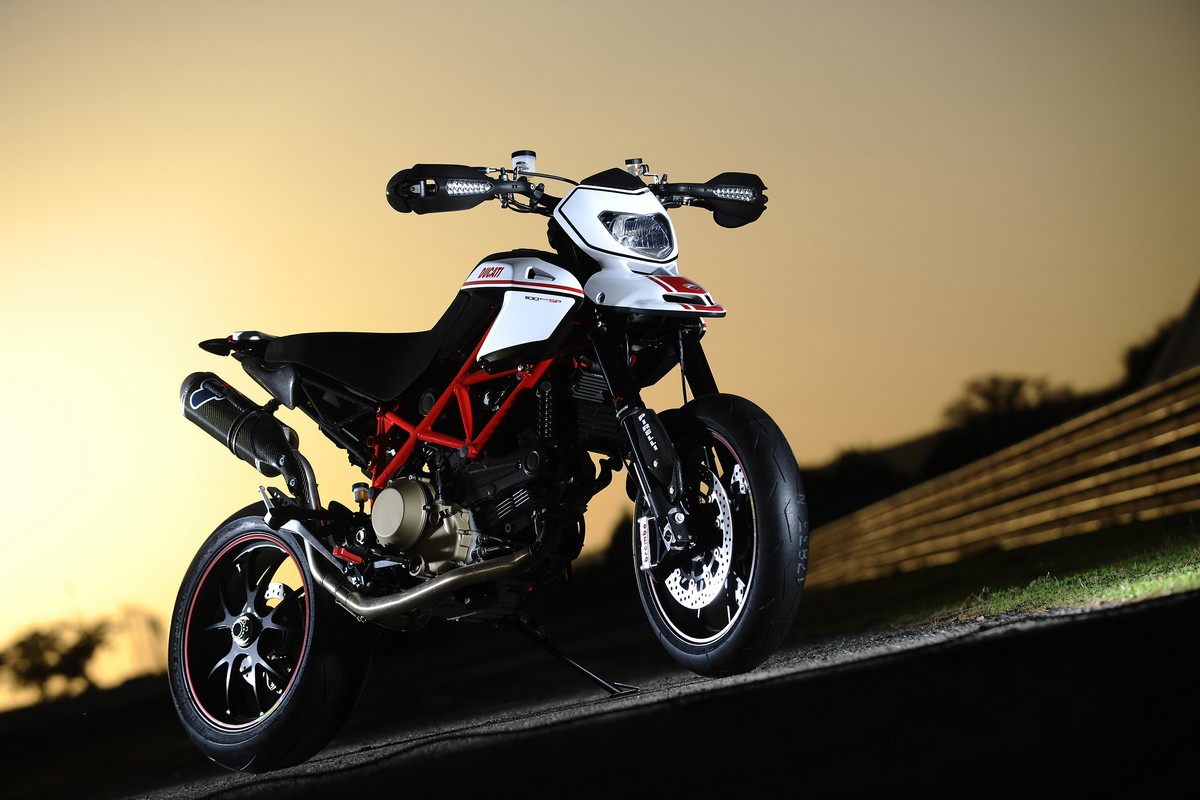
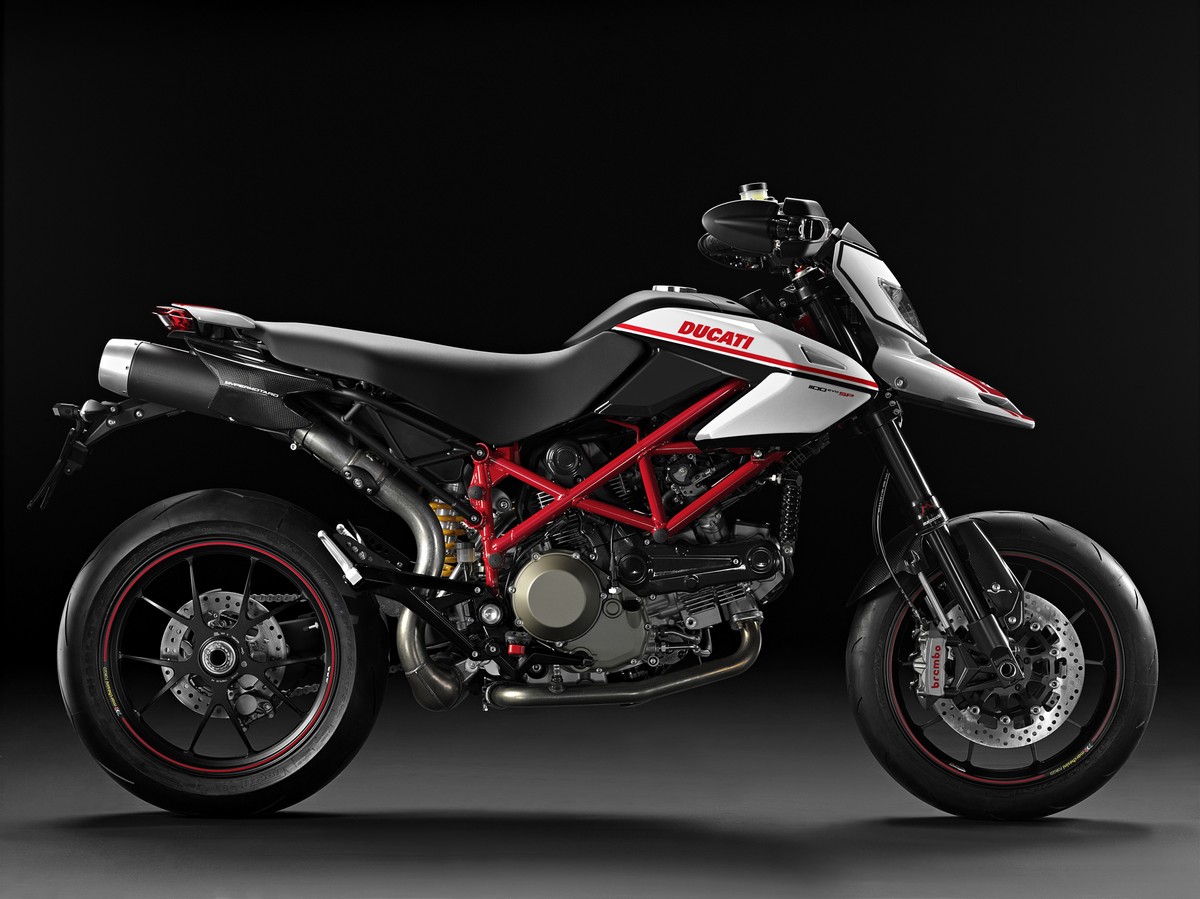
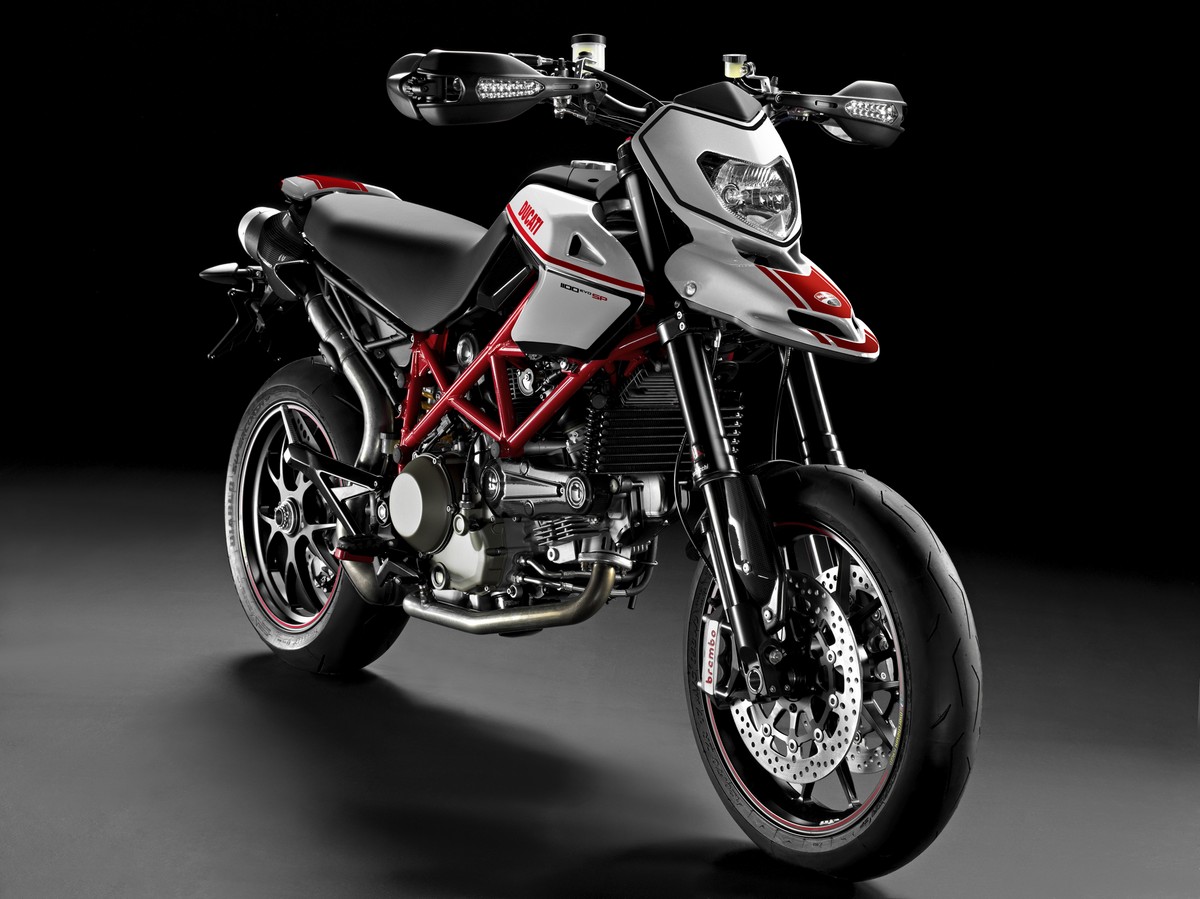
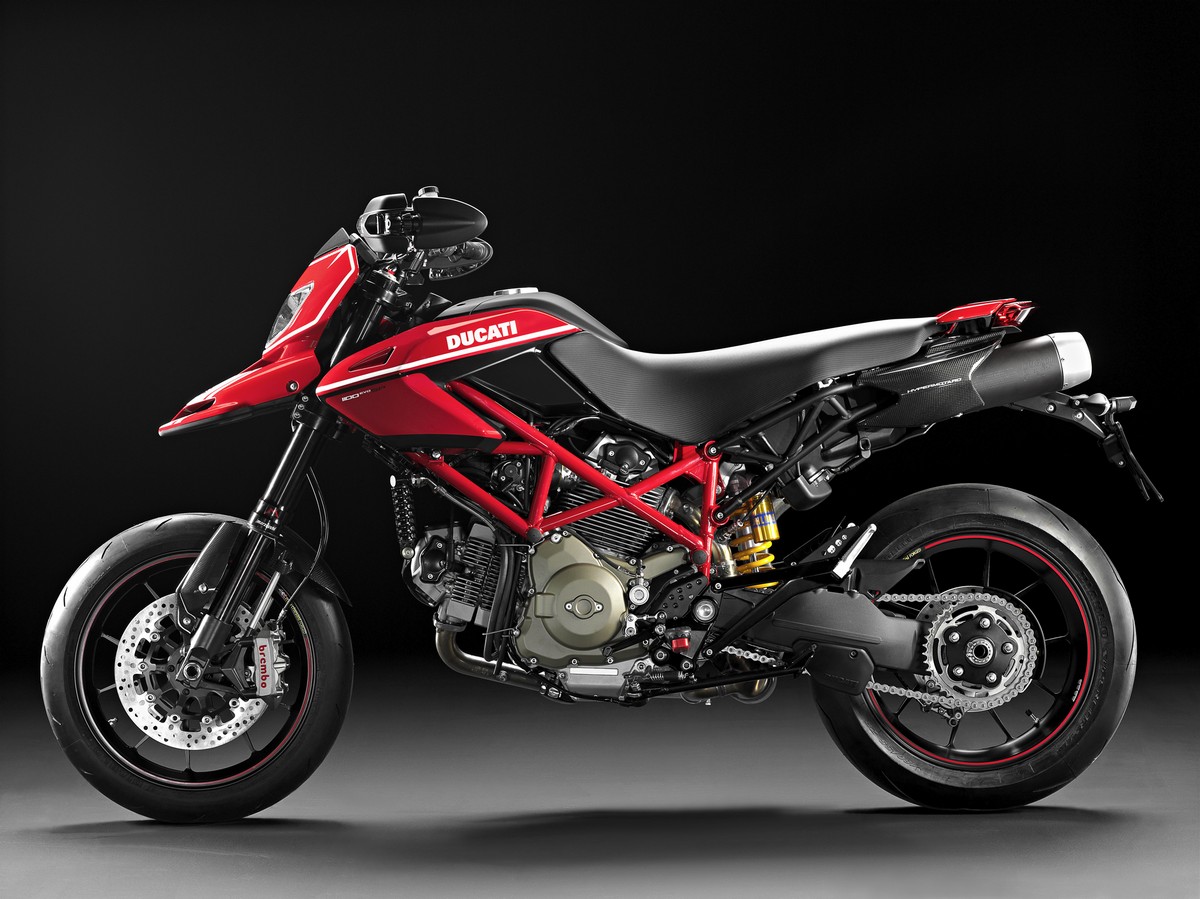
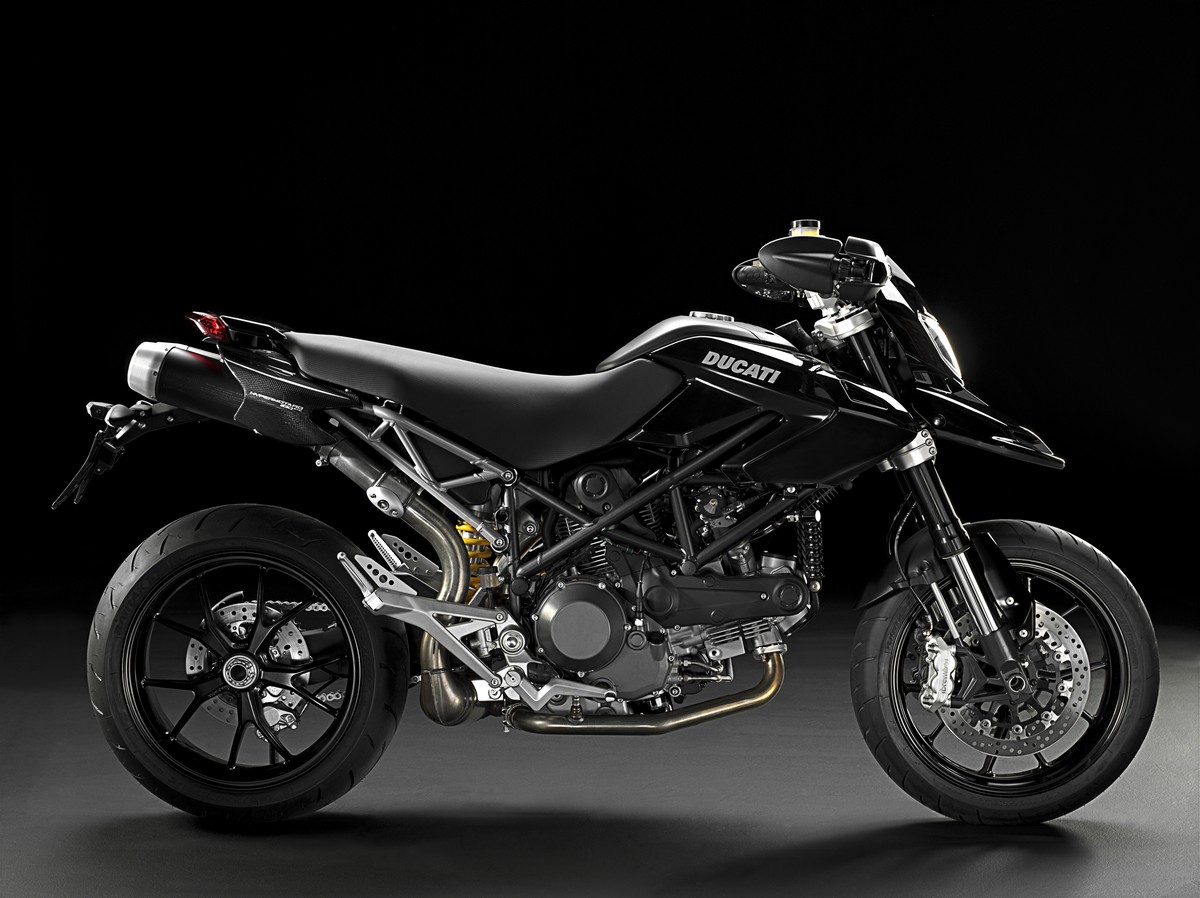
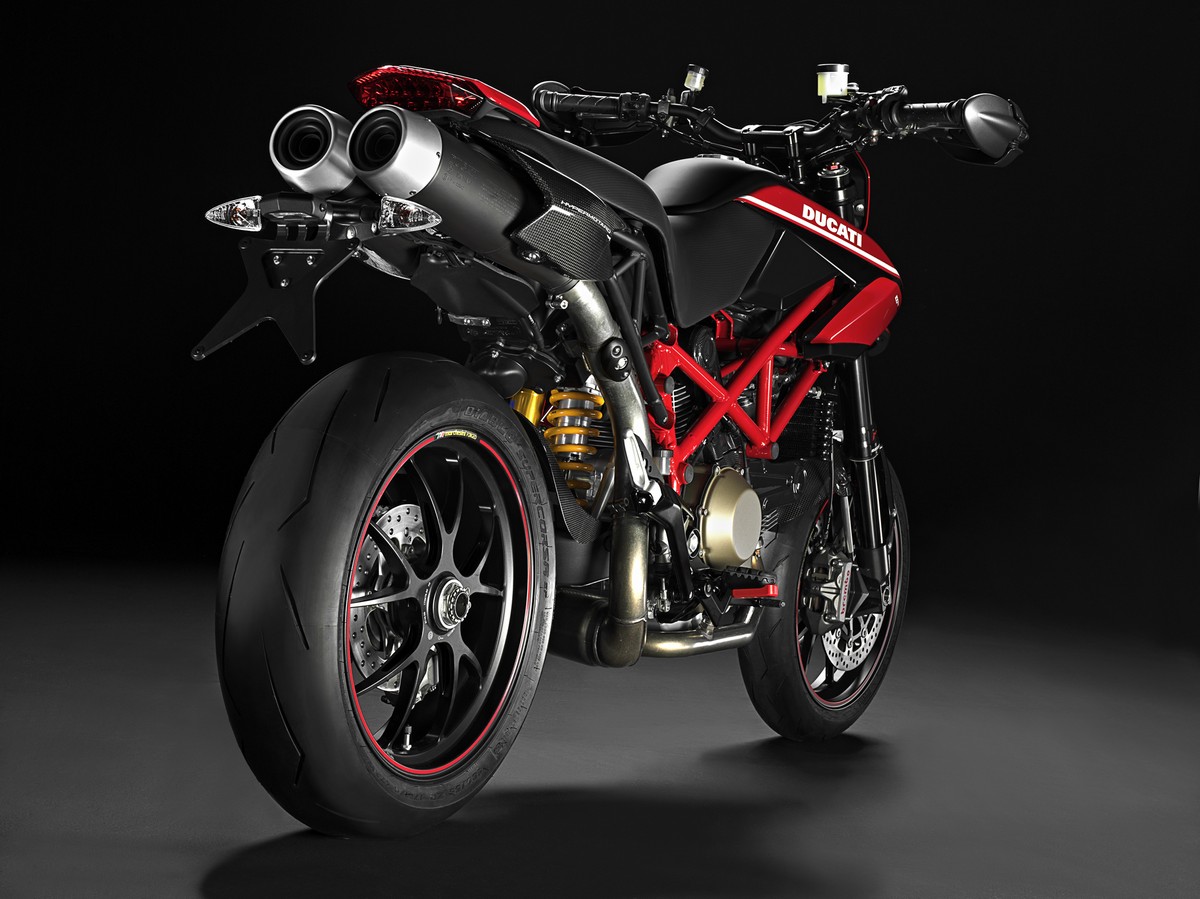
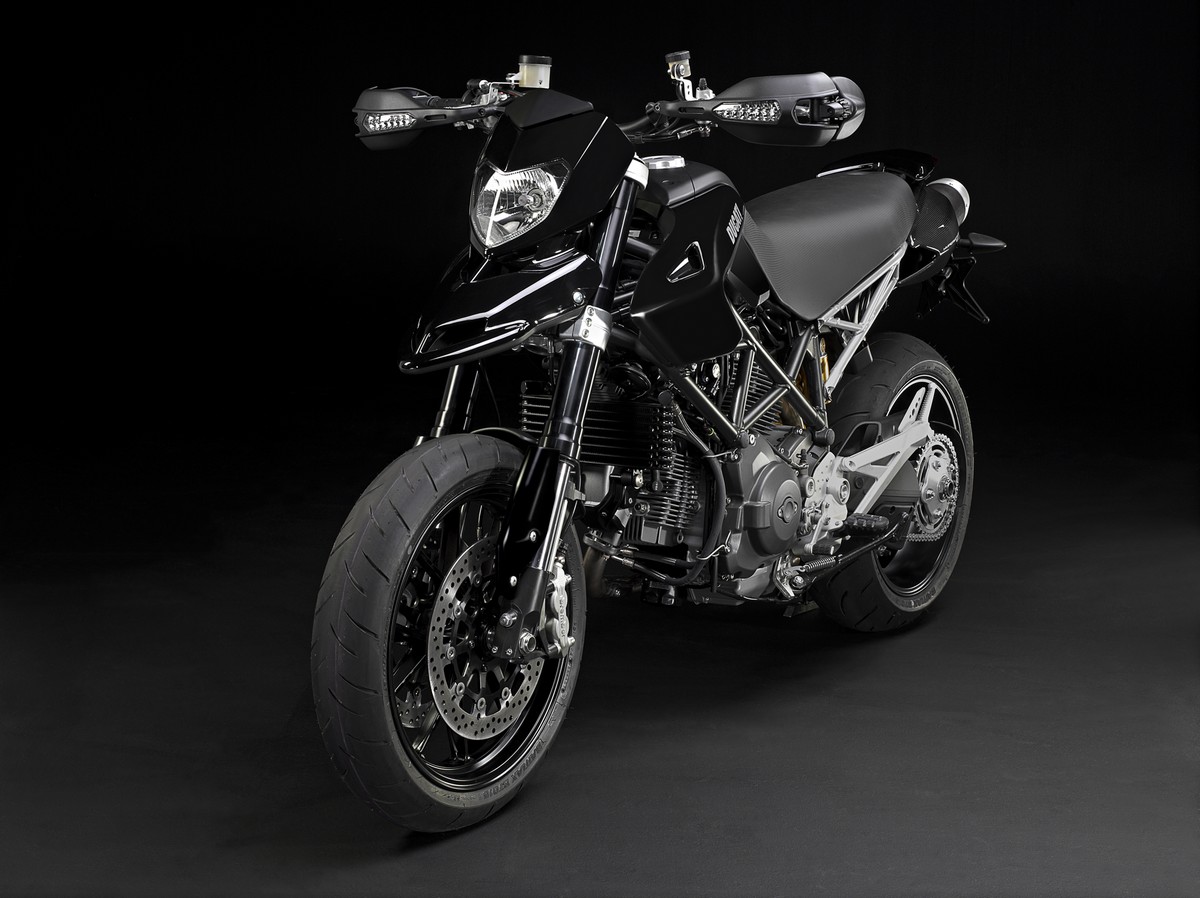
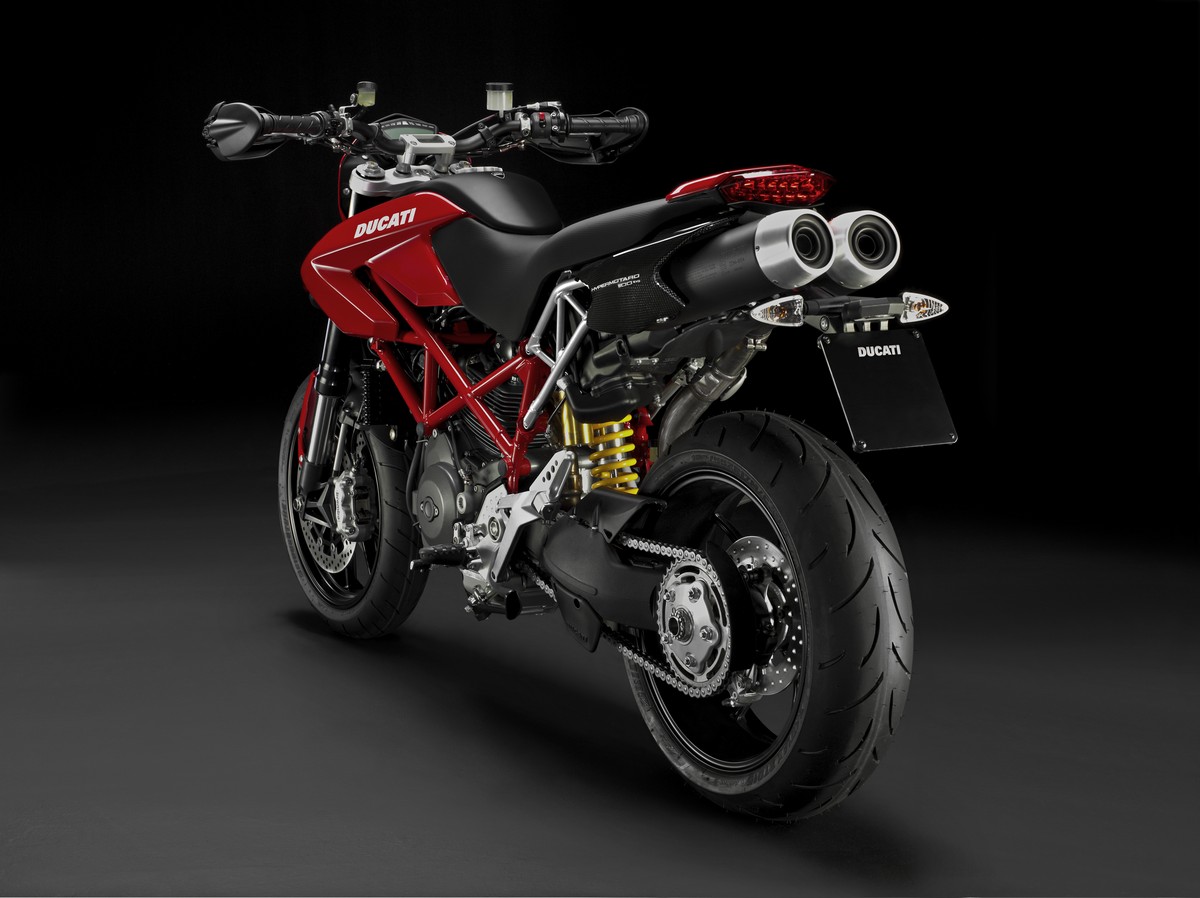
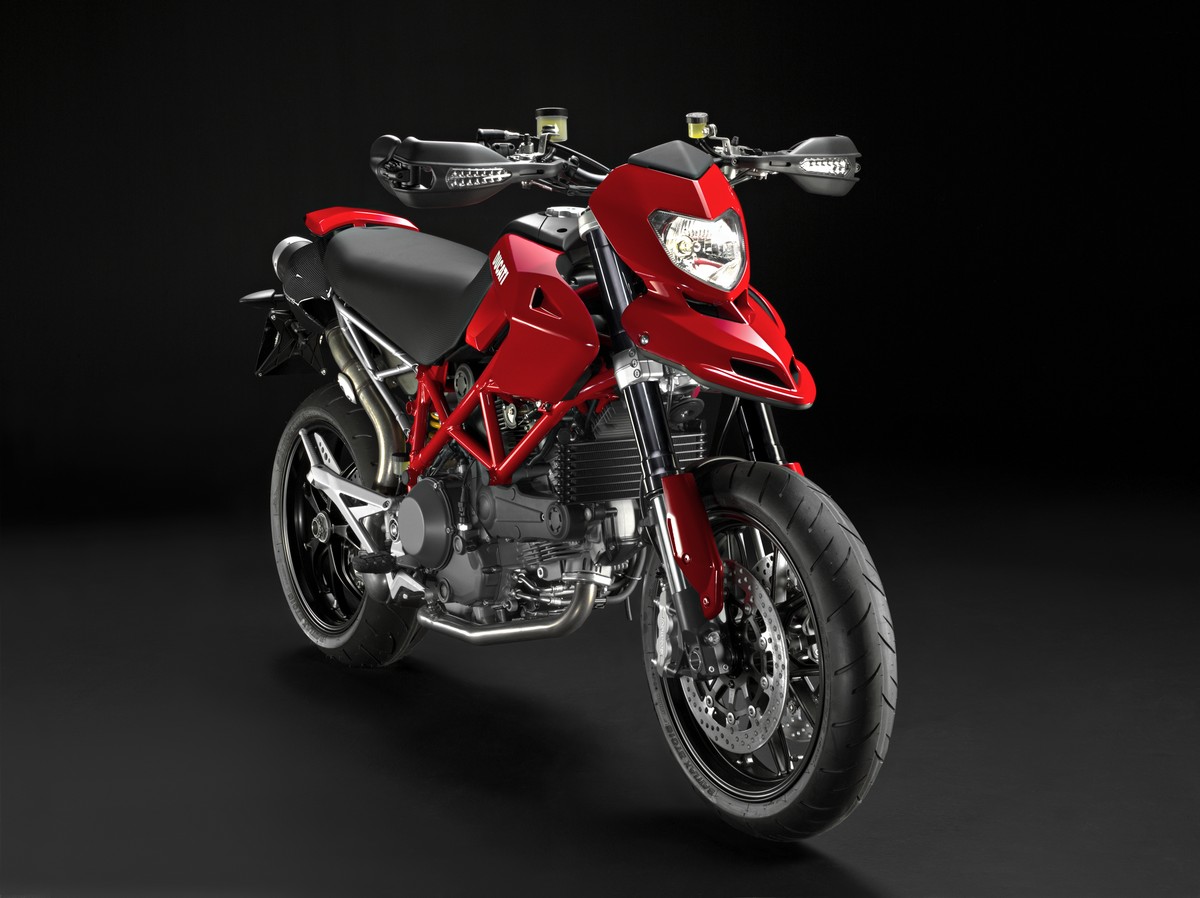
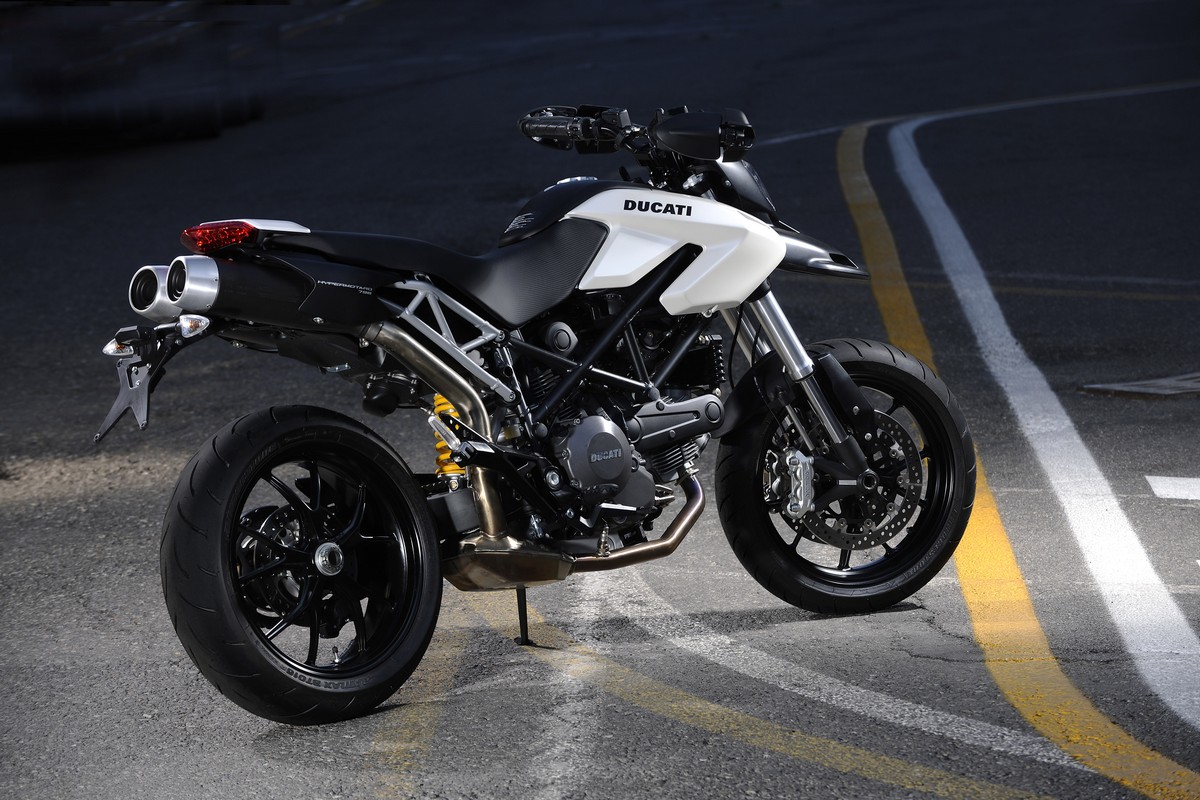
2011 Ducati Hypermotard
  
More Hyper than ever
 The
Hypermotard family moves into 2011 with the highly
successful and accessible Hypermotard 796, the The
Hypermotard family moves into 2011 with the highly
successful and accessible Hypermotard 796, the
Hypermotard 1100EVO and the extreme, track-ready Hypermotard
1100EVO SP.
The powerful evolution models, in addition
to the lightweight 796, represent Ducati's continued
excitement
in the Hypermotard concept and their commitment to
the family's future development. Many features of
the latest models were in response to requests from
Ducatisti worldwide and represent the factory's
ongoing ability to respond to direct owner feedback
.
 The
Hypermotard prototype was an instant success when
first shown in Milan at the end of 2005 and soon The
Hypermotard prototype was an instant success when
first shown in Milan at the end of 2005 and soon
became a top seller when its production started in
2007. Since then, its unique design has excited riders
around the world and praise for this thrilling and
versatile bike has never stopped – and neither
has its
evolution. Today, the range remains as Hyper as ever.
So what's the hype?
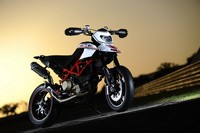 The
original Hypermotard was built to thrill, with its
dirtbike stance, empowering, asphalt-attacking riding The
original Hypermotard was built to thrill, with its
dirtbike stance, empowering, asphalt-attacking riding
position and enough torque on tap to elicit a smile
with each twist of the throttle. But what could really
be
changed to make it better? Ducati applied their usual
engineering process of evolution to an already
successful model by improving it in the two most effective
ways possible: Less weight and more power.
Lightweight Trellis frame
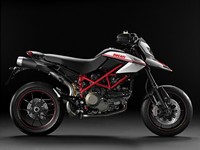 The
quick and precise handling that the Hypermotard provides
is down to the construction and geometry of The
quick and precise handling that the Hypermotard provides
is down to the construction and geometry of
its famous Trellis frame. Its ability to handle the
abundant torque from the L-Twin engine and its rigidity
under powerful Brembo braking are just a few reasons
why Ducati's chassis department would never want
to change it. But it could be made lighter. They realised
that almost all of the heavy forged sections of the
construction could be completely removed without reducing
its strength or its performance, so they applied
it to the entire family.
Light and powerful engines
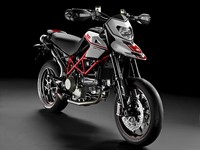 While
the chassis department were busy reducing the weight
of the frame, the engine department went While
the chassis department were busy reducing the weight
of the frame, the engine department went
back to the drawing board for the 796 and started
with a clean sheet of paper. Their complete redesign
of
the crankcases rewarded them with an incredible saving
of 1.2kg (2.64lb) compared to the original 696
castings, and the new 796 crankshaft with 848-style
flywheel further reduced the overall engine weight
to
an impressive 1.9kg (4.2lb) savings over the original
696 power unit. With 81hp (59.6kW) of smooth and
flexible power, the 796 becomes a very credible package.
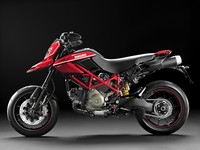 The
1100 air-cooled Desmodue Evoluzione engine truly is
an 'evolution' – both in power and weight –
and is The
1100 air-cooled Desmodue Evoluzione engine truly is
an 'evolution' – both in power and weight –
and is
responsible for the model name extension 1100 EVO.
Engineers used the same Vacural® technology
employed for the lightweight Superbike engines when
they vacuum die-cast the Hypermotard 1100
crankcases, a process that achieves a significant
weight saving and ensures consistent wall thickness
and
increased strength. This process – combined
with the lightweight crankshaft assembly that uses
an 848-
style flywheel and use of lighter rare-earth magnets
in the alternator – reduced the 1100 power unit's
weight by a staggering 5.2kg (11.5lb). Couple those
savings with a boost to 95hp (69.9kW) and it becomes
clear why there's all the hype.
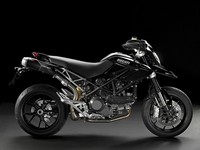 Compact
and efficient, the Desmodue engine's hyper-lightweight
and narrow L-Twin layout, no wider than Compact
and efficient, the Desmodue engine's hyper-lightweight
and narrow L-Twin layout, no wider than
a single cylinder, ensures that all Hypermotards remain
lean and agile. The air-cooled design eliminates the
need for water radiators, hoses, reservoirs and pumps,
keeping the motorcycle's weight down to a
minimum and its lines clean and race-like.
Latest controls and instrumentation
The entire Hypermotard family uses
the electronic advances made in the compact and user-friendly
switchgear and instrumentation first created for the
Streetfighter.
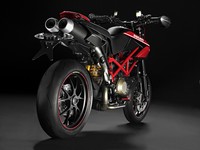 The
slim-line switch bodies house easy-to-use switches
and buttons, and feature a unique weapons-like The
slim-line switch bodies house easy-to-use switches
and buttons, and feature a unique weapons-like
'trigger catch' that slides down to cover the starter
button when the kill-switch is activated. Their minimalist
design fits perfectly in the clean and essential lines
of the Hypermotard's sporting image.
Looking clean and purposeful, the display provides
an extensive amount of data including speed, revs,
time,
oil temperature, battery voltage, A & B trips,
fuel reserve trip and scheduled maintenance, while
the
warning lights illuminate for neutral, turn signals,
high-beam, rev-limit, oil pressure and fuel reserve.
In
addition, it can list recorded lap times by using
the high-beam flash button as a stopwatch. Both the
1100EVO and 1100EVO SP use a white back-lighting while
the 796 uses an orange back-lighting.
The instrument display also doubles as a control panel
for the activation of the Ducati Data Analyser (DDA)
system, which is available as an accessory from Ducati
Performance for the 'system-ready' Hypermotard
796 and 1100EVO and supplied as standard equipment
on the 1100EVO SP. The DDA-intended USB connection
port under all of the Hypermotard seats doubles as
a charging point for a handy battery charger, which
is available as an accessory from Ducati Performance.
Hyper mirrors
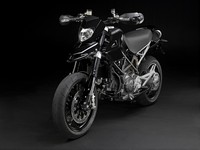 Ducati
pushed motorcycle design limits to find an innovative
solution for the original Hypermotard mirrors Ducati
pushed motorcycle design limits to find an innovative
solution for the original Hypermotard mirrors
and these are now used throughout the family. The
challenge of maintaining a clean, racing look around
the
handlebar area motivated the design of the folding
mirror concept which is based on the handguards
typically found on off-road bikes. Flipped out for
high visibility street mode and easily folded in for
a quick
change to 'Hypermode', the mirror handguard assemblies
also integrate the LED directional indicators for
an even cleaner front-end.
Lighting and indicators
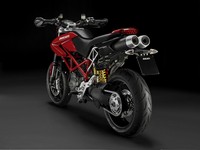 The
headlamp uses a highly compact lighting shape which
blends with the single piece nose fairing and The
headlamp uses a highly compact lighting shape which
blends with the single piece nose fairing and
front fender moulding, while the rear light employs
a specially designed strip of LEDs enhanced by a high
diffusion lens shaped into the sleek lines of the
tailpiece. The same LEDs are intensified under braking.
The
front directional indicators also employ the latest
in LED technology for illumination, and are ingeniously
integrated into the handguards which support the foldable
rear view mirrors.
Tailpiece
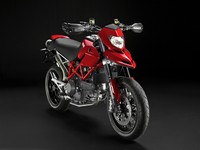 The
high intensity LED rear light assembly is moulded
into a unique tailpiece positioned high behind the The
high intensity LED rear light assembly is moulded
into a unique tailpiece positioned high behind the
seat. The supporting structure has been designed so
that the under tray of the tailpiece is formed perfectly
to offer a sturdy pair of pillion grab-handles. This
ingenious solution not only helps to merge the rear
light
into the Hypermotard styling but also provides a safe
grip for the passenger.
Footpegs
Rider footpegs on all of the Hypermotard
models have removable rubber inserts to expose the
serrated
metal edge and increase boot grip on the peg during
extreme riding. The 1100EVO and 1100EVO SP provide
a further minimalist and no-compromise feature by
having removable passenger footpegs. This attention
to detail enables a clean 'monoposto' look when on
the track, while allowing a fast and easy change to
'biposto' for the street.
DUCATI HYPERMOTARD 796
The easiest way to go Hyper
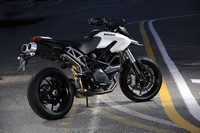 Just
as aggressively striking as the 1100, the Hypermotard
796 features a lower seat height and a smooth Just
as aggressively striking as the 1100, the Hypermotard
796 features a lower seat height and a smooth
and flexible engine to make it the perfect urban assault
vehicle. Whether it's working the daily commute or
attacking the open roads, the 796 rides the common
ground between manners and madness by mixing
Ducati's unrivalled twin-cylinder power and sportbike
heredity with the lightweight and minimalist
supermotard concept.
Urban upstart
The Hypermotard's rigidly triangulated
and lighter-than-ever Trellis frame and track-tested
chassis geometry
is still stylised by a distinct high fender at the
front and dual under-seat silencers at the rear, but
the 796's
overall profile says it all: Go Hyper!
At 825mm (32.5in), the seat height
of the 796 is a sure-footed 20mm (0.8in) lower than
the 1100 and, when
combined with the engine's smooth power delivery,
this Hypermotard inspires confidence however and
wherever its ridden. The upright seating position
offers a commanding view of the road ahead, while
the
wide handlebars make the bike effortlessly flickable
through the urban maze.
Extreme image, accessible character
The 796 has a dry weight of just 167kg
(368lb), partly achieved by a lightweight engine,
but also by
continued chassis development that includes fork clamps,
and radial fork bottoms. An improved frame
layout eliminates almost all of the forged elements
used on the original Hypermotard. The lightened frame
retains its torsional strength to become even more
agile and easier to handle, while 17" wheels
by Enkei are
produced in lightweight aluminium to keep the unsprung
weight low and handling, braking and acceleration
performances high. The 796 uses exactly the same 3.50
front and 5.50 rear rim sizes and Pirelli Diablo
Rosso tyres as its 1100cc big brother.
Suspension duties up front are taken
care of by a pair of very capable 43mm Marzocchi forks,
while the rear
is managed by a Sachs suspension unit featuring adjustable
spring pre-load and return damping, allowing
adjustments for riding style or load. The rear operates
through a similar progressive link to the 1100 and
uses the signature Hypermotard single-sided swingarm.
Twin 305mm semi-floating discs gripped
by radially mounted 4-piston Brembo callipers provide
powerful
and progressive front-end braking with that all-important
rider-friendly 'feeling', while the rear is equipped
with a 245mm disc and 2-piston calliper, also by Brembo.
796 performance
The 796 engine isn't just a stroked
696 – it's a new Desmodue power unit that promises
to deliver an
exhilarating ride without compromising the smooth
tractability found in Ducati's other L-Twin engines.
The
crankshaft uses a lightweight 848-type flywheel, and
spins with a 66mm stroke instead of the 696's
57.2mm, helping to maximise power to an impressive
81hp (59.6kW) @ 8000rpm and torque to 55.7lb-ft
(75.5Nm) @ 6250rpm while maintaining the smooth and
enjoyable character, famous of all Desmo engines.
To protect power delivery and maintain optimum efficiency,
an oil cooler similar to the 1100 is used, adding
even more family resemblance to its bigger brother.
Helping to increase the Hypermotard
796's agility even further, the fully redesigned crankcases
save an
incredible 1.2kg (2.64lb) over the 696 castings, and
are responsible for the major part of the impressive
1.9kg (4.2lb) total saving over the 696 power unit.
The clutch and alternator outer casings of the new
engine
are finished in an 1100-style carbon grey.
Breathing through a revised airbox
intake duct and fed through 45mm throttle bodies,
the 803cc swept
volume is compressed to a ratio of 11:1 – compared
to the 696's 10.7:1 – before being injected
and ignited
with Siemens controlled electronics. The 2-1-2 catalytic
exhaust system uses an efficient pre-silencer
configuration with twin lambda probes providing finer
fuel mapping and Euro3 conformity. The system's
lightweight and compact design is achieved by using
1mm thick tubing and terminates in Ducati's
trademark twin under-seat, black exhaust mufflers,
stylishly contrasted with great looking aluminium
end
caps.
An APTC 'wet' clutch gives a 'slipper'
type action that prevents destabilizing of the rear-end
under
aggressive down-shifting and also gives the extra
benefit of a super-light feel at the lever, a great
benefit in
stop-start city traffic or during longer journeys.
The 21-plate oil-bath clutch (11 friction and 10 steel)
represents a power-enhancing weight reduction over
the 'dry' system as well as having a quieter operation
and requiring less maintenance.
The Hypermotard 796 engine combines
all recent advances in Ducati's ongoing design, manufacture
and
production quality campaigns to offer competitive
service intervals of 7,500 miles (12,000 kilometres).
796 controls
While its motard feeling is enhanced
by wide, tubular handlebars and handguards, the 796's
minimalist
image is further characterised with integral construction
Brembo master cylinders for both the clutch and
brake systems. They maintain a clean handlebar arrangement
for the rider and are fitted with user-friendly
4-point adjustable levers that provide easy-to-reach
control for all hand sizes. Furthermore, the APTC
clutch
provides a super-light lever action ideal for use
in the city.
796 colours
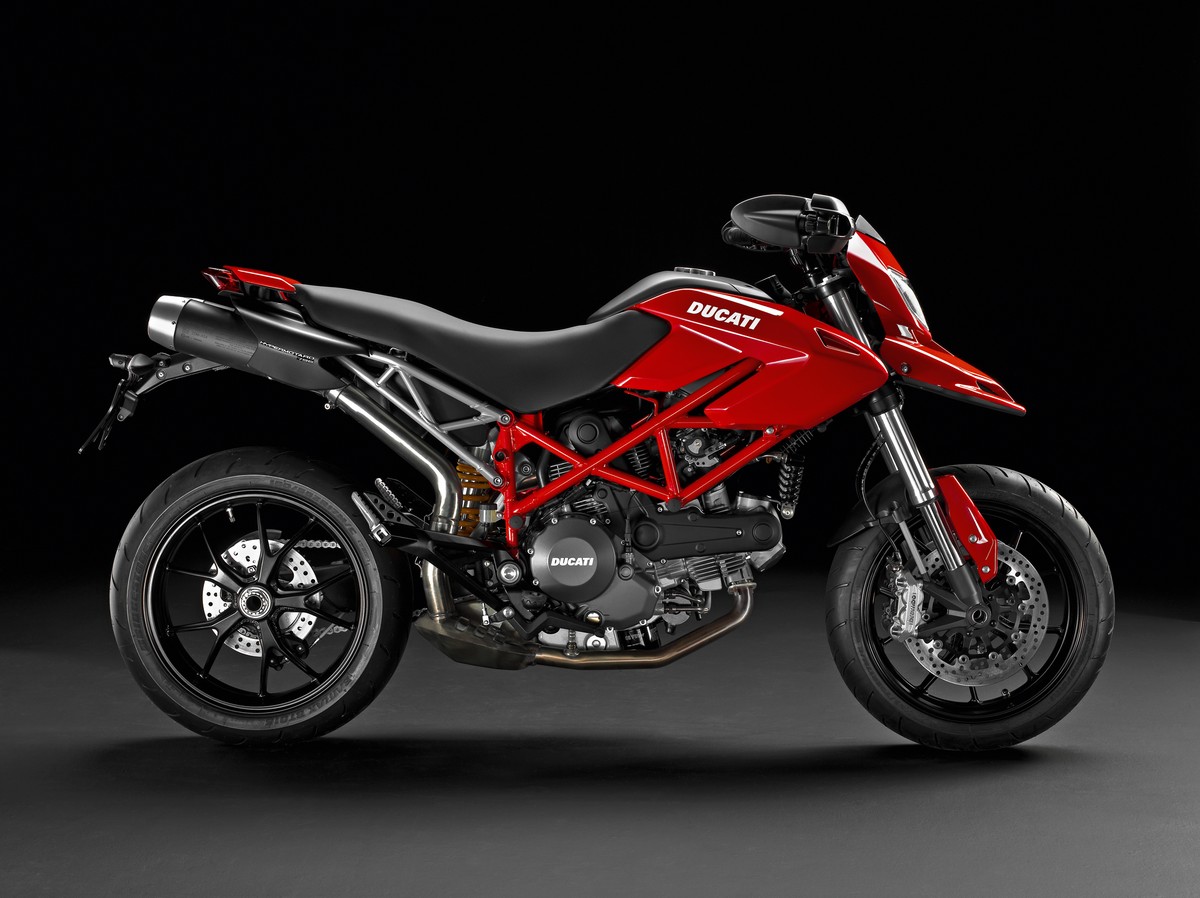
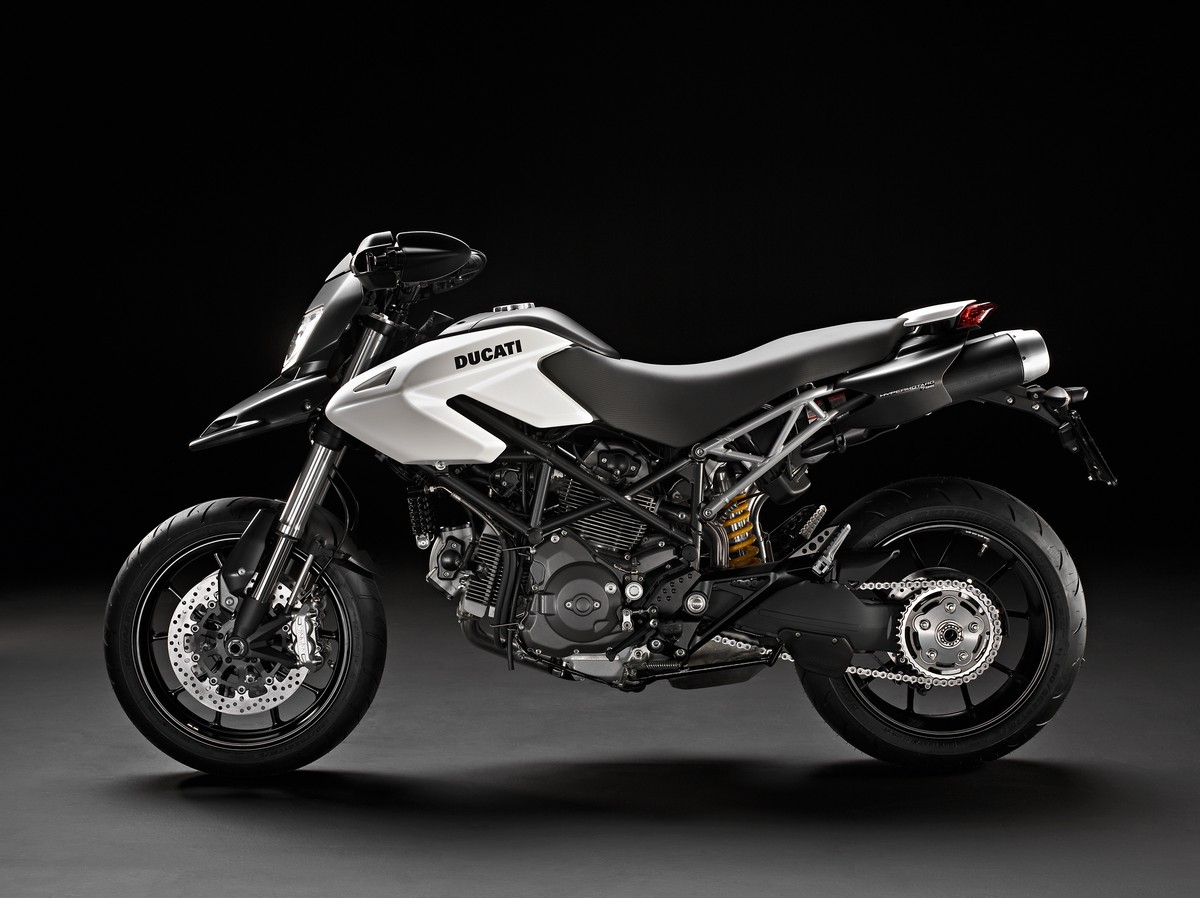
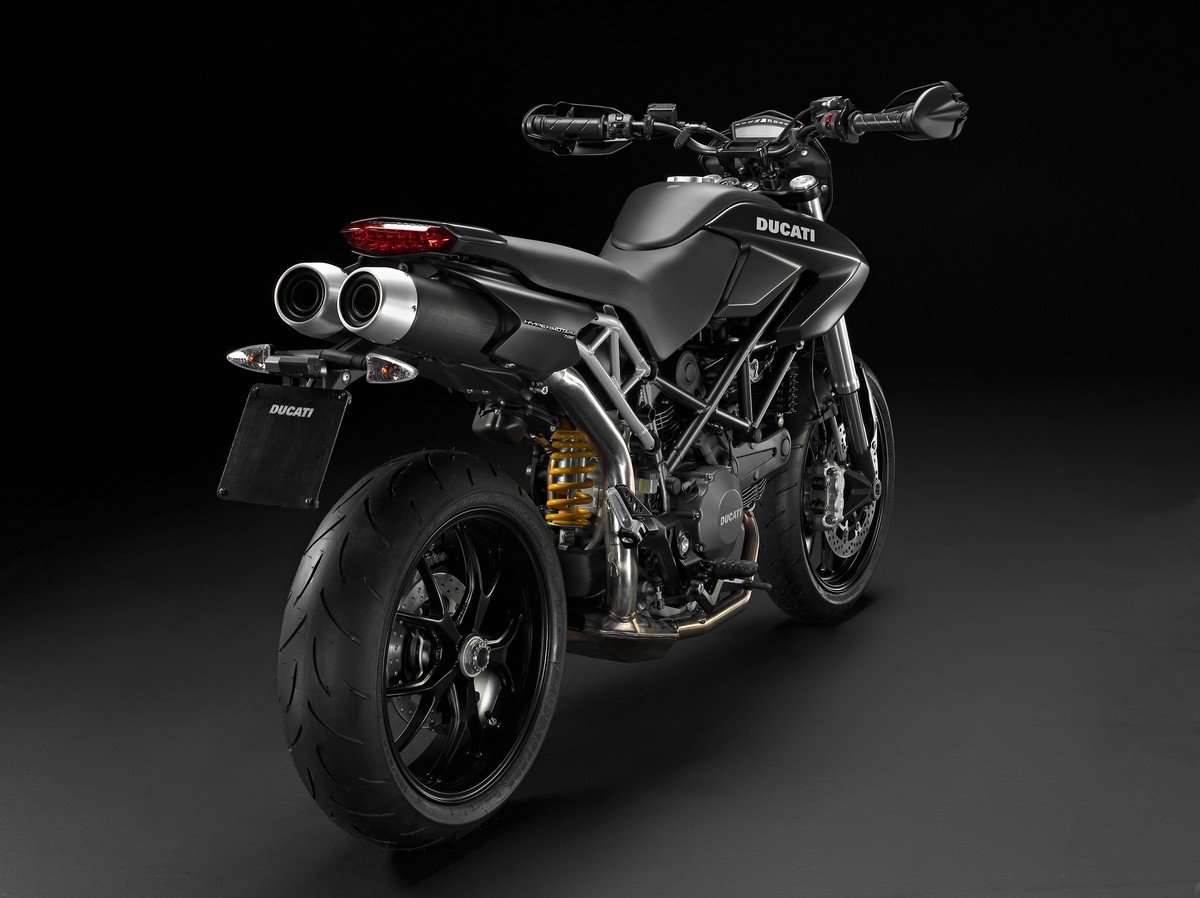
The 796 comes in an urban-style Dark
finish with matte black tank and beak section, black
frame and black
wheels or, alternatively, matte white tank with contrasting
matte black beak, black frame and black wheels.
For the purists, an 1100 look-alike red tank with
matching beak section, red frame and black wheels
keeps
the 796 in traditional livery.
DUCATI HYPERMOTARD 1100EVO
The introduction of the 1100EVO further
enhanced the original Hypermotard concept of 'ruling
the road'. The wide, tapered section handlebars continue
to transfer control of the asphalt to the rider and
the full length
seat still eases the fore and aft movement for extreme
riding. The difference now is that it does it all
better
than before.
A super-light dry weight of 172kg (379lb)
and an impressive 95hp is the result of an intense
program of
redesigns and refinements intended to be the 'evolution'
of the Hypermotard.
Continued chassis development to the
Hypermotard resulted in an improved frame layout which
eliminated
almost all of the heavier forged elements used on
the original model. The rigidly triangulated Trellis
frame
and track-tested chassis geometry is matched by a
state-of-the-art suspension. 50mm Marzocchi forks
are
gripped by a sturdy triple screw lower fork clamp
for precise steering performance. These forks work
as
impressively as they look, with special high rigidity
stainless steel sliders and external adjustability
for
compression and rebound damping, plus spring pre-load.
The rear suspension performs with equal
precision by using a fully adjustable ZF Sachs shock
mounted to a robust single-sided swingarm.
Lightweight wheels mounted on large
diameter axles are fitted with Pirelli Diablo Rosso
tyres. Stopping
power is controlled by two radially mounted Brembo
4-piston callipers gripping lightweight 305mm twin
discs up front, and a 245mm disc at the rear. All
of this combines to make stopping as thrilling as
accelerating.
The Desmodue 1100 Evoluzione
engine
The lightweight, L-Twin stands at the
pinnacle of more than three decades of Desmo air-cooled
development and its torquey power delivery has excited
riders worldwide. The Evoluzione version is
positively awesome and makes it the perfect engine
to give its name to the Hypermotard 1100EVO.
The 1100cc Desmodue Evoluzione power unit uses a bore
and stroke of 98 x 71.5mm, and its long list of
refinements boosted its power to 95hp (69.9kW) @ 7500rpm
with 76lb-ft (10.5kgm) of torque @ 5750rpm giving
it outstanding power delivery, from grunting low rpms
to the singing howl at redline.
The 1100's crankcases are vacuum cast using the same
Vacural® technology employed for the lightweight
Superbike engines, a process that achieves significant
weight saving and ensures consistent wall thickness
and increased strength.
But the crankcases were just the starting
point of the evolution. Apart from the magnesium alternator
cover, the 1100 has a lighter crankshaft assembly
by using an 848-style Superbike flywheel and the search
for further weight reduction even went as far as using
lightweight rare-earth magnets for the generator
assembly. The result reduced the original 1100 power
unit's weight by a staggering 5.2kg (11.5lb) and
contributed towards making the Hypermotard 1100EVO
even more agile.
Power gains have come not only from
the new lightweight crankshaft assembly, but also
from an evolution
of the top-end of the Desmodue power unit. The cylinder
head, not only improves lubrication and cooling
performance, but also uses a redesigned inlet port
shape for optimum flow and a modified combustion
chamber shape for improved burn efficiency. This improved
efficiency is the result of a higher compression
ratio and the change to a single spark per cylinder
ignition managed by high-speed Siemens electronics.
Ensuring a sufficient feed to the higher compression
set-up is a high-flow airbox intake duct and higher-lift
valves for maximum volumetric efficiency.
The incredible valve performances of
the Desmodue engine are only possible because of Ducati's
unique
Desmodromic system, where valve closure is activated
mechanically. At high rpm it would be almost
impossible for the valve to follow the steep closure
profile of the cam lobe if it were relying upon a
normal
valve spring. With the Desmo system, the valve is
closed mechanically with the same accuracy as it is
opened, enabling steep cam profiles and radical cam
timings. This system is used on every single Ducati
power unit including their world-beating Superbike
and Desmosedici MotoGP engines.
In keeping with its extreme character, Ducati continue
to use the 'dry' racing-style clutch for the
Hypermotard 1100, the popular preference of thousands
of Ducatisti the world over. The clutch and
alternator covers are finished in carbon grey for
the 1100EVO and in gold for the 1100EVO SP.
An impressively efficient oil cooler
protects the increased power output of the Hypermotard
1100EVO,
whether ridden on the open roads or through stop-start
urban traffic. Conforming to Euro3 regulations, the
2-1-2 exhaust system is monitored by twin lambda probes
to ensure the most efficient fuel injection under
all conditions. The exhaust terminates with Ducati-famous
twin under-seat mufflers.
Having more experience with twin-cylinder
high performance engines than any other manufacturer,
the aircooled L-Twin remains central to Ducati's philosophy
of motorcycling. This experience - plus constant
investment in quality by design, advanced materials
and engineering techniques - has enabled 7,500 miles
(12,000 kilometres) between service intervals, making
Ducati ownership even more enjoyable than ever.
DUCATI HYPERMOTARD 1100EVO SP
The Hypermotard 1100EVO SP takes the
whole Hypermotard concept to a new level of extreme.
Higher
ground clearance, higher spec suspension, higher bars
and even less weight makes the 1100EVO SP trackready
for action.
When Ducati first launched the Hypermotard
project they knew that there would be extreme riders
out
there who wanted more – they just didn't realise
there would be so many! With a racing heritage built
on
direct rider feed-back and a Hypermotard category
in the Italian Ducati Desmo Challenge series, Ducati's
reputation for listening to owners to improve their
motorcycles has become legendary and the Hypermotard
1100EVO SP is no exception.
Extreme riders all wanted the same
thing from the Hypermotard: More power, more ground
clearance,
more control in extreme situations, more detail and
less weight. With the Hypermotard 1100EVO SP, the
engineers have ticked all the boxes.
SP suspension
Longer, black-bodied, fully adjustable
50mm Marzocchi forks have 30mm (1.2in) more travel
and increase
the SP's ground clearance by 30mm (1.2in), extending
the SP's extreme cornering performance and
providing a more track-oriented set-up. Coated with
a durable low friction, DLC (diamond-like carbon)
black
coating, the sliders enable the Hypermotard
'SP' to respond effortlessly to every minute variation
in the
tarmac, improving on its already impressive road holding.
The advanced 'SP' suspension is further
enhanced with an Öhlins remote reservoir rear
shock, renowned in racing as the ultimate performance
choice. This incredible shock is fully adjustable
for compression and rebound damping as well as spring
preload, ensuring that the 'SP' is readily adaptable
to every riding style and road or track it challenges.
SP colours
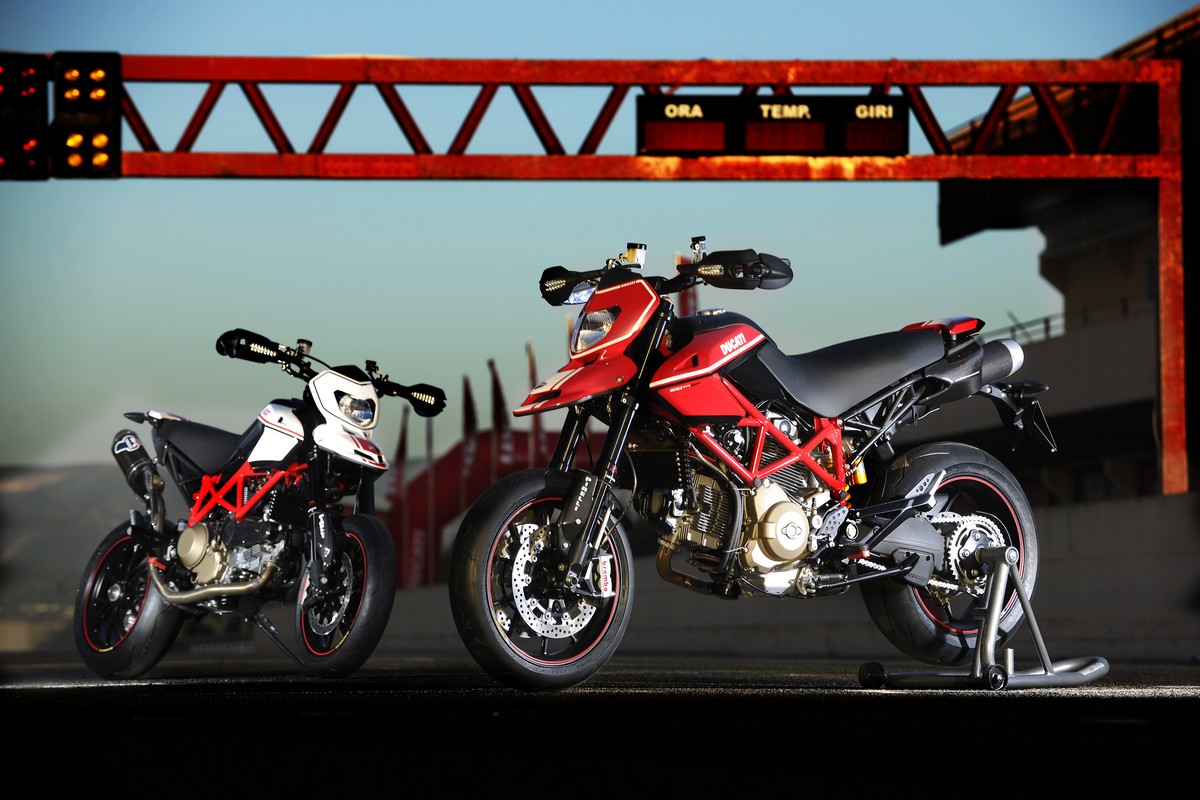
The Hypermotard 1100EVO SP is boldly
finished in a choice of red-themed or white-themed
Ducati Corse
livery to underline its competition intention.
The white-themed livery has a white
tank with thin red stripe and red Ducati graphic,
contrasted with a
black knee-panel area. The headlight fairing and beak
section are also white with a wide red stripe along
the
centre of the beak and thin black striping around
the fairing section. The tailpiece is white with a
wide red
stripe along its centre.
The red-themed livery has a red tank
with thin white stripe and white Ducati graphic, contrasted
with a
black knee-panel area. The headlight fairing and beak
section are also red with a wide white stripe along
the
centre of the beak and thin white striping around
the fairing section. The tailpiece is red with a wide
white
stripe along its centre.
Both colour schemes have red Trellis
frames with black wheels and the Ducati Corse logo
proudly displayed
on the Hypermotard's beak section.
Hyper data
Supplied as standard equipment on the
1100EVO SP, the Ducati Data Analyser (DDA), which
includes PC
software, a USB-ready data retrieval card and instructions,
enables owners to review and analyse the
performance of the bike and its rider, and make comparisons
between various channels of information.
The system records numerous channels of data including
throttle opening, vehicle speed, engine rpm,
engine temperature, distance travelled, laps and lap
times. It also automatically calculates engine rpm
and
vehicle speed data, enabling it to display gear selection
as an additional channel of information. At the end
of a ride or track session, up to 4mb of data can
be downloaded ready to compare, analyse and get an
inside view of the performance of both the rider and
the Hypermotard.
The Hypermotard Story
When the prototype Hypermotard was
first shown at the Milan show it represented the creation
of a new
segment, one that bridged the gap between refined
sportbikes and minimalist supermotards. But some at
Ducati had reservations about the initial Hypermotard
concept and were unsure whether or not the market
was ready for such a motorcycle.
Despite those reservations, the project
continued to be developed, driven by the belief in
the upright and incontrol riding position of a dirtbike,
but not the harsh characteristics of its single cylinder
engine. These
confident few liked the feel of a skinny, taut and
agile chassis, but not the fact that its original
off-road
design made it a compromise on the street. They set
about creating a bike that combined the agility and
lightweight precision of a supermotard, with the refined
power characteristics of a charismatic L-Twin
Ducati sportbike. They were designing the future.
As each day went past, more and more
people in the factory got to hear about the completed
bike and
those who had the chance to catch sight of it all
responded in the same way: "Wow! We're going
to
produce it, right?" There was one way to gauge
market response: show it at the 2005 Milan show as
a
prototype and conduct an online survey.
Ducati presented the prototype Hypermotard
as its centrepiece that year and their confidence
was
rewarded with a global 'yes!' from the public, the
'Best of Show' award, and demands from riders all
over
the world to produce it immediately. In fact, a staggering
15,000 people completed the Ducati.com survey,
with more than 50% asking for the Hypermotard to be
built exactly as shown at the show. But Ducati were
serious when they asked the public for their feed-back
and took time to sift through thousands of additional
suggestions and requests, such as twin front brake
discs instead of the prototype's single, and integrated
many of them into the final production design.
The innovative Hypermotard spawned
a new and exciting 'cross-over' category that had
reinvented pure
riding pleasure with a practical and versatile motorcycle
that could be used every day. Riders hungry for
excitement immediately understood the concept and
have been enjoying it ever since.
Quick glance history
- November 2005: Prototype Hypermotard 1100 shown
at Milan International Motorcycle Show.
Awarded 'Best of Show'.
- November 2007: Production Hypermotard 1100 and
1100 S launched at Milan International
Motorcycle show.
- June 2007: Hypermotard 1100 and 1100 S arrived
in showrooms as an early release model year
2008.
- November 2008: Model year 2009 Hypermotard 1100
updated with an additional colour option of
pearl white. Hypermotard 1100 S updated with Kayaba
forks, an additional colour option of black and
DDA kit supplied as standard equipment. The Hypermotard
1100 S takes victory at Pike's Peak
International Hill Climb, Colorado (1200cc category).
- October 2009: Release of new model year 2010
Hypermotard 796.
- November 2009: Model year 2010 Hypermotard 1100EVO
and 1100EVO SP launched at Milan
International Motorcycle Show.
- October 2010: Model year 2011 Hypermotard 796,
1100EVO and 1100EVO SP presented in Cologne’s
INTERMOT Motorcycle Show.
|