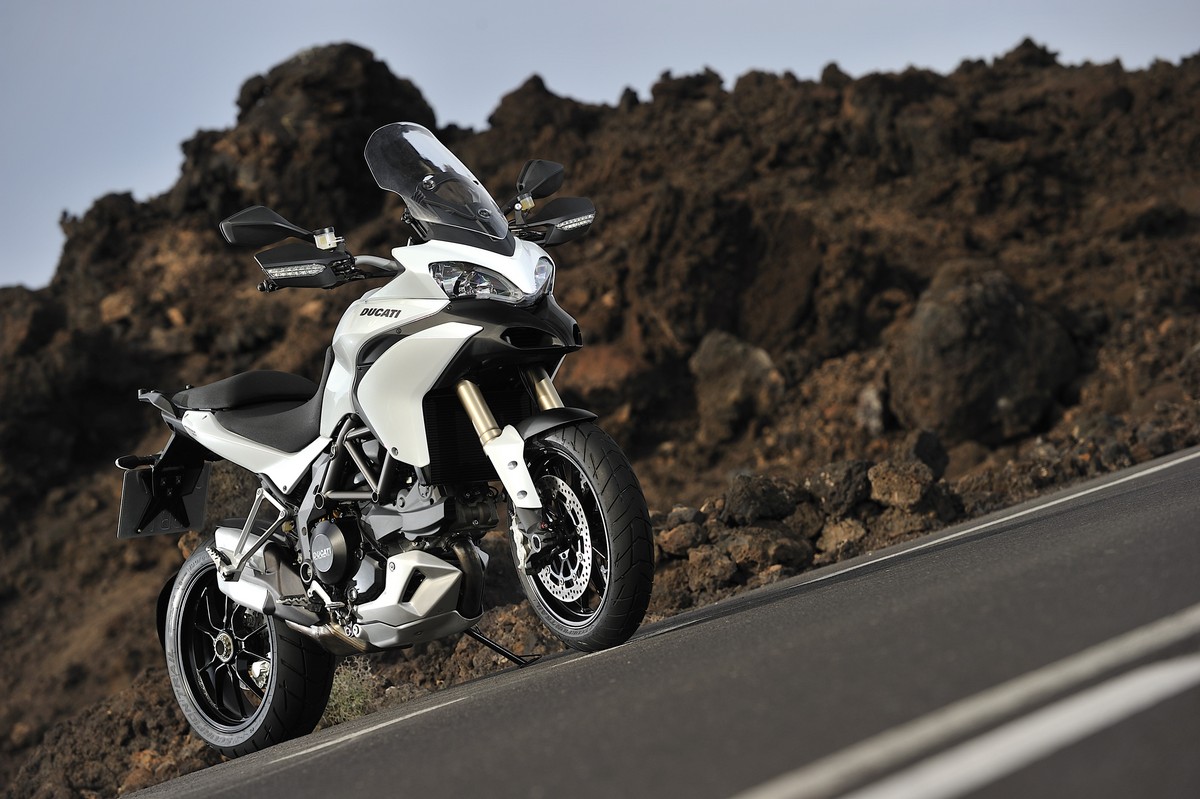
2011 Ducati Multistrada
  
 
Endless transformations
The award-winning and highly successful
Ducati Multistrada 1200 moves into 2011 having proved
its
innovative concept and established itself as a new
industry benchmark. Combining ground-breaking design
and unprecedented technology, the Multistrada’s
Sport, Touring, Urban and Enduro riding modes enable
a
truly enjoyable and customisable riding experience
separated by just one click.
The ground-breaking four-bikes-in-one
design makes instant adjustment to power and torque
delivery in
addition to electronic adjustment of suspension settings
and traction control, transforming the Multistrada
1200 to the rider’s needs, and not the other
way around.
Hailed as a true ‘game-changing’
motorcycle, the technologically-advanced Multistrada
1200 has attracted
all types of riders by opening up the borders between
motorcycle categories.
With the 150hp Testastretta 11°
engine, a class-leading dry weight of just 189kg (417lb)
and the application
of advanced ergonomics, the Multistrada 1200 is not
only powerful and playful, but also a comfortable
and
versatile adventure on two wheels.
The Multistrada 1200 offers ABS as
optional, while the flagship Multistrada 1200 S presents
ABS and
Ducati Electronic Suspension by Öhlins as standard
equipment. The 1200 S is available in ‘Sport
edition’
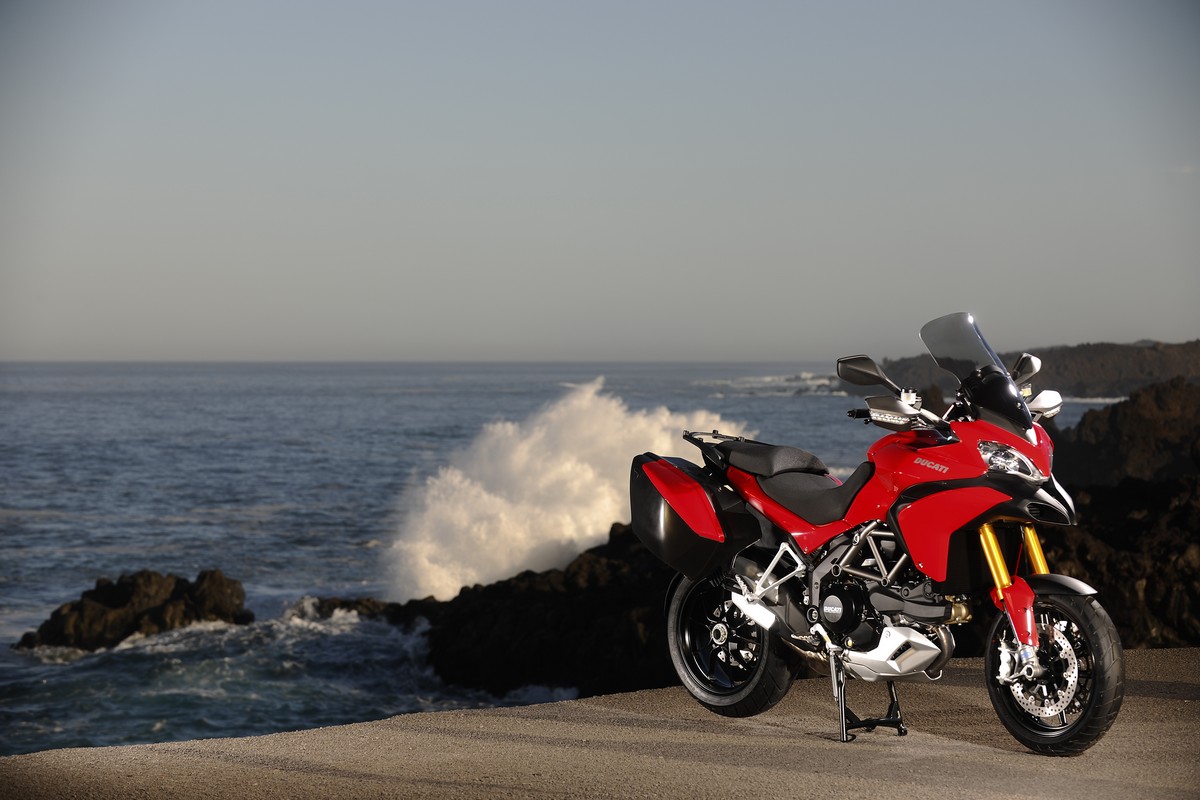
with carbon fibre components or ‘Touring edition’
with side luggage, heated grips and centre stand.
Four-bikes-in-one
The four-bikes-in-one concept is achieved
by selecting, even while riding, from a choice of
four pre-set
modes programmed to instantly change the engine character
and chassis set-up of the Multistrada 1200.
The four modes are made possible by combining a number
of class-leading technologies.
An electronic Ride-by-Wire (RbW) system
administers different mappings to regulate power delivery
by
interpreting the rider’s throttle input, while
the world-beating Ducati Traction Control system (DTC)
uses
eight levels of system interaction to enhance control
by reducing wheel-spin. For the ‘S’ version,
Ducati
Electronic Suspension (DES), by Öhlins, instantly
configures the suspension set-up with electronic
adjustment. At the touch of a button, four different
motorcycles to suit the specific needs of the rider
and
not the other way around.
Sport
The Sport riding mode provides the
rider with an adrenalin-fuelled 150hp ride with a
sport-oriented throttle
response and, on the ‘S’ version, an instant
high performance suspension set-up. In character with
its
Superbike bloodline, the sport mode also changes the
DTC system intervention to level 4 for expert riders
whose ‘comfort zone’ is a little closer
to the limit.
Touring
The Touring riding mode is also programmed
to produce 150hp, however, the power characteristics
are
designed in a touring configuration with a smoother,
more user-friendly delivery. Active safety is enhanced
by increasing DTC system intervention to level 5,
specifically intended for an enjoyable and relaxing
ride
and, on the ‘S’ version, the suspension
automatically dials-in a set-up ideal for long distance
touring,
ensuring maximum comfort for both the rider and passenger.
Urban
As navigation of the urban jungle can
require an even more user-friendly motorcycle, the
Urban riding mode
instantly transforms the Multistrada 1200 into the
most manageable, everyday transport. Power output
is
reduced to 100hp, and the suspension, on the ‘S’
version, to a setting perfect for tackling the maze
of city
streets full of speed bumps and drain covers. DTC
is further enhanced to level 6 to provide high system
intervention during the most chaotic of stop-start
traffic.
Enduro
Should the journey aboard the Multistrada
1200 leave the beaten track, it has the capability
to take off-road
routes in its stride. Agile and lightweight and with
high, wide handlebars, serrated footrests and specially
designed tyres, the Multistrada also features an Enduro
riding mode which instantly produces a smooth
100hp engine, immediately dials-in an appropriate
suspension setting on the ‘S’ version
and reduces the
DTC system to level 2 for minimal intervention.
Innovative technology
Ride-by-Wire
The Ride-by-Wire (RbW) system is an
electronic interface between the twistgrip and the
engine which
decides the ideal power response depending on the
riding mode selected and according to the rider’s
throttle input. The twistgrip no longer has a throttle
cable connected directly to the throttle body butterflies,
but instead delivers a signal to a control unit, which
in turn operates the butterfly opening.
The RbW system uses three different mappings to regulate
the power delivery. The three maps offer
150hp with a sports-type delivery, 150hp with a progressive
delivery suitable for touring and 100hp with
progressive delivery for city or off-road use.
Ducati Traction Control
The racing-derived Ducati Traction
Control (DTC) is a highly intelligent system which
acts as a filter between
the rider’s right hand and the rear tyre. Within
milliseconds, DTC is able to detect and then control
rear
wheel-spin, considerably increasing the bike’s
active safety and performance.
The system offers eight ‘levels
of sensitivity’, each programmed with a level
of rear wheel-spin tolerance in
line with progressive levels of riding skills classified
from one to eight. Level one is programmed to offer
the least amount of interaction while level eight
uses the most amount of interaction. DTC is an integral
part of the pre-programmed riding modes on the Multistrada
1200.
The system uses front and rear wheel
sensors to compare speed differential and sense when
rear traction
is being broken (wheel-spin). DTC then decides the
best combination of two different types of instant
electronic adjustment, calculated with data supplied
from multiple sources.
The first 'soft' stage of system interaction
is executed by high speed software that makes instant
electronic
adjustment to the ignition timing, administering varying
amounts of ignition retardation to reduce the
engine's torque.
If the DTC software detects that the
first 'soft' stage of system interaction is inadequate
to control the
wheel-spin, it continues to administer ignition retardation
and, in addition, instructs the engine ECU to
initiate a pattern of constantly increasing injection
cuts until, if necessary, full injection cut.
Red lights around the circular riding mode section
of the instrumentation illuminate to indicate the
interaction of the DTC system. As soon as the system
recognises the gradual return of equal wheel
speeds, it incrementally re-establishes normal power
delivery. This seamless interaction is key to the
super-smooth operation of the system.
The real innovative thinking behind
the DTC system is how the various range of sensitivity
levels decide
precisely how to react to excessive wheel-spin by
understanding the bike's exact 'dynamic situation'.
From
slow mid-corner acceleration with considerable vehicle
inclination to high speed corner exits while almost
upright, this 'system intelligence' is achieved by
processing a mass of data in a matter of milliseconds.
DTC levels are factory pre-set in each of the four
riding modes, but can be individually customised and
saved to suit the rider by accessing the set-up menu
within each riding mode. A ‘Default’ option
is available
to easily return all settings to factory pre-sets.
Ducati Electronic Suspension
by Öhlins
The ‘S’ version of the
Multistrada 1200 is equipped with the latest generation
48mm Öhlins forks featuring
the innovative Ducati Electronic Suspension (DES).
The new fork technology enables rebound and
compression damping adjustments electronically controlled
via the instrument panel. The top of the range
Öhlins TTX rear monoshock is also adjusted electronically
in both spring pre-load and rebound and
compression damping.
The electronic suspension adjustment
can be made easily by using the pre-set riding modes,
which have
been developed by Ducati test riders, or independent
mode, which allows riders to use their own personal
settings. Adjustments made electronically send a signal
that initiates electronic actuators mounted on the
suspension units.
In addition to the riding modes of
Sport, Touring, Urban and Enduro, there is also an
option to quickly
change the suspension setting to suit ‘rider
only’, ‘rider with luggage’, ‘rider
and passenger’ or ‘rider and
passenger with luggage’.
Hands-free ignition
The Multistrada 1200 ignition is not
actuated with a normal key. Instead, an electronic
key in the rider’s
pocket communicates with the Multistrada when within
a distance of approximately 2 metres (6.5ft),
recognising the dedicated key code and automatically
enabling the bike’s systems. Pressing the key-on
switch then activates all systems to ‘on’
and the engine is ready to be started.
The electronic key, which internally
consists of a radio circuit, externally doubles as
a mechanical flip-key,
required to open the seat and fuel tank cap. When
parking the motorcycle an electronic locking device
can
be actuated on the steering simply by applying full
steering-lock and pressing the ignition-off button
a
second time.
Instrumentation
The instrumentation has a large, high
visibility LCD showing all main data and a dot-matrix
circular LCD
which displays the riding modes, additional data or
set-up menus depending on whether the bike is
stationary or moving.
The main LCD displays data for speed,
rpm, gear, total mileage, trip1/trip2, engine coolant
temperature, fuel
level and time. When the motorcycle is in motion,
the dot-matrix LCD displays the selected riding mode,
remaining fuel/distance, current fuel consumption,
average fuel consumption, average speed, air
temperature, trip time, and ‘freezing conditions’
alarm. When stationary, it enters a setting menu from
where adjustments to the various functions can be
made including personalised DTC set-up and, on the
‘S’
version, suspension settings.
The Sport, Touring, Urban or Enduro
riding modes can be changed while either stationary
or in motion, as
well as load settings for ‘rider only’,
‘rider with luggage’, ‘rider and
passenger’ or ‘rider and passenger with
luggage’.
Engine
Testastretta 11°: The ideal
travelling companion
The heart of the highly complex and
innovative Multistrada 1200 project is the engine
and, as a prestigious
model, the motorcycle had to be powered by the most
advanced, evolved twin-cylinder engine to come out
of the Ducati factory. The Testastretta Evoluzione
engine that powered the world-beating 1198.
The challenge, however, was to produce
an engine that would be enjoyable to use in all conditions
and able
to adapt to the rider’s character and not the
other way around. Making the best ever L-Twin performance
engine smoother and more user-friendly was a challenge,
but Ducati’s innovative designers and engineers
met the challenge by designing the revolutionary Testastretta
11° engine. Their achievement succeeded in
harnessing the immense power of the Superbike engine,
making it smooth and adaptable to suit to any
occasion, a significant step forward in balancing
performance with usability.
Why 11°?
For a motorcycle intended for touring,
the smoothness and user-friendliness of the engine
is key to
achieving an effortless and comfortable ride and the
main engine characteristic that enabled this
configuration was the revision of the valve overlap
angle.
The overlap angle is defined as the
interval of crankshaft rotation, measured in degrees,
during which both
the intake and exhaust valves are open at the same
time. This overlap occurs between the end of the
exhaust stroke and the start of the intake stroke.
High performance engines, which are subject to
compromising smoothness for extreme power delivery,
use high values of this parameter in order to
benefit from the pressure waves to improve engine
performance by maximising volumetric efficiency.
On the Testastretta 11° engine, this angle has
been reduced from 41°, used in the Testastretta
Evoluzione
engine which powers the 1198, to just 11°. As
a result, the fresh inlet charge flow is less compromised
by
the exiting exhaust gases, resulting in a much smoother
combustion in addition to improved fuel economy
and lower exhaust emissions. Unburnt hydrocarbon emissions
(pre-catalyser) are reduced by up to 65% and
specific fuel consumption (and consequent CO2 emissions)
by up to 12% (Euro3).
With its 150hp and 12.1kgm (87.5lb-ft)
of torque, the Testastretta 11° sets a new standard
for Ducati twincylinder engines. Fluid dynamics testing
on ports and combustion chambers has resulted in a
modified
power delivery profile, specifically the torque. New
intake and exhaust ports combined with a radical
adjustment of the cam timing and slight reduction
of the compression ratio have enabled Ducati to achieve
a favourable torque curve at low rpm, which remains
strong through a wide range. This particular
characteristic considerably enhances the Multistrada
1200’s effortless ridability.
The gearbox and final drive ratios
have also been optimised to enable reduced fuel consumption
and
achieve increased riding comfort by reducing vibration.
If the 1198 Superbike reaches its top speed in 6th
gear, the Multistrada 1200 is able to reach it in
5th gear and maintain it effortlessly in 6th.
The Multistrada 1200 features an oil
bath clutch with ‘slipper’ function and
super-light feel at the lever. Its
design uses a progressive self-servo mechanism that
presses the plates together when under drive from
the engine, enabling the reduction of the clutch spring
rates. This results in a much lighter clutch lever
at
the handlebar, ideal in stop-start traffic or long
journeys. When the drive force is reversed (over-run),
the
same mechanism reduces the pressure on the clutch
plates, enabling them to provide a race-like ‘slipper’
action, which reduces the destabilizing effect of
the rear-end under aggressive down-shifting and provides
a
much smoother feeling when closing the throttle or
down-shifting under normal riding conditions.
The layout for the exhaust system,
which is simple and minimalistic, uses two primary
manifolds flowing
directly into the triple chamber single silencer.
Apart from carrying out the 2-1-2 compensator function,
the
silencer also contains the catalyser and sound-absorbent
materials. The two compact and lightweight
aluminium alloy end pipes depart in a low, lateral
configuration to keep the overall weight to a minimum.
More strada between major services
Constant investment in quality by design,
advanced materials and engineering techniques, has
enabled the
distance between major service intervals (valve clearance
check) to be doubled to a highly competitive
24,000km (15,000 miles). This has been achieved partly
by the introduction of a new valve seat material and
partly by the improved combustion efficiency and temperature
management designed into the Testastretta
11° engine.
Innovative design
189kg (417lb) Multistrada sets
the benchmark
Constantly reducing weight is part
of the design brief for all Ducati models. Less weight
enables maximum
performance both in terms of dynamic behaviour and
safety. A lighter motorcycle will brake in a shorter
distance, accelerate faster and be easier to steer.
Every single component of the Multistrada 1200,
therefore, has been designed to achieve weight reduction
without compromising its load-bearing capacity.
With a dry weight of just 189kg (417lb) the Multistrada
1200 is lighter than any other road enduro, touring
or
sport touring bike currently available in this category.
The lightweight and excellent chassis set-up ensures
exceptional handling, a key factor for Sport, Touring,
Urban or Enduro riding.
This weight saving is the result of
applying new technologies to Ducati’s design
and engineering of all major
components. Crankcases are now cast using Vacural
technology and chassis construction uses welded
Trellis tubes, cast alloy elements and hi-tech polymers.
Further savings have also been made with the
single-sided swingarm in aluminium and the fuel tank,
which has been developed using blow moulding
technology in pursuit of the best balance of capacity
and weight.
Ergonomics and comfort
The Multistrada 1200 was subjected
to an extensive ergonomic study using both CAD and
repeated
prototype testing, guaranteeing a high level of comfort
with a fully loaded motorcycle for long-range touring.
The ‘ergonomics triangle’ of handlebar,
seat and footpegs has been designed for both the rider
and
passenger, optimising comfort while providing a commanding
and upright riding position.
The Multistrada 1200 feels spacious
and accommodates both rider and passenger in complete
comfort,
even with the top case and side luggage in place.
Its 1530mm (60.2in) wheelbase ensures that not only
the
weight of the passenger remains inside the wheelbase
length, but also that of the side luggage when
loaded, a considerable contribution to the motorcycle’s
dynamic performance. Underlining its multi-tasking
intention, ergonomic attention was even applied when
designing the riding position while standing on the
footpegs, off-road style.
The wide, tapered steel handlebars
have been designed for maximum comfort and ensure
a commanding
riding position enhanced by a generous steering lock
of 76° (38° left and right). In addition,
the handlebars
have been mounted on anti-vibration isolators, specially
designed to balance riding comfort with a precise
road ‘feel’.
The Multistrada 1200 seat immediately
transmits a sense of comfort. Constructed in two separate
sections
for the rider and passenger, the design focussed on
form and cushion density to ensure maximum comfort
during long journeys and user-friendly lateral shaping
to help give sure-footed ground contact when
stationary. A confidence-inspiring passenger grab-handle
offers a secure and comfortable grip.
The footpeg position represents part
of the optimum ‘ergonomics triangle’ for
both the rider and passenger
with added consideration to ground clearance during
maximum lean angle and position of side luggage. The
footpegs have rubber inserts that insulate vibration,
removable to expose a motocross-style serrated edge
that provides enhanced boot grip when riding off-road.
The Multistrada 1200’s rear view
mirrors have both vertical and horizontal adjustment
and increased surface
area to provide the most efficient visibility. Two
handy onboard stowage areas are built into the motorcycle,
one suitable for a mobile phone or toll road tickets
situated in the right cockpit side panel and a larger
three
litre area situated under the passenger seat.
Ideal for long journeys
The Multistrada 1200’s screen
is designed with 60mm of vertical adjustment to ensure
efficient wind
protection for all rider heights and effortless high-speed
riding over long distances. The fuel tank has been
developed using a new moulding technology which enables
a favourable balance between capacity and
weight. Subject to riding style, the 20 litre (5.3
US gal) capacity can provide up to 400km (250 mile)
of
motorcycle pleasure between fuel stops by returning
approximately 47mpg (US) at a constant 120km/h
(75mph).
Two 12v power outlets situated on either
side of the area below the rider’s seat can
be used to power up
to 8A (fused) accessories such as thermal apparel,
intercoms or mobile phone chargers. In addition, a
special connection point for powering the GARMIN satellite
navigator (optional feature) is situated near the
instrumentation.
The Touring edition of the Multistrada
1200 S adds even more comfort and convenience. Easily
controlled
heated grips are ideal for journeys where adverse
weather conditions threaten rider comfort, while stylish
side luggage offers a load capacity of 57 litres and
a fast and secure attachment system that blends
perfectly when removed. In addition, a centre stand
provides parking confidence when fully loaded and
essential security in the event of tyre maintenance
during long journeys.
Character
For Ducati, design is not just creating
an attractive look. It is about knowing how best to
combine exciting
appearance with intelligent function and outstanding
performance. Even the Multistrada 1200’s exhaust
tail
pipes are a feature that perfectly demonstrates this
concept.
Their innovative design is well integrated
with the motorcycle’s overall shape and the
positioning of the
exhaust system improves overall weight distribution.
The tailpipes are short so they do not impinge on
the
space needed for the side luggage. The internal structure
of the silencer is designed to achieve the
characteristic Ducati sound without compromising compliance
with sound and hydrocarbon emission
standards (Euro3).
Components that are far more than just
aesthetic detail, include the frontal air intakes
that characterise the
face of the Multistrada and also deliver air to the
oil cooler and airbox, and the beautifully formed
aluminium
sump guard and side plates that help to protect the
engine off-road.
The single-sided rear swingarm is also
a good example of Ducati’s blend of design and
functional
engineering. It is made using a single piece casting,
with fabricated and welded sections creating a strong,
hollow and lightweight component that contributes
considerably to the Multistrada’s sure-footed
handling.
The headlight is a characteristic feature of the face
of the Multistrada 1200, its symmetrical layout uses
four
halogen lamps, two for low and two for high beam to
provide excellent illumination. In addition, the front
and rear side lights use LEDs, and feature a special
shape of intense light guidance, making the motorcycle
more visible to other road users.
Chassis
Design
All components used in the construction
of the Multistrada 1200 are of the highest quality.
Their selection
and subsequent assembly is the result of a design
brief based on uncompromised performance.
Chassis geometry, such as wheelbase,
swingarm length, and rake, trail and offset is the
result of a quest
for the best balance of stability at high speeds and
dynamic agility. The chassis is designed to achieve
lean
angles of up to 45° and the combination of reduced
weight and generous steering lock of 76° (38°
left and
right) makes tight manoeuvres at low speeds easy to
manage.
Frame
The Ducati signature Trellis frame
uses large diameter, light gauge tubing with two central
cast aluminium
sections and a Trellis rear subframe to achieve 19%
more torsional rigidity than the original Multistrada
1100. The high pressure, die cast, magnesium front
sub-frame reduces the high, frontal weight and
contributes to chassis feel and control.
Suspension
The standard version Multistrada 1200
uses 50mm Marzocchi front forks, featuring a special
forged fork
bottom and full adjustability in spring pre-load,
compression and rebound damping. The rear is controlled
by
a Sachs monoshock adjustable in compression and rebound
damping and in spring pre-load by using the
handy remote manual adjuster.
The ‘S’ version features
the front and rear Ducati Electronic Suspension (DES)
system by Öhlins. The
48mm Öhlins forks are adjustable electronically
in compression and rebound damping while spring pre-load
is manual. The Öhlins TTX rear unit features
twin tube technology to offer totally separate damping
adjustment in compression and rebound and uses experience
gained in racing to minimise friction and
reduce the risk of cavitation under extreme conditions.
In addition, the unit is fully adjustable electronically
in compression and rebound damping as well as spring
pre-load.
The front and rear suspension of both
versions provide 170mm of travel, the extra-long movement
ensuring
excellent comfort even when fully loaded or if the
rider decides to leave the asphalt for off-road routes.
Braking system & ABS
The front brakes use twin radially-mounted
Brembo four piston, two pad callipers actuated by
a master
cylinder with an adjustable lever. The fronts grip
320mm discs, while a single 245mm disc on the rear
is
gripped by a single Brembo calliper. Typical of all
Ducatis, these components ensure high performance
braking and set the standard in this segment.
The Multistrada 1200 is also equipped
with a Bosch-Brembo ABS system, optional for the standard
version
and fitted as original equipment on the ‘S’
version. It delivers outstanding braking performance
in all
conditions and provides a major contribution towards
performance safety. An option to disable the ABS is
available via the instrumentation, but is automatically
reactivated at the next ignition-on.
Wheels and tyres
Ducati’s technical partner, Pirelli,
worked alongside the Multistrada’s engineers
throughout the project,
developing the new Pirelli Scorpion Trail tyres specifically
for the Multistrada 1200. The new tyres represent
the first ever dual compound for on/off road use with
a harder compound central section. Combined with a
special tread design and carcass structure, their
190/55 section delivers racing performance on the
road in
terms of grip and lean angles, while ensuring high
mileage for touring and good off-road performance.
The
new generation tyres are purposely designed for the
Multistrada’s four-bikes-in-one concept.
The Multistrada 1200 rides on lightweight
10-spoke lightweight alloy wheels, 3.50x17 front and
6.00x17
rear. All colours of Multistrada 1200 use wheels finished
in black.
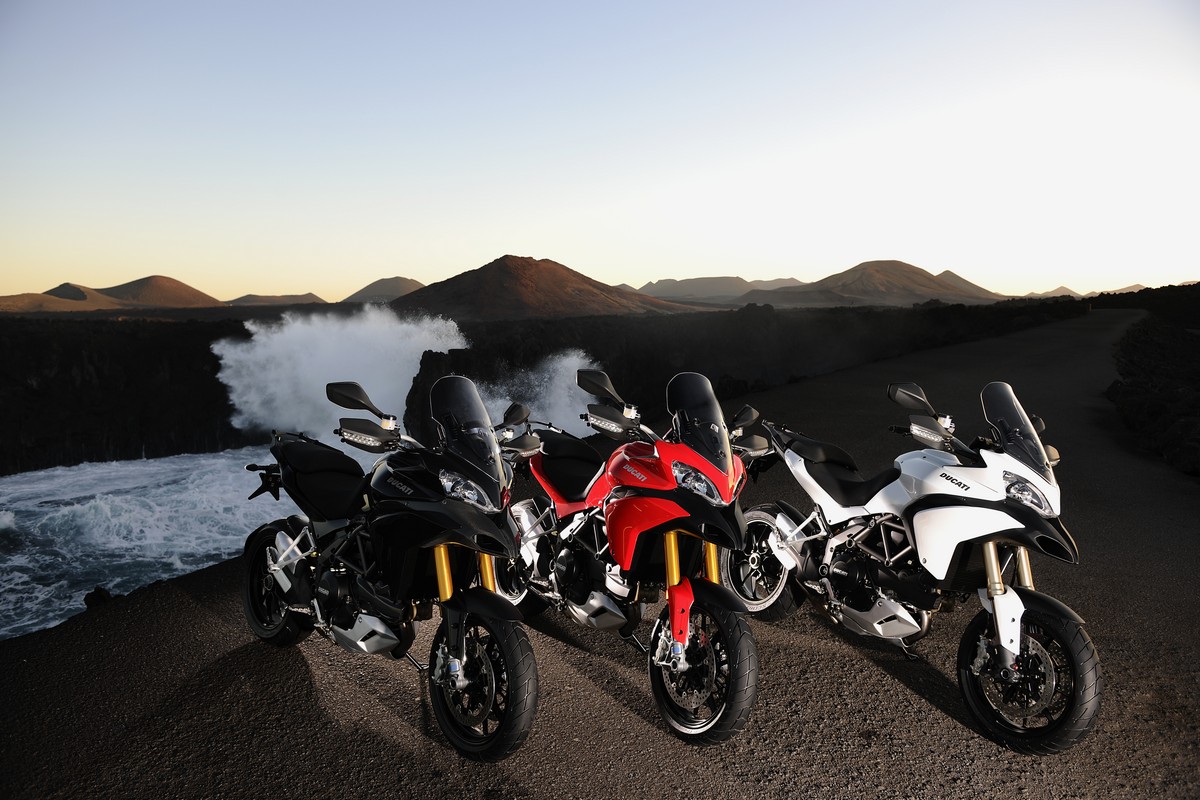
Colours
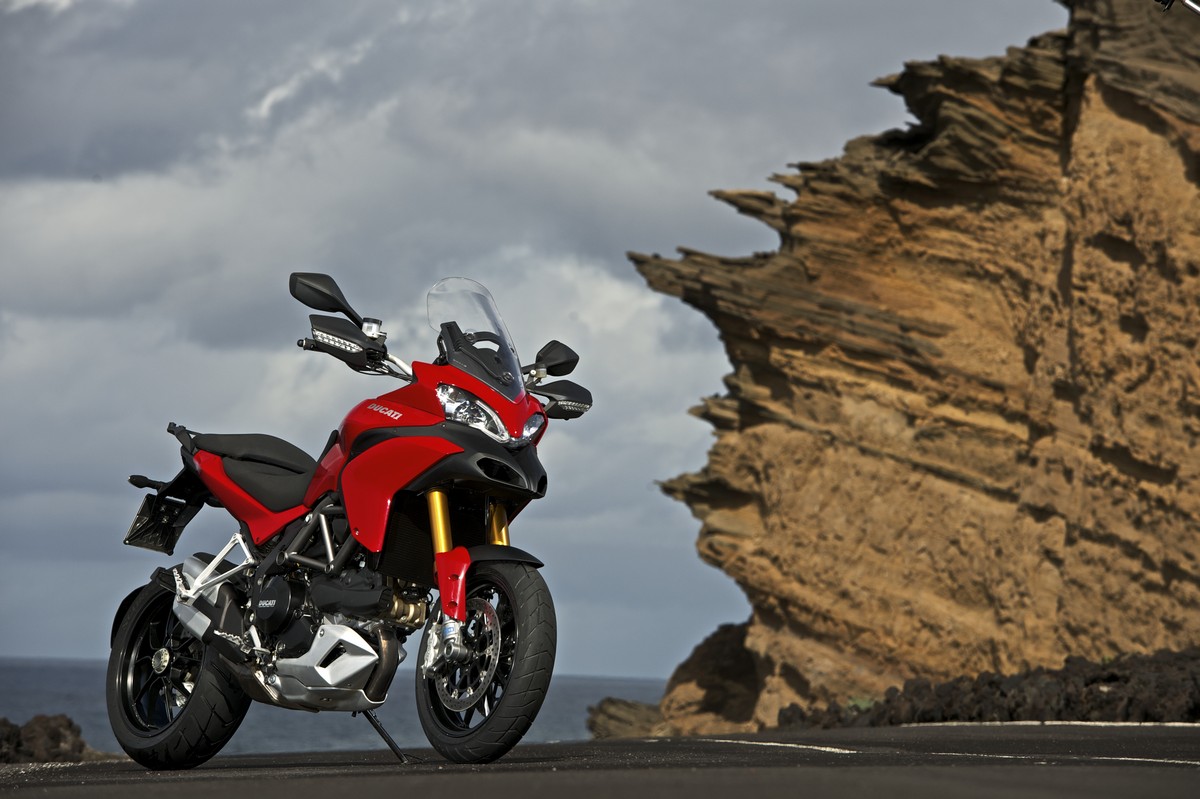
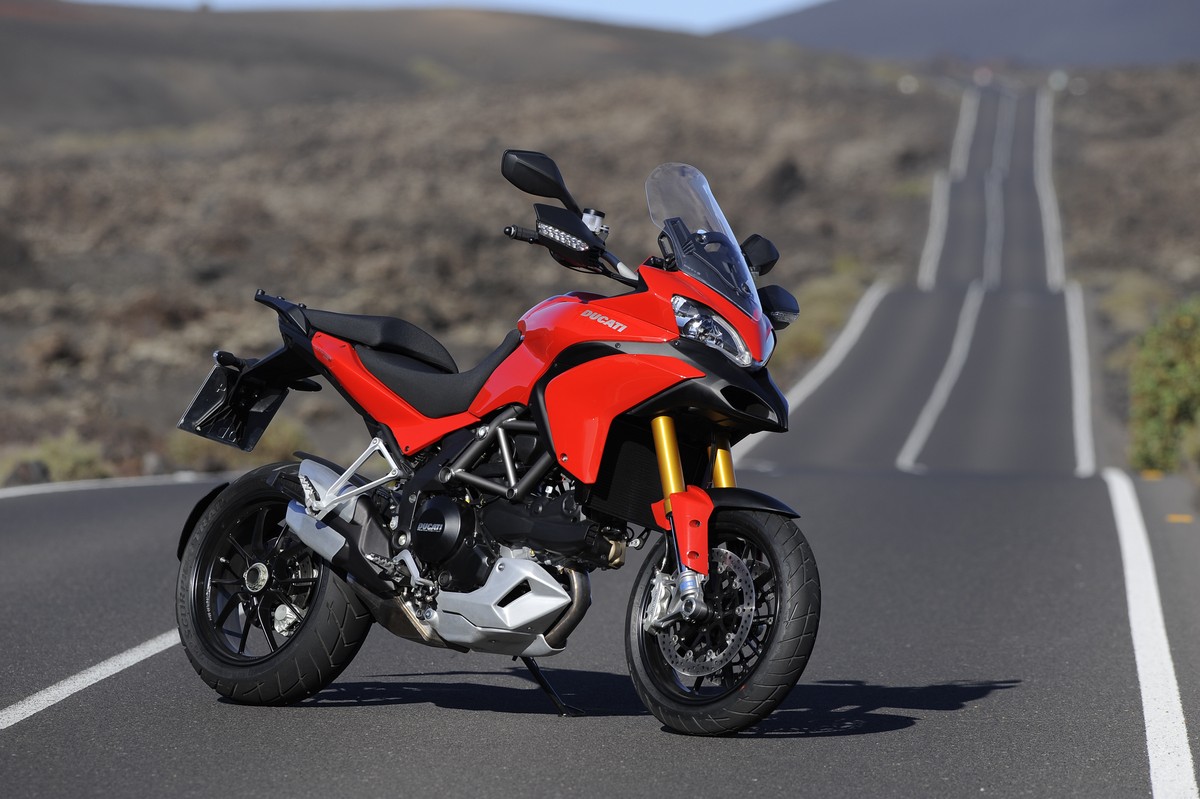
The Multistrada 1200 is available in
red or arctic white while The Multistrada 1200 ‘S’
is available in red,
arctic white and diamond black. All models have frames
finished in racing grey and wheels in black.
Versions
Multistrada 1200
• Optional Bosch-Brembo ABS braking
system
Multistrada 1200 S Sport edition
• Bosch-Brembo ABS braking system
• Ducati Electronic Suspension system
• Front air intakes, cam belt covers, rear hugger
and lateral air extractors in carbon fibre
Multistrada 1200 S Touring edition
• Bosch-Brembo ABS braking system
• Ducati Electronic Suspension system
• Heated grips
• Side luggage
• Centre stand
All versions come with an additional
kit of optional larger rear hugger and front fender
rear section
extension.
|