2012 BMW K 1600 GT & GTL
 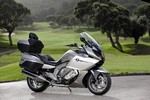
BMW K 1600 GT and BMW K 1600
GTL – fascination with six cylinders.
Ever since BMW Motorrad presented the
concept study Concept 6 in autumn 2009, the new 6-cylinder
in-line engine installed in it has caught the imagination
of many motorcycle fans. For over seven decades now,
6-cylinder in-line engines have stood for fascinating
engine technology in automobiles at BMW more than
with any other brand. With the new K 1600 GT and K
1600 GTL, BMW motorcycles are now available for the
first time with a 6-cylinder in-line power unit developed
in-house. The two touring motorcycles have a supreme,
impressive and equally distinctive appearance, creating
a desire to travel at first sight.
Riding dynamics, long-distance
suitability and comfort.
For decades, 6-cylinder in-line engines
have exercised a special fascination. In addition
to their perfect running smoothness they also offer
supreme output and torque, giving the rider powerful
emotional impressions.
In addition to safety, equipment and
comfort, prestige and dynamic performance are the
key criteria for a supreme touring bike. With the
most compact in-line 6-cylinder engine in serial motorcycle
production to date, the K 1600 GT and the K 1600 GTL
penetrate a whole new dimension in terms of riding
properties, long-distance suitability and comfort.
They combine maximum agility and riding dynamics with
a luxurious overall package. With an engine output
of 118 kW (160 bhp) and a maximum torque of 175 Newton
metres, their 6-cylinder engine provides superb propulsion
in all conditions.
Lightest and most compact serial production
6-cylinder in-line engine in a motorcycle > 1000
cc.
Previously, the in-line arrangement of six cylinders
resulted in either very long or very wide constructions,
depending on the installation position, which led
to drawbacks in terms of chassis geometry, weight
distribution and centre of gravity. This where the
K 1600 GT and K 1600 GTL break new ground.
Overall concept.
Weighing 102.6 kilograms, the engine
is by far the lightest serially produced 6-cylinder
in-line engine for motorcycles in the class > 1000
cc. What is more, the engine is significantly narrower
in construction width than all other 6-cylinder in-line
motorcycles in serial production to date. This extremely
compact construction and reduced width was achieved
in particular by means of a cylinder bore of 72 millimetres
in conjunction with a spacing of just 5 millimetres
between the cylinder the cylinder sleeves.
Both the low engine weight and the
consistent lightweight construction of the vehicle
as a whole contribute to the low weight of the vehicle.
At 319 kg (K 1600 GT without panniers) and 348 kg
(K 1600 GTL with panniers and topcase) the new touring
bikes are in the lower range of the segment.
Three modes to choose from and DTC
(Dynamic Traction Control) for maximum safety when
accelerating.
The rider of the K 1600 models has three different
engine characteristics directly available at the press
of a button at the right-hand end of the handlebars
so as to be able to adapt to different uses such as
touring on the road, riding on wet surfaces and sporty,
dynamic motorcycling - the modes "Rain",
"Road" and "Dynamic". Available
as an option ex works, the traction control function
DTC is combined individually with the different modes,
fully harmonised with them so as to provide maximum
riding safety.
E-gas.
The control of the central throttle
valve with a diameter of 52 millimetres is effected
via an e-gas, also known as a ride-by-wire system.
The rider's wishes are registered by means of a sensor
in the accelerator twist grip. The engine control
then adjusts the position of the throttle valve accordingly.
Chassis with ideal mass concentration
for dynamic riding properties.
The essential chassis elements of the
BMW K 1600 GT and K 1600 GTL are the light alloy bridge-type
frame, and the Duolever and Paralever for wheel control
at front and rear. Because of the special requirements
of a touring bike with a 6-cylinder engine, particular
attention was paid to balancing the masses.
All in all, the interplay of chassis
and engine position, together with the seating position
of the rider, not only makes for a low overall centre
of gravity with a very favourable concentration of
masses, it also provides an ideally balanced wheel
load distribution for excellent riding properties.
The combination of ride stability, riding dynamics
and lightness of handling in all riding and load conditions
sets a new benchmark in the touring bike segment.
Electronic Suspension Adjustment
ESA II for optimum adaptation to all uses and load
states.
The new 6-cylinder touring bikes also
benefit from the innovative Electronic Suspension
Adjustment II (ESA II), which is offered as a special
equipment feature ex works.
With this system, globally unique on
the motorcycle market, the rider can conveniently
press a button to electronically adapt not only the
rebound damping properties of the front and rear spring
strut but also the spring rest ("spring preload")
of the rear spring strut as well as the latter's spring
rate and therefore the "hardness" of the
suspension. This makes for outstanding stability and
impressive responsiveness in all load states.
The additional adaptation of the spring
rate allows the damping settings "Sport, Normal,
Comfort" to be spread widely in ESA II, giving
them clearly perceptible characteristics during riding.
So in "Sport" mode, the K 1600 GT and K
1600 GTL are even more dynamic and precise and in
"Comfort" mode they are more comfortable
- while still retaining excellent stability.
Adaptive headlight - a world
first for increased safety at night.
With the new BMW Motorrad touring bikes,
the first ever "Adaptive Headlight" option
is available ex works in the motorcycle sector as
a supplement to the standard xenon headlamp. In addition
to standard pitch compensation, the light of the main
headlamp is also balanced in relation to banking angle.
This produces significantly improved illumination
of the road when cornering and therefore an enormous
increase in active riding safety.
Integrated operating concept
with Multi-Controller, TFT colour screen and menu
guidance.
The instrument panel of the K 1600
models comprises two classic circular instruments
for the speedometer and tachometer and a 5.7-inch
TFT colour display. The design of the information
display is also completely new in the motorcycle field.
Among other things, it enables the attractive presentation
of text and graphics over several lines.
Another world first is the Multi-Controller
as part of an integrated operating concept, first
introduced in the BMW R 1200 RT at the end of 2009.
In addition to audio system control, the K 1600 models
also have a menu for operating the comfort functions
and on-board computer.
Innovative design with outstanding
wind and weather protection.
Particular attention was paid during
development to the combination of innovative design,
optimum wind and weather protection and the very highest
level of functionality. A very good example of this
is the electrically adjustable windshield with memory
function.
The bike's aerodynamic qualities in
terms of reduced air swirl - especially in the pillion
passenger area - were developed in sophisticated wind
tunnel tests. But the windshield not only protects
the rider and pillion passenger: it automatically
returns to the starting position when the ignition
is switched off, acting as an anti-theft system for
the optionally available navigation system.
BMW K 1600 GT with active riding
ergonomics for proactive touring.
The design of the ergonomic triangle
from the position of the footrests, seat top and handlebars
makes for a highly proactive seating position in the
K 1600 GT, while still retaining a high level of long-distance
comfort. The rider and pillion passenger enjoy a comfortable
knee angle but the seating position is geared towards
the front wheel for a dynamic riding style. The seat
is height-adjustable in the rider area so that it
can be adapted to individual needs.
The K 1600 GT is has a very extensive
range of standard features ex works consisting of
xenon headlamps, heated grips and seat, cruise control
and on-board computer. In conjunction with the supreme
riding qualities of the new BMW Motorrad 6-cylinder
engine, this motorcycle leaves nothing to be desired
as far as the proactive touring rider is concerned.
BMW K 1600 GTL with very comfortable,
relaxed ergonomics set-up for long trips with pillion
passenger.
The luxurious touring bike BMW K 1600 GTL meets the
very highest demands. Rider and pillion passenger
benefit from the very relaxed, upright seating position
as is especially appreciated over long distances.
The ergonomic design is geared towards maximum comfort
and derives from a single-section, dual level seat
in conjunction with rider footrests which are further
forward and lower, as well as handlebars which reach
further backwards. The standard topcase rounds off
the range of comfort features for the pillion passenger.
Like the K 1600 GT, the K 1600 GTL has a very extensive
range of standard features consisting of xenon headlamps,
heated grips and seat, cruise control and on-board
computer. The overall impression of the fascinating
6-cylinder motorcycle in combination with a carefully
conceived storage concept, a standard audio system
and numerous design elements make the BMW K 1600 GTL
the flagship model among the BMW Motorrad touring
bikes.
Individual paint finish concepts
adapted to the character of each bike.
As touring bikes, the new BMW K 1600
GT and K 1600 GTL stand for a perfect synthesis of
supremacy, dynamic performance and comfort. This is
also reflected in the colouring of the two models.
In the K 1600 GT, the body colours
of Light Grey metallic and Vermilion Red metallic
create a fascinating contrast with the frame and wheels
in Ostra Grey and the engine in Platinum metallic
matt. The colouring especially highlights the bike's
technical components. The lines are concentrated and
give the motorcycle a marked sense of agility.
With its emphasis on comfort and equipment,
the K 1600 GTL has a powerful presence and elegance
with elongated lines. This was achieved by means of
a harmonious interaction between body colours and
the colouring of the engine and chassis components.
Here, Mineral Silver metallic or Royal Blue metallic
2 provide a perfect match for the Magnesium metallic
matt of the painted frame and wheels. The engine in
Platinum metallic matt ensures an appealing overall
impression.
An overview of highlights of
the BMW K 1600 GT/ K 1600 GTL:
- Supreme in-line 6-cylinder engine with a high
level of pulling power, especially in the lower
and medium engine speed range.
- Engine output 118 kW (160 bhp) at 7 750 rpm and
maximum torque 175 Nm at 5 250 rpm.
- Over 70 per cent of the maximum torque is already
available from 1 500 rpm.
- The lightest and most compact 6-cylinder in-line
engine in serial motorcycle production > 1000
cc weighing just 102.6 kg and measuring 555 mm in
width.
- Consistent lightweight construction throughout
the entire vehicle (magnesium front panel carrier,
aluminium rear frame, crankshaft etc.).
- E-Gas.
- Three modes to choose from ("Rain",
"Road", "Dynamic")
- High active safety due to standard BMW Motorrad
Integral ABS (part integral).
- Dynamic traction control DTC (Dynamic Traction
Control) for maximum safety when accelerating (optional
extra).
- Chassis with Duolever and Paralever and ideal
mass concentration for dynamic riding properties
combined with optimum comfort.
- Electronic Suspension Adjustment ESA II for optimum
adaptation to all uses and load states (optional
extra).
- World premiere in a motorcycle: Adaptive Headlight
(optional extra) for increased safety at night in
conjunction with standard xenon headlamp and fibre
optic rings.
- Integrated operating concept with Multi-Controller,
TFT colour display and menu guidance for the first
time.
- Audio system with preparation for navigation
device and controllable interface for iPod, MP3,
USB, Bluetooth and satellite radio (USA and Canada
only) (standard in the K 1600 GTL).
- Innovative design with outstanding wind and weather
protection.
- K 1600 GT with active riding ergonomics for proactive
touring.
- K 1600 GTL with a very comfortable, relaxed ergonomics
set-up for long trips with pillion passenger as
well as luxurious touring equipment.
- Central locking for storage compartments, panniers
and topcase (optional extra).
- Extensive fittings and individually tailored
accessories at the familiar high level of BMW Motorrad.
Lightest and most compact serial production
6-cylinder in-line engine in a motorcycle > 1000
cc.
Previously, the in-line arrangement of six cylinders
resulted either in very long or very wide constructions,
depending on the installation position, which led
to drawbacks in terms of chassis geometry, weight
distribution and centre of gravity. The K 1600 models
break new ground here.
The engine is significantly narrower in construction
width than all other 6-cylinder in-line motorcycles
in serial production to date. This extremely compact
construction and reduced width was achieved in particular
by means of a just slightly undersquare stroke-bore
ratio of 67.5 to 72 millimetres (0.938) with a relatively
long stroke and very small cylinder centre distance
spacings of 77 millimetres. The effective distance
between the cylinder sleeves is thus only 5 millimetres.
What is more, weighing 102.6 kilograms (basic engine
including clutch, gearbox and alternator) the engine
is by far the lightest serially produced 6-cylinder
in-line engine for motorcycles in the class > 1000
cc.
Supremacy and ride comfort.
The transversely mounted 6-cylinder inline engine
of the BMW K 1600 models has a capacity of 1649 cc.
Its rated output is 118 kW (160 bhp) at 7 750 rpm.
The maximum torque of 175 Nm is reached at 5 250 rpm.
Over 70 per cent of the maximum torque is available
from 1 500 rpm. The development goals here were highly
superior touring characteristics and ridability combined
with maximum running smoothness.
Compact overall design and space-saving construction.
In order to achieve this narrow construction, the
electrical ancillary units and their drive mechanisms
were moved behind the crankshaft into the free space
above the gearbox.
Powertrain.
This also made it possible create a powertrain with
ideal mass concentration at the centre of the vehicle.
The total width of the engine is 555 millimetres.
This makes the engine only slightly wider than a current
large-volume 4-cylinder engine.
Due to the perfect mass balance created by the construction,
the 6-cylinder engine does not require a compensation
shaft and the associated drive elements, which results
both in weight benefits and increased running smoothness.
In its layout, the 6-cylinder in-line engine is
based on the familiar 4-cylinder in-line engine of
the K 1300 series and, like the latter, has a cylinder
axis which is tilted forwards by 55 degrees. This
not only results in a low centre of gravity but also
a balanced weight distribution. The tilt of the engine
likewise creates space for an aerodynamically optimised
intake system directly above the engine, as well as
allowing freedom for frame profile design geared towards
optimum stability and rigidity.
Crankshaft drive and basic engine - narrow and light
construction with six cylinders and a capacity of
1649 cc.
The crankshaft of the K 1600 engine is a single-piece
construction forged in heat-treated steel. It has
counterweights and inertia-optimised discs as well
as the usual 6-cylinder offset of 120 degrees for
even firing intervals. Particular attention was also
paid here to the issue of lightweight construction.
For example the weight of the crankshaft is only very
slightly in excess of a comparable 4-cylinder engine
at just 12.9 kilograms The crankshaft is friction-bearing.
The main bearing journals are 42 millimetres in diameter,
while the connecting rod pin journals have a diameter
of 40 millimetres. All main bearings are supplied
directly with pressure oil. The lubrication supply
to the connecting-rod bearing comes from the main
bearings.
One of the crankshaft web counterweights acts as
a cogwheel for the primary drive to the clutch. Another
cogwheel on the outer crankshaft web is used for engine
speed sensing. The other counterweights are aerodynamically
optimised.
The drive of the camshafts in the cylinder head
is effected by means of a tooth-type chain which runs
via a compression-moulded toothed chain wheel on the
right-hand end of the crankshaft.
The friction-bearing connecting rods are light forged
parts made of heat-treated steel. Measuring 124.45
millimetres in length, they benefit smooth engine
running and ensure low lateral forces in the pistons,
thereby securing a low level of inner friction in
this area. Horizontal partitioning is achieved by
means of the well-established crack technology: the
large connecting-rod eye is "cracked" in
the centre plane by the specific hydraulic application
of a powerful traction force. This rupture point enables
extremely precise-fitting assembly without further
centering.
Lightweight slipper pistons are used with a short
piston skirt, two narrow piston rings optimised for
frictional loss and a narrow oil scraper ring. The
flat design of the combustion chamber means than in
spite of the high compression ratio of 12.2:1 it has
been possible to keep the piston head and piston relief
flat. This supports thermodynamically favourable combustion
and enables a weight-optimised piston head shape.
Horizontally separated case in open deck
construction.
The dual-section cylinder crankcase is made of highly
rigid aluminium alloys. The partition level is at
the centre of the crankshaft. The compact upper section
forms a highly rigid composite unit made up of the
six cylinders and the upper bearing pedestal for the
crankshaft. The use of the sand cast technique in
the construction permits thin walls.
The cylinder block is designed in an open-deck construction,
i.e. the water jacket is open to the cylinder head.
The barrels have a wear-proof, low-friction nickel-silicon
dispersion coating. The die-cast lower section forms
the counterpiece to the main bearing of the crankshaft
and supports the 6-speed gearbox.
Cylinder head with barrel camshafts and bucket-type
tappets.
The output, characteristics, efficiency and therefore
fuel consumption of engines are largely determined
by the cylinder head and valve gear. The design of
the chill-cast 4-valve cylinder head in the K 1600
models is geared towards optimum channel geometry,
compactness, excellent thermodynamics and a reliable
heat balance.
With a view to maximising inspection intervals in
particular, the BMW Motorrad engine experts have opted
for a valve operating system using bucket tappets.
This combines the qualities of rigidity, compact construction
and reliability.
The valve angle of the engine in the K 1600 GT and
K 1600 GTL is 12 degrees on the intake side and 13
degrees on the exhaust side. The valve sizes are 29
millimetres on the intake side and 24.8 millimetres
on the exhaust side, with a shaft diameter of 5 millimetres.
The two overhead shafts are powered by a tooth-type
chain. This tooth-type chain drive is hydraulically
tensed and damped, as well as being characterised
by a high level of running smoothness.
The construction and manufacture of the camshafts
represent an innovation in motorcycle engine construction.
These are composite camshafts in which the individual
cams are compression-moulded for positive coupling
with the shaft, which is designed as a tube. The advantages
as compared to conventional clear-chill cast camshafts
derive mainly from the reduced weight, with around
1 kg being saved here. The rotational speed limit
defined for serial production is 8 500 rpm, though
the purely mechanical rotational speed tolerance is
much higher.
In order to reduce the weight of the drive unit
as far as possible, the valve cover and the clutch
cover are made of light magnesium.
High compression for maximum efficiency.
A tight valve angle enables a very compact combustion
chamber with a flat calotte, thereby providing the
basis for a high geometrical compression ratio of
12.2:1 with a thermodynamically favourable, largely
even piston head. This high level reflects the effectiveness
of the combustion chamber design in terms of achieving
an ideal combustion process and optimum efficiency.
Integrated dry sump lubrication for optimum
oil supply.
The 6-cylinder in-line engine of the K 1600 GT and
K 1600 GTL uses an integrated dry sump lubrication
system. In addition to a high level of operating reliability,
it allows a flat construction of the crankcase and
therefore a lower installation position of the engine
and a concentration of masses close to the centre
of gravity. This makes it possible to do without a
conventional oil sump with oil reservoir, so the engine
can be placed much lower in the vehicle than would
be the case with a conventional construction. The
oil reservoir forms an integrated oil tank in the
rear section of the engine casing. A separate tank
is therefore not required, which consequently has
a positive effect in terms of the compact construction
of the motorcycle and overall weight.
The dual oil pump is housed in the rear section
of the engine casing and driven by cogs from the clutch
shaft, circulating 4.5 litres of lubricant (engine
oil capacity including filter change). It draws the
lubrication oil from the oil reservoir and initially
feeds it into the oil filter (full-flow filter) as
pressure oil. The latter is located on the left lower
crankcase side where it is easily accessible. From
here the pressure oil reaches the main oil ducts in
the crankcase and is distributed to the lubrication
points via internal bores. The returning lubricant
collects at the lowest point of the crankcase in the
sump pan. The second pump supplies the returning oil
to the oil cooler initially, and from here it flows
back into the oil tank. The oil cooler is located
below the headlamp in the front trim panel for optimum
air flow. No monitoring of lubricant supply is necessary:
if the oil level drops excessively, this is displayed
in the instrument panel by means of an electronic
oil sensor.
Carefully conceived cooling concept for
maximum thermal stability.
A sophisticated cooling concept ensures perfect
thermal balance in the 6-cylinder engine. Coolant
flows transversely through the cylinder head. The
intake of the cooling fluid is effected via the cylinder
bank on the "hot" outlet side. Precisely
where the greatest thermal stress occurs, the intensive
cooling at the cylinder head ensures rapid heat dissipation
and therefore an excellent temperature balance. The
diminished water flow at the cylinders reduces the
warm-up phase and restricts cold-running wear-and-tear
and friction, which also benefits fuel consumption.
The coolant volume (50 % water, 50 % nitrite-free
antifreeze) is 3.5 litres including 0.5 litres of
levelling volume.
The water pump and the oil pump are powered by the
primary drive via cogwheels. The radiator is trapezoid
and curved in shape and housed in the trim at the
bottom front to optimise the centre of gravity. Due
to the minimised frictional loss of the engine, the
high degree of efficiency and the sophisticated aerodynamic
design of trim and air flow, a comparatively small
area of just 920 cc is sufficient for reliable heat
dissipation in all conditions. The integrated thermostat
keeps warm-up times as short as possible.
Ancillary units - alternator and starter.
In order to save construction space the electrical
ancillary units and their drive mechanisms were moved
behind the crankshaft into the free space above the
gearbox. The three-phase generator is driven by the
primary toothing of the clutch. The rated output of
the generator is 580 watts, with a peak current of
57.5 ampere. With a view to optimising power consumption,
the gear ratio of the crankshaft to the generate was
fixed at 1:2.0. The reduction-gear starter is linked
via a one-way clutch which acts on the generator drive
gear.
Power transmission: narrow three-shaft transmission
and self-energising clutch.
Torque is transmitted from the crankshaft to a 10-disc
wet clutch via a straight-toothed primary drive.
Here the developers paid particular attention to a
low level of control force at the hand lever. This
is achieved by means of a self-energising mechanism
in the clutch cage. When this is active, it may cause
slight movements in the clutch lever.
The gearbox complete with bevel gear is integrated
in the engine casing. In order to reduce construction
width in the area of the rider footrests in particular,
it is designed as three-shaft transmission with three
gearbox shafts arranged one on top of the other. The
cogwheels are helical-cut, providing an excellent
basis for low running noise.
Shifting between transmission stages is effected
by means of a shift drum, shift forks and shift sleeves
to achieve a force-fit connection. In order to save
weight the rolling-bearing shift drum is hollow and
made of a highly rigid aluminium alloy. The shift
forks are made of steel and are lubricated with pressure
oil.
Maintenance-free Cardan shaft drive at the rear wheel.
As in all large-volume BMW touring bikes, a drive
shaft powers the rear wheel. The bevel gear at the
gearbox outlet is housed in the gearbox cover. The
entire rear-wheel drive is described in detail in
section 3 "Chassis".
New engine control BMS-X.
The new BMW 6-cylinders feature the most state-of-the-art
engine control to date. BMS-X is being used for the
first time in the K 1600 GT and K 1600 GTL. Fully
sequential, cylinder-selective injection for six cylinders,
rapid processing of extensive sensor signals by means
of state-of-the-art microelectronics, a compact layout,
low weight and self-diagnosis are its most important
features. Here BMW Motorrad extends its longstanding
pioneering role in the area of electronic engine management.
The torque-based engine control with Alpha-n draws
on a wide range of parameters. In this way it enables
select torque delivery and a finely tuned adaptation
of the engine to the most diverse conditions.
The control system is based on the volume of intake
air which is determined indirectly via the throttle
valve angle and the engine speed. From additional
engine and environmental parameters (including engine
temperature, air temperature and environmental air
pressure), the engine control determines individually-adapted
levels for injection volume and ignition timing together
with stored mapping characteristics and pre-set correction
functions. The fuel type is premium unleaded, i.e.
at least 95 octane.
Ideal fuel dosage by means of variable pressure
control.
The supply of fuel is effected on a needs-oriented
basis via the control of the electrically regulated
petrol pump with a pressure of 3.5 bar. The mixture
composition is regulated by means of two oxygen sensors.
These are positioned at the junction points of three
exhaust manifolds and ensure precise registration
of exhaust gas composition.
In the K 1600 GT and K 1600 GTL, the BMS-X integrates
the functions of automatic idling-speed control and
cold-start enrichment via the electronically regulated
throttle valve. Idling speed increase during warm-up
is carried out automatically by means of an increase
in desired engine speed.
E-gas for excellent response and precise
fuel dosage.
The control of the central throttle valve with a
diameter of 52 millimetres is effected via an E-gas,
also known as a ride-by-wire system. The rider's wishes
are registered by means of a sensor in the accelerator
twist grip. The fully electronic engine control converts
this command into a torque requirement within a fraction
of a second and electronically regulates the throttle
valve accordingly.
This makes it possible to achieve optimum ridability
in the most diverse situations, as well as providing
electronic cruise control and traction control. What
is more, the use of the electromotive throttle actuator
via various selectable modes also opens up new potential
in terms of fuel consumption and riding dynamics.
Intake system with long tract lengths for
excellent torque.
The central throttle valve enables the achievement
of long induction tract lengths, which benefits an
especially full torque development in the lower and
medium engine speed ranges - a desirable characteristic
in a touring bike. For example, some 125 Nm of torque
is already available at 1 500 rpm.
The heavily tilted engine position means that an
intake silencer in perfect shape and position can
be installed directly above the engine. With a volume
of 8.5 litres, this intake silencer with upright panel
air filter contributes to superior power delivery
and high torque development. Air intake is via two
air inlets which are fitted in the side trim section
for optimum aerodynamic response.
Low fuel consumption due to efficiency optimisation.
Low engine speed level, high gas velocities, efficient
combustion and minimised frictional loss in the engine
of the BMW K 1600 GT and BMW K 1600 GTL result in
a high degree of efficiency and therefore a low level
of fuel consumption. In view of its power potential,
the engine achieves top figures in this area, equivalent
to the level of a comparable 4-cylinder motorcycle
when a touring-oriented riding style is maintained.
For example at a constant speed of 90 km/h, a fuel
consumption level is achieved of just 4.5 l/100 km
(K 1600 GT). This is largely due to the high geometrical
compactness and the specific orientation of the in-line
6-cylinder engine towards maximum efficiency.
Exhaust system with 3-way catalytic converter
and characteristic 6-cylinder sound.
Six individual manifolds of equal length come together
under the gearbox, initially in two pipes which then
lead into a large-volume rear silencer (6-in-2 system).
The two silencers with oval section have a volume
of 7.5 litres each and work according to the combined
principle of reflection and absorption damping. The
outer layer is thermally protected by the inner absorption
layer.
At the points where the manifolds feed into the
silencers there are metal-carrier catalytic converters
with a cell width of 200 cpi (cells/inch²). By
doing without a linking pipe it was possible to create
a typical 6-cylinder sound, while of course still
adhering to statutory requirements. In keeping with
its dynamic concept, the K 1600 GT sounds a shade
more aggressive than the K 1600 GTL. While the two
rear silencers in the K 1600 GT are made of brushed
stainless steel, two chrome specimens reflect the
luxurious style of the K 1600 GTL.
Three modes "Rain", "Road" and
"Dynamic" to choose from for optimum adaptation
to surface conditions and riding style.
The rider has three different engine characteristics
available at the press of a button at the right-hand
end of the handlebars ("Rain", "Road",
"Dynamic") so as to be able to adapt to
different uses such as touring on the road, riding
on wet surfaces and dynamic motorcycling. To make
the required setting, the "Mode" switch
on the right of the handlebar fitting is activated
until the display in the instrument panel shows the
desired mode. It is also possible to implement the
rider's wish during travel and change modes by pulling
the clutch lever and setting the throttle twist grip
position to idle. When the motorcycle is restarted,
the last selected setting is always maintained.
Both the K 1600 GT and K 1600 GTL can be fitted
with DTC (Dynamic Traction Control as a special equipment
feature ex works. Traction control DTC is combined
individually with the different modes and fully harmonised
with it so as to provide maximum riding safety.
For riding on wet surfaces with the resulting lack
of grip, "Rain" mode offers a flatter, especially
homogeneous output and torque curve (see section 8
"Engine output and torque"). The response
and power delivery of the engine are particularly
soft due to the altered electromotive throttle actuator
parameters. In this mode, traction control DTC intervenes
very early on before the frictional coefficient limit
is reached, ensuring maximum safety for the rider
even in difficult road surface conditions.
The rear wheel has sufficient lateral force to prevent
break-away of the motorcycle rear section on wet,
slippery surfaces. The ABS system remains unchanged
in its settings.
For use on dry roads, "Road" mode provides
full torque combined with a gentler, more touring-oriented
accelerator response. This mode was developed for
touring use on country roads and when travelling with
a pillion passenger. In this mode, DTC allows the
vehicle greater controlled agility. The ABS system
remains unchanged in its settings.
The "Dynamic" model was developed for
sporty, dynamic use of the K 1600 GT and K 1600 GTL.
Here again, the full torque is available, though the
response to the throttle grip is entirely direct and
perceptibly dynamic. Regulatory intervention of DTC
is only effected when maximum power has been transferred
to the rear tyre. The ABS system remains unchanged
in its settings.
Low overall centre of gravity, very favourable concentration
of masses and ideal static wheel load distribution.
The chassis of the BMW 6-cylinder motorcycles is
based on the innovative BMW Motorrad concept as already
used in the current 4-cylinder models of the K series.
The essential elements are the light alloy bridge-type
frame, Duolever and lightweight construction Paralever
for wheel control at the front and rear.
Because of the special requirements of a touring bike
with a 6-cylinder engine, particular attention was
paid to balancing the masses. All in all, the interplay
of chassis and engine position together with the seating
position of the rider not only makes for a low overall
centre of gravity with a very favourable concentration
of masses, it also provides a ideally balanced static
wheel load distribution of 52 per cent at the front
to 48 per cent at the rear (K 1600 GT unloaded). Even
with a pillion passenger and a heavy load, this guarantees
outstanding riding properties.
Main frame made of light alloy in a bridge-type
construction combined with a light alloy rear frame.
The central bearing component is the main frame in
a bridge-type construction. The entirely newly-developed
aluminium lightweight construction frame consists
of a welded unit with four highly rigid, heat-treated
chill-cast parts with thin walls. Both the complex
geometry and the large number of attachment points
make very high demands in terms of manufacturing technology.
Due to the fact that the engine is tilted heavily
forward, the profiles of the main frame can run above
the cylinder head so their configuration is largely
independent of the latter's width. This means that
the frame can be very narrow, especially in the ergonomically
important knee area. The main frame weighs just 16
kilograms. The 6-cylinder engine is firmly bolted
to the frame at eight points and thus acts as a rigidifying
element.
Chassis.
In spite of the demands made by a motorcycle such
as the K 1600 GT/GTL in terms of pillion passenger
riding and load, the developers have nonetheless succeeded
in creating a rear frame in light aluminium construction.
It consists of highly rigid, welded aluminium extruded
sections and is bolted to the main frame at four points.
The robust construction is supplemented with deformation
elements in the area of the pannier support. The rear
frame weighs just 4 kilograms.
BMW Duolever front wheel control for excellent ride
precision, cornering predictability and comfort.
In the BMW Motorrad K series, the Duolever stands
for maximum ride precision and cornering predictability.
It combines the greatest possible ride comfort with
a sensitive response. The spring travel is 115 millimetres
(60 mm compression, 55 mm rebound).
The kinematics of the Duoloever provides automatic
anti-dive control in the K 1600 models, so the longitudinal
forces acting on the front wheel during braking cause
virtually no compression. Only the dynamic wheel load
distribution generates a slight dip which gives the
rider feedback on braking power as is familiar from
conventional telescopic forks. In this way the Duolever
combines the desired amount of front wheel feedback
with the comfort and safety benefits of anti-dive
control.
Adapted BMW Paralever rear wheel swinging
arm and Cardan shaft drive.
In large-volume BMW touring bikes in particular,
the Cardan shaft drive is an indispensable part of
the overall concept due to its numerous advantages.
Based on the familiar Paralever swing arm, the rear
wheel control and the Cardan shaft drive have been
adapted to the new 6-cylinder engine in terms of construction
requirements. In accordance with the increased performance
and torque demands, the propeller shaft and rear axle
final drive have been newly designed.
As always, the Paralever swinging arm is made of
a highly rigid aluminium cast alloy. It is mounted
directly on the rigid main frame which at this point
is formed by a highly stable structure made of cast
light alloy.
The torque support for the housing of the rear-wheel
drive is still located above the swinging arm, while
the brake caliper is now mounted at the rear in the
extension of the vehicle's longitudinal axis.
The central suspension strut, adjustable via a needle
valve in the damping, is controlled by means of a
lever construction and is supported by a stabiliser
arm on the main frame. The progression combines sensitive
response of the suspension with excellent traction
response while still providing sufficient reserves
for riding with a full load.
The spring travel is 135 millimetres (100 mm compression,
35 mm rebound). In the standard version, the rear
spring strut offers continuously variable adjustment
for rebound damping and continuously variable adjustment
of the spring rest by 10 millimetres by means of an
adjuster knob so as to be able to adapt the rear to
different load states.
The new K 1600 GT and K 1600 GTL roll on lightweight,
elegantly designed light alloy cast wheels in ten-spoke
design which combine an attractive shape with high
rigidity and low weight. The front wheel measures
3.5 x 17 inches, the rear wheel 6.0 x 17 inches. The
corresponding tyre sizes are 120/70 ZR17 at the front
and 190/55 ZR17 at the rear. The rear tyre has been
especially developed to meet the demands of a touring
motorcycle in terms of load and speeds.
Electronic Suspension Adjustment ESA II
for optimum adaptation to all uses and load states.
The new BMW K 1600 GT and K 1600 GTL also benefit
from the innovative Electronic Suspension Adjustment
II (ESA II) which is offered as a special equipment
feature ex works.
With this system, which is globally unique on the
motorcycle market, the rider can conveniently press
a button to electronically adapt not only the rebound
damping properties of the front and rear spring strut
but also the spring rest ("spring preload")
of the rear spring strut as well as the latter's spring
rate and therefore the "hardness" of the
suspension. This is carried out conveniently using
the Multi-Controller in conjunction with the menu
in the TFT colour display panel.
This second-generation "Electronic Suspension
Adjustment" - or ESA II for short - enables the
suspension settings to be adapted highly conveniently
and more precisely than ever before to riding style
and load, thereby achieving a whole new dimension
of ride stability and comfort while offering excellent
responsiveness.
In order to make operation as simple as possible and
prevent unwanted, erroneous settings the rider first
simply enters the load state ("solo", "solo
with luggage" or "with passenger and luggage").
The relevant spring rest and spring rate are then
set automatically as the system harmonises these two
values.
The rider also chooses the chassis character of
the machine with either "Comfort", "Normal"
or "Sport", depending on the planned riding
style. From these entries, the electronic control
system calculates the appropriate damping rates based
on optimum parameters and sets them accordingly. This
means that the new 6-cylinder touring bikes offer
a total of nine different setting variations.
The additional adaptation of the spring rate allows
optimum adaptation of ride height to varying load
states, thereby guaranteeing an even higher level
of ride stability, agility and comfort. Even under
maximum load with pillion passenger and luggage, this
means that full banking freedom is maintained, enabling
a sporty riding style. What is more, the adaptation
of the spring rate drastically reduces the risk of
bumping with an extreme load. Damper settings can
be changed simply at the press of a switch ("Normal",
"Sport", "Comfort") even while
riding. For functional and safety-related reasons,
the spring rest can only be changed when stationary.
An electric motor with a gear unit is used to vary
the spring rate. The damping rate is altered by means
of small stepper motors at the dampers.
The alteration of the spring rate is effected by
two springs connected in series. Here the compression
forces are absorbed by an elastomer element (Cellasto)
combined with a conventional coil spring underneath.
The radial expansion of the Cellasto element is permanently
limited by a steel sleeve. An aluminium sleeve is
moved on the inside by means of an electrohydraulic
mechanism. The position of this inner sleeve influences
the inward expansion response of the Cellasto element
and therefore its spring rate. The effect is equivalent
to that of two springs of differing strength. When
the inner sleeve rests on the steel spring, the Cellasto
element is out of function and only the steel spring
takes effect. If the inner sleeve is then moved further,
the spring rest of the steel spring can be varied,
i.e. the "spring preload".
In this way, static normal position and ride geometry
are optimally preserved in all load states. Thanks
to this "ride-height levelling", the BMW
K 1600 GT and BMW K 1600 GTL are just as stable when
fully loaded as when only carrying a rider.
The additional adaptation of the spring rate across
the range of 110 to 160 N/mm allows the settings "Sport",
"Normal" and "Comfort" to be spread
widely in ESA II, giving them clearly perceptible
characteristics during riding. So in "Sport"
mode the K 1600 GT and GTL are even more dynamic and
precise and in "Comfort" mode they are more
comfortable - while still retaining excellent stability.
All in all the benefits of ESA II can be
summarised as follows:
- Excellent adjustment range in the settings "Sport"/"Normal"/"Comfort".
- Static normal position and ride geometry are
optimally preserved in all settings.
- Optimum adaptation of damping and spring rate/spring
rest in all settings.
- Significant change of vehicle character through
damping adjustment.
- Excellent adaptation to all load states through
spring rate/spring rest adjustment.
- Clear increase in safety in terms of braking
and ride stability, cornering freedom and bump response.
Brake system with BMW Motorrad Integral
ABS (part integral) for optimum deceleration.
The very highest safety standards are met by the
brake system with BMW Motorrad Integral ABS in the
part integral version, which is fitted as standard.
For even better controllability an additional pressure
sensor was integrated in the ABS hydraulic system.
In this way, maximum yet controllable deceleration
at low levels of control force give the rider additional
safety.
Generously sized brake disc diameters of 320 millimetres
at the front and rear ensure maximum deceleration
capacity even at very high speeds and under heavy
loads. In many tests the system has demonstrated its
further advantages such as unsurpassed speed of brake
pressure build-up and very low control force even
on full braking. The current system is among the safest
and most effective brake systems on the market.
Traction control DTC (Dynamic Traction Control)
for maximum safety when accelerating.
For both K 1600 models, traction control DTC (Dynamic
Traction Control) is available as a special equipment
feature ex works. It contributes significantly to
a high level of riding dynamics and exemplary riding
safety.
Traction control DTC was used in the supersports
bike BMW S 1000 RR for the first time: it provides
the rider with valuable support especially in changing
conditions, on surfaces with limited grip and where
there are big changes in friction levels.
By comparing the rotational speeds of the front
and rear wheel via the ABS sensors and the data collected
by the sensor box (banking detection), the BMS-X system
detects spin in the rear wheel. In this event the
system cuts back drive torque accordingly by reducing
the ignition angle, adapting injection and influencing
the position of the throttle valve.
Unlike previous BMW Motorrad ASC systems, the traction
control system DTC also detects the banking position
of the vehicle by means of sophisticated sensor clusters,
taking this into account in its control response.
Traction control DTC is combined individually with
the different modes and fully harmonised with it so
as to provide maximum riding safety (see section 2
"Powertrain").
Although DTC provides valuable support for the rider
and therefore an enormous safety bonus when accelerating,
just like ABS it cannot redefine the boundaries of
physics. It is still possible to exceed these limits
by misjudgement or riding error, which in extreme
cases can lead to a fall. However, DTC (Dynamic Traction
Control) does help the rider make much more effective
use of the dynamic potential of the K 1600 touring
bike - in particular ensuring greater safety. Nonetheless,
DTC (Dynamic Traction Control) can be separately deactivated
for special purposes.
The first motorcycles in the world with adaptive
xenon headlight for even greater safety at night.
With the new K 1600 models, the first ever "Adaptive
Headlight" option is available ex works in the
motorcycle area as a supplement to the standard xenon
headlamp.
The low beam unit fitted as standard in the main
headlamp consists of a centrally positioned, movable
xenon project module with reflector mirror. Ride height
sensors at the front and rear axle provide data for
permanent headlamp levelling. Due to the pitch compensation
function, the headlamp also sheds light in the optimum
set area when the motorcycle is travelling straight
ahead, regardless of riding and load conditions.
The optional extra "Adaptive Headlight"
also features a servomotor which turns the standard
static reflector mirror into a swivel mirror. In relation
to the banking angle the mirror is then turned on
an axis and compensates for the roll angle of the
vehicle. In addition to pitch compensation, the low
beam light of the main headlamp is also balanced in
relation to the banking angle. The two movements are
superimposed, resulting in light being directed into
the bend. This produces significantly improved illumination
of the road when cornering and therefore an enormous
increase in active riding safety.
Calculation of the vehicle's banking angle is carried
out by means of a centrally positioned sensor box,
as already used in BMW Motorrad's supersports bike,
the S 1000 RR. The information is distributed via
CAN bus and used by the traction control system DTC
as well as ABS. The complex algorithms used here were
developed entirely by BMW Motorrad.
The high beam circular headlamps positioned to the
right and left of the xenon module with fibre optic
rings give the K 1600 GT an K 1600 GTL a striking
"face". And for the first time, BMW Motorrad
uses the side lights so characteristic of BMW automobiles.
Electrical system and electronics.
LED additional headlamp and ground lighting
as a special equipment feature ex works.
For even further increased light efficiency, BMW
Motorrad offers additional LED headlamps for the K
1600 GT and K 1600 GTL which are mounted at the side
below the fairing (K 1600 GTL special equipment feature
ex works; available for both models as a special accessory).
In addition to improved illumination of the road,
the combination of xenon headlamp and LED additional
headlamps also gives the K 1600 models a distinctive,
unmistakable front view at night. Another highlight
is the ground lighting, available as a special accessory.
When the remote control is activated for central locking
(option) and the ignition key is removed, the lights
remain on for a certain period of time.
New vehicle electrical system with partitioning
of functions for even greater flexibility.
The BMW K 1600 GT and K 1600 GTL are the first BMW
motorcycles to be fitted with the new 2010 vehicle
electrical system. It is based on the previous system
but features a modified partitioning of functions.
As before, it offers significantly reduced wiring
as compared to a conventional system by means of CAN
bus technology (Controller Area Network). Within this
network, information is only relayed via a single
signal path. This also reduces the potential error
sources that may occur in conventional vehicle electrical
systems due to the quantity of wiring and the numerous
plug connectors - a key factor in ensuring all-round
reliability.
As part of the further development process in creating
the 2010 vehicle electrical system, the existing central
frame and suspension electronics were divided into
three separate control units. One control unit performs
all the basic functions to be found in every BMW motorcycle.
Over and above this there are so-called functional
satellites which take care of the specialised functions.
For example there is a second control unit for all
functions specific to touring bikes such as windshield
adjustment, seat heating and the additional headlamp,
while a third control unit comprises all ESA II functions.
This partitioning of functions provides a high degree
of flexibility and allows the simple extension and
adaptation of functions in the future.
Communication network and central diagnosis.
Including the alarm system, ABS and DTC there are
a total of 16 control units which form a communication
network in which data can be exchanged. This means
a simple, comprehensive diagnosis of the entire system
can be carried out centrally. The electronic system
filters out unimportant data and interference signals
within a defined tolerance and makes the system largely
impervious to disruption such as electromagnetic interference.
The digital engine electronics control unit (BMS-X)
is not only responsible for engine control as described
in the "Powertrain" section but also relays
all data to the workshop diagnosis device.
Electrically adjustable windshield with
electronically controlled anti-trap mechanism.
The electrical windshield adjustment with memory
function is controlled from the functional satellite
and for the first time has an electronically controlled
anti-trap mechanism. The system monitors the current
intensity of the servomotor. If the current intensity
increases before the windshield has reached its final
position, the windshield automatically retracts. This
prevents trapping between the windshield and upper
fairing section. At the same time, when it is lowered
the windshield acts as an anti-theft guard for the
optionally available navigation system BMW Motorrad
Navigator IV.
Extended tyre pressure control (RDC) with
gradient monitoring.
For use in the K 1600 GT and K 1600 GTL, RDC (tyre
pressure control) - optionally available ex works
- has now been fitted with a new, lighter and more
compact receiver control unit and new wheel sensors.
In addition to the existing warning threshold for
tyre air pressure, the new control unit also enables
gradient monitoring. For example a marked pressure
loss occurring even before the critical threshold
point is reached results in a warning being activated,
thus offering even greater safety in this area.
Electronic immobiliser (EWS) for top-level
anti-theft protection.
The K 1600 models are fitted as standard with an
electronic immobiliser (EWS). Controlled by a transponder
integrated into the key, thiefproofing is activated
at the same level as that of BMW automobiles. When
the ignition key is inserted in the ignition lock
and the ignition is switched on, a ring aerial integrated
in the ignition lock allows a chip in the key to communicate
with the digital engine control where the EWS algorithms
are stored.
By means of a so-called "Challenge Response
Procedure" (the engine control unit issues a
randomly generated figure - the "challenge"
- and the ring aerial and key answer with the required
match - the "response" - so as to authenticate
identity), there is an exchange between the coded
chip data and the EWS data which is subject to continuous
change. If the responses of the ring aerial corresponds
to the "questions" asked, the engine control
unit releases the ignition and fuel injection and
the vehicle can be started.
Central locking in conjunction with alarm system (DWA)
for maximum comfort and thiefproofing.
Additional safety over and above the standard immobiliser
is provided by the central locking system available
as an option ex works in conjunction with the alarm
system (DWA - also optional ex works). Here the locks
of the storage compartments, panniers and topcase
are electrically opened and locked. The central locking
is activated via a switch on the handlebars or by
means of a newly designed remote control.
Extended electrical switch units.
The new generation of switch units familiar from
the K and S series is used in the K 1600 models. These
switch units are very small and compact and feature
a high degree of functionality, a clearly structured
design and optimum reachability.
The function for the left and right direction indicators
are clustered on the left-hand side of the handlebars.
The hazard warning flashers are activated via a separate,
clearly visible switch at the top of the left-hand
handlebar fitting. The functions for low beam, high
beam and headlamp flasher are combined in a switch
which is located near the left index finger for convenient
access.
The functions for starter and kill switch are conveniently
combined in a rocker switch. If the kill switch is
activated by mistake, this prevents the starter from
being triggered when the ignition is not switched
on, thereby discharging the battery.
There are five settings for grip heating and rider
seat heating which are selected using the Multi-Controller.
The seat heating for the pillion passenger is activated
by means of a switch placed to the left of the seat
for convenient access. This enables individual activation
of the heating by the passenger independently of the
rider. The status display for the heating elements
is shown by means of symbols in the TFT colour display
in the instrument panel.
LED rear light in clear glass look.
The BMW K 1600 GT and BMW K 1600 GTL are fitted
with an LED rear light in the clear glass look. The
use of LED technology instead of conventional filament
bulbs guarantees error-free and maintenance-free operation
and significantly extends lifetime.
Integrated operating concept with Multi-Controller,
TFT colour screen and menu guidance for the first
time.
The instrument panel of the K 1600 models comprises
two classic circular instruments for speedometer and
tachometer and a 5.7-inch TFT colour display. The
design of the information display is also completely
new in the motorcycle field. Among other things it
enables the attractive presentation of text and graphics
over several lines and offers a high level of light
density. The entire instrument unit is controlled
by a photovoltaic cell and automatically adapts to
environmental brightness, ensuring excellent readability.
Another world first in the motorcycle field is the
Multi-Controller as part of an integrated operating
concept, first introduced in the BMW R 1200 RT at
the end of 2009. Positioned on the inner side of the
left-hand handlebar grip and therefore always within
optimum reach, it replaces the functional unit previously
installed on the handlebars. The significant advantage
of the Multi-Controller as compared to a cluster of
operating buttons is that the rider's hand can remain
on the handlebars. Operation is carried out by turning
up and down as well as toggling to the left/right.
Unlike a key pad, this means that it is possible to
activate the controls without taking your eyes off
the road.
The functional range of the Multi-Controller has
been significantly expanded for use in the new touring
bikes. In addition to operating the audio system,
it is also possible to select other functions with
the Multi-Controller with reference to the menus shown
on the TFT colour display. This means that the on-board
computer, ESA II, the navigation system and the grip
and seat heating can all be operated in this way.
What is more, the set-up menu can be used to configure
settings specific to both rider and vehicle. For example,
different languages are available as is adaptation
of the xenon headlamp to riding on the right-hand
or left-hand side of the road.
The menu structure has been specially developed for
the particular demands of motorcycling and optimised
based on user tests. For reasons of safety, flat hierarchies
are used to do away with the need for complex clicking
through sub-menus during travel. During travel the
number of functions whoch can be controlled are reduced
even further. The rider has the option to program
his or her most important function onto a bookmark
button, providing direct access to this menu (e.g.
navigation system) at all times. This made it possible
to reduce the large numbers of buttons as compared
to competitor solutions to a reasonable level while
at the same time improving operating convenience.
Audio system with extended range of functions.
The audio system itself has also been newly conceived.
It provides interfaces for MP3 players, iPod and USB
stick as well as for conventional audio devices via
an AUX input. These are housed to the right in the
fairing and are available for the K 1600 GT as a special
equipment feature ex works, while the K 1600 GTL has
them fitted as standard. With USB/MP3 and iPod it
is possible manage a number of playlists by artist,
genre etc. Alternatively, all titles can be played
randomly. The selected volume level and current title
are shown on the TFT colour display. The external
devices can be housed in a lockable, waterproof storage
compartment in the interior trim on the right where
they are excellently protected from the weather. They
are operated using the Multi-Controller and the radio
control panel with just four buttons.
The radio function features a double tuner which
permits continuous station updates. An auto store
function allows twelve stations to be saved automatically.
Another twelve stations can be stored manually by
the rider. If desired, traffic news can be relayed
even when listening to non-TMC stations. The version
for the USA and Canada also includes the satellite
radio Sirius XM. The current channel is shown on the
TFT colour screen. The speed- related volume control
function can be set at three different levels. In
addition to the functions provided by the Multi-Controller,
the audio system can also be operated by four buttons
in the interior trim on the left (audio control unit).
The Bluetooth function of the audio system allows
audio, telephone and navigation signals to be transmitted
to rider and passenger helmet speakers. A special
comfort feature is also offered by the Multi-Controller:
the volume of the helmet speakers can be controlled
without taking one's hands away from the handlebars.
Navigation system integrated into the vehicle
electrical system
The BMW Motorrad Navigator IV available as a special
accessory is integrated in the vehicle electrical
system if the customer chooses the special equipment
features "Audio system and preparation for navigation
unit", "Preparation for audio system and
navigation unit" or "Preparation for navigation
unit", available ex works for the K 1600 GT (the
K 1600 GT is fitted as standard with the audio system
and navigation unit preparation). This means that
the most important functions such as zoom or voice
instruction can be operated using the Multi-Controller,
so the rider's hands can stay on the handlebars.
Data is also exchanged between the navigation system
and the vehicle electrical system. For example, the
navigation system automatically relays the date and
time to the instrument panel or suggests the nearest
filling station after a certain individually adjustable
residual range has been reached. The TMC data of the
audio platform also enables dynamic routing so as
to avoid congested traffic. Voice instructions from
the BMW Motorrad Navigator IV can be played through
the audio platform if desired.
The navigation unit can be left in the vehicle when
it is parked: the windshield provides reliable thiefproofing
when lowered. Alternatively the BMW Motorrad Navigator
IV can be removed and used for route planning or as
a city guide.
Innovative design which sets the benchmark
for touring bikes.
As new high-end products among the BMW Motorrad
touring bikes, the new K 1600 GT and K 1600 GTL stand
for a supreme, impressive and equally distinctive
appearance, creating a desire to travel at first sight.
Striking lines and surfaces and the visibility of
the 6-cylinder engine radiate a powerful sense of
dynamic performance, with a perfect finish vouching
for premium value and quality.
The front view includes elements of the overarching
design line of BMW Motorrad. Although the two new
models K 1600 GT and K 1600 GTL offer a powerful visual
presence from the front, they nonetheless come over
as slim-lined with the extremely narrow 6-cylinder
engine, thus conveying an agility and dynamism which
is very much in keeping with their proactive riding
character.
The trim has been deliberately broken down into
individual sections so as to create an impression
of lightness. This effect is also enhanced by the
various colour concepts as described in section 7
"Paint finishes".
The rear view is dominated by the two rear silencers.
Their signature feature is the group of three vertically
arranged openings which provide a reference to the
6-cylinder engine.
The dynamic design of the K 1600 GT and K 1600 GTL
includes numerous technical innovations for even greater
functionality, comfort and riding fun:
Powerful visual presence with perfect wind
and weather protection.
Particular attention was paid during development
to the combination of innovative design, excellent
wind and weather protection and the very highest level
of functionality. A good example of this is the electrically
adjustable windshield with memory function.
Body and design.
The aerodynamic qualities in terms of reduced air
swirl - especially in the pillion passenger area -
were developed by means of sophisticated wind tunnel
tests.
The windshield performs an additional function as
an anti-theft system for the optional accessory navigation
system BMW Motorrad Navigator IV (described in detail
in section 4 "Electrical system and electronics").
For reasons of safety it is also fitted with an anti-trap
mechanism.
The K 1600 GTL has the slightly higher comfort windshield
as standard (available for the K 1600 GT as a special
accessory). This provides both rider and passenger
with maximum wind protection combined with excellent
aero-acoustic properties.
The characteristic BMW Motorrad "split face"
divides the fairing top section into two halves when
viewed from the front and, in conjunction with the
striking headlamp unit, makes for a high level of
recognisability. This "split face" motif
is also reflected in the "twin tip" engine
spoiler and gives the machine a light, dynamic touch
in this area.
The K 1600 GTL emphasises the theme of luxury in
its visual details, too. For example the type badge
is designed as a chrome fin on the fairing side panels,
an effect which is continued in a chrome strip on
the panniers. Discreet chrome features at the appropriate
points perfectly round off the image of modern luxury
conveyed by the K 1600 GTL. These range from the windshield
mount covers and slipstream deflectors to the handlebar
weights, decorative elements on the panniers, the
topcase fairing panel and the rear silencers.
Lightweight construction: magnesium front panel carrier.
The upper trim section, headlamp, cockpit and rear
mirror are all supported by a highly rigid front panel
carrier. With the aim of achieving optimum concentration
of masses near the machine's centre of gravity, this
dual section front panel carrier, weighing less than
2 kilograms, is made of a very light but highly rigid
magnesium alloy.
Optimum storage concept and central locking.
In keeping with their dynamic aspirations in terms
of touring capabilities, both K 1600 models have standard
panniers which are designed to be removable but still
fit in the vehicle line seamlessly as design elements.
With the aim of achieving maximum lightness, both
panniers are single-shell but without any compromise
in terms of rigidity, endurance strength or waterproofness.
The aerodynamic fine-tuning of the K 1600 GT and
K 1600 GTL is also reflected in the fin integrated
in the outer pannier shell which creates a backflow
air stream and improves the aerodynamic quality of
the vehicle as a whole. It also ensures reduced soiling
of the vehicle rear when riding in the rain.
Additional storage space is provided by two waterproof
compartments integrated in the side of the interior
trim. The panniers, the 49-litre topcase and the storage
compartments can all be opened and closed not only
by using the mechanical locking system but also via
the central locking system (optional ex works). This
system is activated either by remote control or by
pressing a button on the vehicle itself.
The K 1600 GTL is fitted as standard with a topcase
featuring two gas-filled dampers which support opening,
as well as interior lighting. The backrest of the
topcase is very generous with a markedly comfortable
design while the upholstery on the K 1600 GT is sportier
in style. Due to the more sumptuous upholstery, the
topcase of the K 1600 GTL is positioned 30 millimetres
further back and requires a different luggage carrier
centre section for attachment. For both types, mounting
is reliable, simple and convenient by means of a turning
mechanism. As a special accessory the topcase can
be fitted with an integrated second brake light.
Aerodynamically optimised, down the last
detail.
The two rear mirrors also contribute to the vehicle's
visual lightness and dynamism. They are not integrated
in the fairing but linked to the magnesium front panel
carrier via an aerodynamically designed arm. Here
again, importance was attached in formal design to
optimum function in conjunction with visual lightness
and dynamism.
Thanks to the long stabiliser arm they offer an
excellent view to the rear and for reasons of space
- for example when parking in a garage - they have
been designed to be foldable.
Another overarching design feature of many BMW motorcycles
which is also to be found in the new 6-cylinder touring
bikes are the "floating panels" - fairing
side sections finished in body colour. The visual
separation of these "floating panels" is
combined with a dynamic line which continues on upwards
to the rear section. This also supports a much lighter
and more dynamic style than is commonly found in touring
motorcycles. The aerodynamic qualities and the aspiration
to dynamic design are also enhanced by the front direction
indicators in LED technology, which are fitted smoothly
into the fairing side sections.
Other aerodynamic developments are to be seen in
the two slipstream deflectors integrated on the left
and right of the fairing top section. If necessary
they can be folded outwards, thereby generating a
clearly perceptible air stream in hot temperatures,
even at low speeds. In the K 1600 GT these are finished
in contrasting colours whereas in the K 1600 GTL they
are finished as chrome parts.
Innovative cockpit in refined style providing
clear readability.
Dynamic performance, functionality and innovative
design are also the defining characteristics of the
instrument panel in the K 1600 models. The speedometer
and tachometer each feature a scale which is designed
as a so-called arena and not in the usual flat format.
The lighting also creates a solid impression, especially
when riding at night, which provides excellent readability
since each scale marking is illuminated separately.
The speakers of the audio system and the TFT colour
display have been integrated in the design of the
cockpit. Accentuations in white aluminium metallic
matt around the two tweeters and under the two woofers
provide further variation of the surface.
High-quality elements such as the display surround
in stainless steel and the contrasting paint finish
in Magnesium metallic matt round off the picture.
The high-quality impression is underscored by the
handlebars in forged aluminium.
Seats and seating positions for supreme, dynamic
long-distance comfort.
The new K 1600 GT and K 1600 GTL benefit from a
very slim-line design in the area of the rider's seat.
This has been made possible by the use of a three-shaft
gearbox and a very narrow frame configuration. Due
to the special design of the gearbox, the clutch has
been placed much further inwards, thereby creating
space for the rider's foot.
The design of the ergonomic triangle from the position
of the footrests, seat top and handlebars makes for
a proactive seating position in the K 1600 GT while
still retaining a high level of long-distance comfort.
The rider and pillion passenger enjoy a comfortable
knee angle but the seating position is geared towards
the front wheel for a proactive riding style. The
two-section seat of the K 1600 GT is height-adjustable
in the rider area so that it can be adapted to individual
needs.
The K 1600 GTL offers outstanding pillion passenger
suitability and ergonomics geared towards an even
higher level of comfort. It has a single-section,
dual-level seat. In conjunction with rider footrests
which are placed further forward and lower down, as
well as handlebars which reach further backwards,
the seating position is very relaxed - something which
is especially appreciated over long distances. The
K 1600 GTL also does justice to individual adjustment
requirements with an adjustable foot shift lever.
The pillion passenger also benefits from a slightly
longer and wider seat top on the K 1600 GTL, as well
as a more comfortable backrest in the standard topcase.
The K 1600 GTL can also be equipped with pillion passenger
armrests as a special accessory in order to further
enhance safety.
Both for the K 1600 GT and the K 1600 GTL, the BMW
Motorrad equipment range offers special comfort seats
so as to enhance individual touring enjoyment further
still. An exact listing of the various possible seat
heights is to be found in section 6 "Equipment
program".
Special equipment features and special accessories
- perfect individualisation from BMW Motorrad.
Both the K 1600 GT and the K 1600 GTL fulfil their
"Gran Turismo" promise with a fascinating
blend of supremacy, dynamic performance and comfort
to a virtually perfect degree even in the standard
trim. In addition, BMW Motorrad offers its usual extensive
range of special equipment features and special accessories
for further individualisation.
Special equipment features are supplied directly
ex works and are integrated in the production process.
Special accessories are installed by the BMW Motorrad
dealer. These are features which can also be retrofitted.
Special equipment features.
- ESA II (Electronic Suspension Adjustment II).
- Dynamic traction control DTC.
- Adaptive Headlight.
- Tyre pressure control RDC.
- Central locking (only in conjunction with alarm
system DWA).
- Alarm system DWA (only in conjunction with central
locking).
- LED additional headlights (K 1600 GTL).
- Seat, high, single-section 780mm (K 1600 GTL).
- Rider seat, low, 780/800 mm incl. pillion passenger
seat (K 1600 GT).
- Audio system and navigation unit preparation
(K 1600 GT)
Equipment program.
- Preparation for audio system and navigation unit
(K 1600 GT)
- Preparation for navigation unit (K 1600 GT)
Special accessories.
Storage program.
- Topcase in body colour, 49 l (K 1600 GT).
- Impact guard for panniers, 4-section.
- Liners for pannier and topcase.
- Storage compartment for topcase.
- Tank bag, waterproof (K 1600 GT).
Ergonomics and comfort.
- Comfort footrests. (K 1600 GT).
- Comfort windshield, large ( K 1600 GT).
- Windshield high, narrow (K 1600 GTL).
- Pillion passenger armrests, foldable (K 1600
GTL).
- Seat, single-section, 750 mm (K 1600 GT only).
- Seat, single-section, 780 mm (K 1600 GT only).
- Rider seat, 810/830 mm incl. pillion passenger
seat (K 1600 GTL).
- Rider seat, 780/800 mm incl. pillion passenger
seat (K 1600 GTL).
Design
- Slipstream deflectors, chrome (K 1600 GT only).
- Windshield mechanism trim panel, chrome (K 1600
GT only).
- Coolant hose trim panel, chrome (K 1600 GT only).
- Topcase lid trim panel, chrome (K 1600 GT only).
- Chrome strips for pannier (K 1600 GT only).
Safety.
- Second brake light (LED) for topcase.
- LED additional headlamp.
- Ground lighting (only in conjunction with central
locking)
- Engine protection bars.
Technology.
- Sports silencer Akrapovic.
- BMW Motorrad Navigator IV.
- iPod adaptor cable.
- 3rd on-board charging socket.
As touring bikes, the new BMW K 1600 GT and K 1600
GTL represent the perfect synthesis of supremacy,
dynamic performance and comfort. This is also reflected
in the colouring of the two models.
Conceived as a supreme, proactive touring bike, the
K 1600 GT deliberately makes use of contrasts and
a dynamic impression in its colouring. The two main
colours available for the body, Vermilion Red metallic
and Light Grey metallic, provide an exciting and vivid
contrast to the engine in Platinum metallic matt.
Another striking contrast with the body colours is
to be seen in the Ostra Grey metallic of the frame
and wheels as well as other fairing parts.
The aspiration of the K 1600 GTL in terms of comfort,
equipment and prestige is also reflected in its colour
concept, which offers a powerful presence and an elegant
sense of overall unity. Mineral Silver metallic or
Royal Blue metallic 2 provide a perfect match for
the Platinum metallic matt of the engine and for the
frame and trim parts and wheels in Magnesium metallic
matt. The premium positioning of the K 1600 GTL is
highlighted by its colouring as well as surface details
such as refined chrome parts.
|


