2012 BMW S 1000 RR
 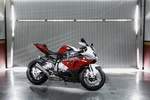 
Scarcely two years after the launch
in 2009, BMW Motorrad is now presenting the revised
model of this successful supersports bike, now with
many optimised details. The primary objectives were
even greater riding precision and agility, a punchier
power buildup, and a more sensitive response. The
revised model of the S 1000 RR has incorporated quite
a few feedback reports from national super stock races.
Like its predecessor, the new RR knows
no compromise, providing the highest level of sporting
character and riding dynamics. The convincing features
of the new S 1000 RR are its improved handling with
absolute riding stability, supreme engine performance
with perfect everyday practicality, and a resounding
dynamic performance. The highest level of active safety
is safeguarded by the most advanced brake system today
on the market, the BMW Motorrad Race ABS. When accelerating,
the rider is supported by the Dynamic Traction Control
system DTC. Both of these systems have been optimised
for the perfect interaction.
There have been no changes to the superior
engine power of 142 kW (193 hp) with a weight of only
204 kilograms including 90% fuel (206.5 weight with
Race ABS).
Concept with optimised riding
dynamics.
One of the primary objectives pursued
for the revised S 1000 RR model was to improve ridability
by boosting thrust and enhancing the linearity and
harmoniousness of the power and torque curves. The
reconfigured throttle improves overall response.
The new, optimised design raises response
sensitivity, tightens the twistgrip angle, and reduces
the twisting force.
Suspension with improved handling
and feedback.
The modifications to the new RR suspension
have been instrumental in boosting its riding dynamics.
For instance, the upside down fork and the spring
strut feature a new internal structure, providing
an even wider range of damping forces from comfort
to performance.
Overall Concept and Features.
Moreover, the suspension geometry has
been modified with new values for the steering head
angle, offset, position of the swing arm pivot, fork
projection, and spring strut length to yield even
better handling, steering accuracy, and feedback for
the new S 1000 RR. This has required modifications
to the main frame that also included enlarging the
cross sectional area of the intake air guide through
the steering head for greater air flow efficiency.
This package of suspension optimisations is rounded
off by an adjustable mechanical steering damper.
Instrument cluster with new
functions.
The engine speed display has been redesigned
for better readability. In addition, the display can
now be dimmed and provides more functions. For instance,
the lap timer can now present “Best lap in progress”,
and if required, “Speedwarning” can inform
the rider when he exceeds a particular speed.
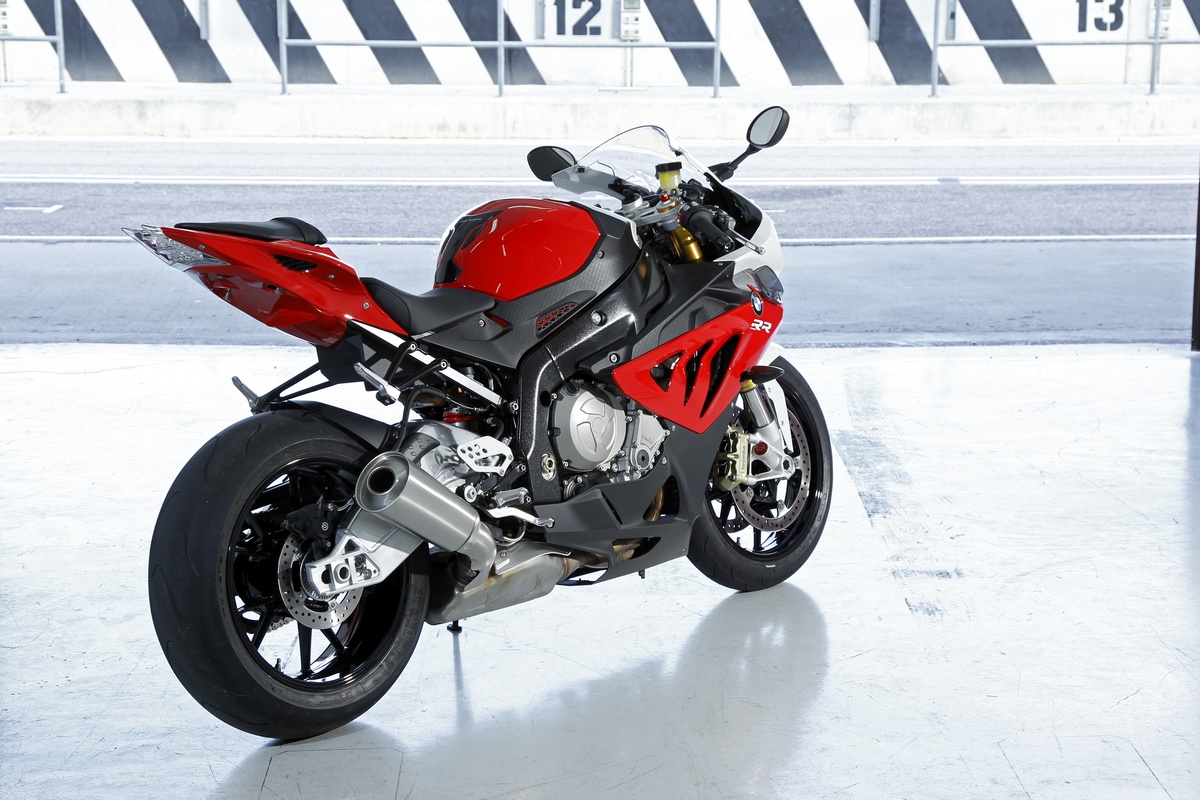
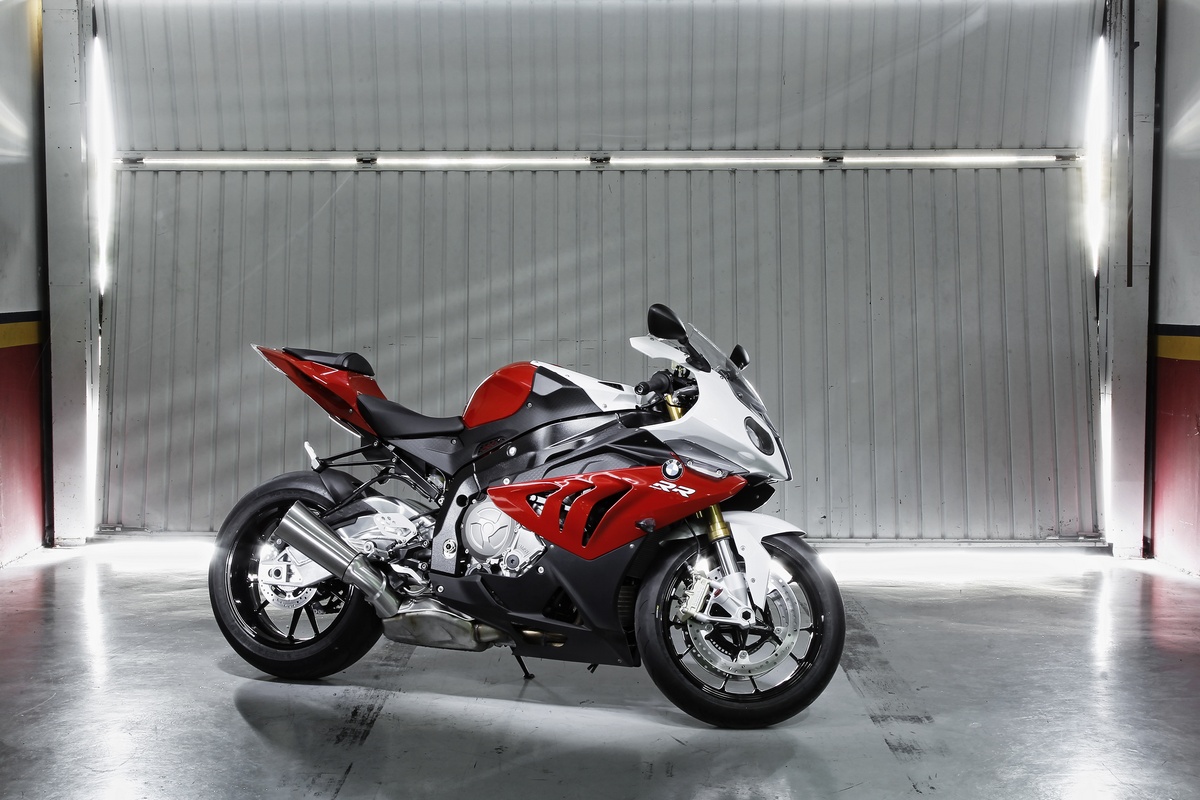
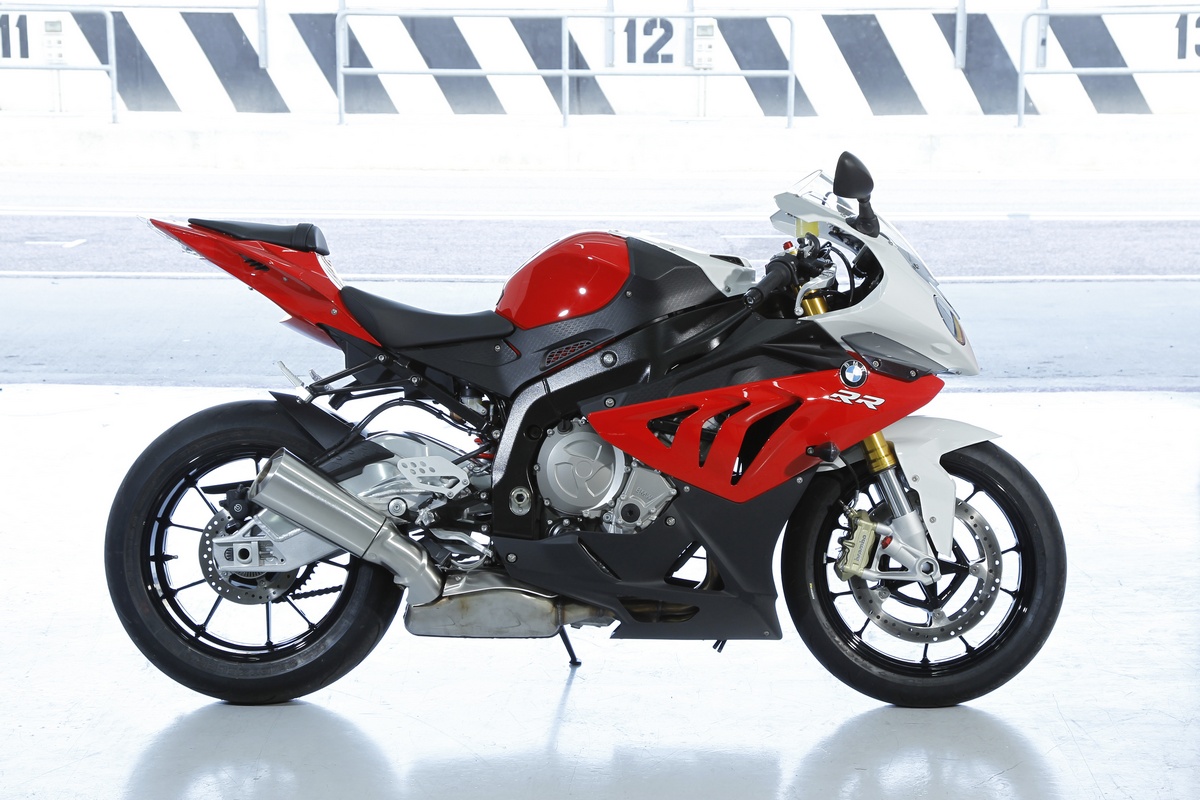
Refined design and new colours.
The new S 1000 RR not only benefits
from the advanced developments for the engine, suspension,
and cockpit. It has also gained yet another step ahead
in terms of design. The tail section now presents
a considerably leaner look. There have been some discrete
changes to the asymmetrical side panels, and the centre
airbox cover now sports side aperture grilles. On
the top part of the panels, a new, telling identifying
feature takes the form of two winglets that enhance
the aerodynamic qualities.
In the most sporting colour combination
of Racing red and Alpine white, the RR exudes power
and speed even when it is stationary, whereas plain
Bluefire lends it a decidedly extravagant look.
Sporty dynamics is conveyed by Sapphire
black metallic, and in BMW Motorrad Motorsport colours,
the new S 1000 RR testifies to its direct relationship
with BMW Motorrad Motorsport. The distinctive RR logo
has been slightly modified.
Additional visual accents take the
form of wheels painted in glossy black and the red
spring in the central strut. The matching swing arm
either presents an anodised coating or is kept in
black.
Also the ergonomics has been improved
in the form of new heel plates for the rider. The
stabilisers on the passenger footrests have now been
designed for a leaner look.
Extended range of optional
extra and special equipment.
For individualising the new S 1000
RR, BMW Motorrad is expanding its range of optional
extras and special equipment ex works with a number
of attractive features. Riders with a particularly
sporty bent can now equip their RR with an HP titanium
exhaust system (with or without ABE) or the HP race
data logger. Also the heated grips offering two levels
and fitted as optional extra can take the bite out
of the early morning run on the racetrack or longer
rides in cold weather.
The new features at a glance
- Optimised torque curve for improved ridability.
- Expansion from two to three performance curves
(one each for Rain and Sport modes and an additional
one for Race and Slick modes); Rain mode now 120
kW (163 hp).
- Reconfigured throttle for enhanced response (particularly
gentle and sensitive acceleration in Rain mode,
and immediately direct and spontaneous response
in Sport, Race, and Slick modes).
- Reduced twisting force and tighter twistgrip
angle.
- Smaller secondary ratio for boosted thrust.
- Refined tuning between Race ABS and Dynamic Traction
Control (DTC).
- Enlarged cross sectional area of the intake air
guide through the steering head for greater air
flow efficiency.
- Better handling, steering accuracy, and feedback.
- Revised spring elements for an even wider range
of damping forces.
- Suspension geometry modified with new values
for the steering head angle, offset, position of
the swing arm pivot, fork projection, and spring
strut length.
- New mechanical steering damper adjustable over
ten levels.
- Forged and milled fork bridge in a new design
and with a smaller offset.
- Revised design with a leaner tail section, redesigned
side panels, centre airbox cover with side aperture
grilles, and winglets.
- For new colour variants: plain Racing Red with
Alpine white, Bluefire, Sapphire black metallic,
BMW Motorrad Motorsport colours.
- New heel plates and leaner stabilisers on the
passenger footrests.
- Redesigned LCD engine speed display for better
readability and with five dimming levels.
- Instrument cluster with the new functions “Best
lap in progress” and “Speedwarning”;
deactivation of “Lamp” fault message
when headlamp or number plate carrier removed.
- Catalytic converters relocated, so no heat shield
necessary.
- Expansion to the optional extras and special
equipment ex works.
Just as before, the S 1000 RR sports the water cooled
four cylinder inline engine of solely 59.8 kg delivering
a top power output of 142 kW (193 hp) at 13,000 rpm
and a top engine speed of 14,200 rpm. The max torque
of 112 Nm is reached at 9750 rpm.
Reconfigured throttle for improved overall
response.
The primary objective in this next level of development
for the new RR was to target the powertrain for combining
the outstanding engine power with even greater ridability.
To this end, the throttle was first reconfigured in
engine control. To date, engine control consisted
of four individual throttle curves for each of the
Rain, Sport, Race, and Slick modes. For the new RR,
these have been reduced to two: a characteristic curve
for a particularly gentle and sensitive throttle in
Rain mode, and a second for immediately direct and
spontaneous response in the Sport, Race, and Slick
modes. Following this measure, the rider now no longer
needs to adjust to the constantly changing throttle
characteristics when switching frequently between
Sport, Race, and Slick modes. At the same time, this
also served to optimise the load change behaviour.
For particularly sensitive and fast regulation,
the throttle valve now features a supporting spring
with a low spring rate that reduces the actuating
force. And the twisting angle is now considerably
smaller on the new twistgrip throttle.
Optimised power and torque curves and lower
secondary ratio.
The higher priority objective of the best possible
ridability also included the optimisation of the power
and torque curves.
Three new power curves have been defined: one each
for the Rain and Sport modes and an additional one
for the Race and Slick modes (in contrast to earlier,
when there was one for the Rain mode and a second
for the Sport, Race and Slick modes). With an eye
to improving acceleration and thrust properties, we
have reduced the secondary ratio from its former 17:44
to its present 17:45.
Drivetrain.
In Rain mode, the new S 1000 RR now delivers 120
kW (163 hp), or 8 kW (11 hp) more than previously.
In Sport, Race, and Slick modes, the RR can still
deliver a top power output of 142 kW (193 hp), but
the power could be significantly raised especially
in the lower speed range between 5000 and 7500 rpm.
The result is essentially more linear and punchier
engine characteristics.
Also the torque curves have been redefined for the
purpose of improved ridability. So the new RR now
offers three different torque curves (previously two):
one each for the Rain and Sport modes and an additional
one for Race and Slick. All four modes benefit from
the greater harmony and linearity of the torque curve.
In addition, the new S 1000 RR delivers in all four
modes a considerably greater torque in the 5000–7500
rpm range. And particularly in Rain mode, the RR offers
considerably improved ridability. Whereas the torque
curve for the predecessor model virtually plateaued
from 4500 rpm, the new engine now revs up more freely,
and the curve rises to over 9000 rpm.
New combustion control in the overrun phase.
For uncompromising sporting characteristics with
treadless tyres on the racetrack, Slick mode has been
reconfigured for enhanced performance. This involved
a series of modifications to the characteristic map
for overrun phase combustion that effectively eliminated
permanent overrun fuel cutoff. Now, overrun phase
combustion control converts braking torque and engine
drag torque into an optimised retarding torque on
the rear wheel. The result is even greater riding
and directional stability during braking and turning.
Modified stainless steel exhaust system
and optimised intake air guide.
The all stainless steel exhaust system on the S
1000 RR features a redesigned catalytic converter
and front pipes. Fitted previously in the front pipes,
the catalytic cartridges are now integrated in the
front silencer. The interactions between the 20% larger
cross section of the intake air guide in the steering
head, the modified airbox, the new bellmouth geometry,
and modified engine application all served to increase
the torque as described above. These modifications
to the exhaust system now eliminate the need for the
heat shield installed previously on the oil sump.
Dynamic Traction Control (DTC) with enhanced
control performance.
When unveiled in 2009, the S 1000 RR was the first
series supersports bike in the world to combine Race
ABS with Dynamic Traction Control (DTC). The fact
that BMW Motorrad could implement these two technologies
with such ease proved to be so convincing that nearly
100% of the vehicles leaving production are fitted
with these two systems. Both systems have seen continued
optimisations in the course of technical advances.
Dynamic Traction Control (DTC) is a rider assist
system with a lean angle sensor that supports the
rider and provides him with that extra safety on roads
with compromised coefficients of friction. Following
the laws of physics, it regulates the transferred
drive torque, preventing the rear wheel from spinning
in nearly all situations.
For the new RR, modifications have been made to
reflect the new geometry, and wheelie detection has
been optimised. When wheelie detection engages, the
throttle valves now open much more gently. Moreover,
Dynamic Traction Control (DTC) has been optimised
for greater riding and control performance in the
Race and Slick modes.
The new DTC application is based on the BMW Race
Power Kit for better transparency during highly sporty
manoeuvres on the racetrack. The experienced rider
can therefore achieve faster lap times.
he S 1000 RR boasts innovative suspension technology
for the highest level of supersports performance.
The refinements made to the suspension have focused
particularly on enhancing agility, handling, and inclined
stability. In addition, the modifications lead to
greater suspension reserves and an enhanced feeling
for all situations and the threshold level. In short,
the new RR feels even lighter and more manoeuvrable,
but without sacrifice to riding stability.
New suspension geometry for better handling
and greater steering accuracy.
The new S 1000 RR features a modified frame with
a new steering head and tail section. Besides new
key figures for the geometry there is also a 20% larger
cross section of the intake air guide in the steering
head. The steering head angle is now 66° instead
of the earlier 66.1°. The wheelbase has now been
shortened by 9.3 mm to 1422.7 mm, and the afterrun
has been lengthened by 2.6 mm to 98.5 mm. The fork
bridge offset (front end) is now 2.5 mm shorter at
29.5 mm. In addition, the fork projection is 5 mm
shorter than in the predecessor model. These modifications
also included revisions to the steering head bearing
for a lower breakaway torque and hence greater steering
precision.
Redesigned spring elements for a wider range
of applications.
The new spring elements now allow a wider range
of suspension configurations between comfortable for
the road and tight for the racetrack. As before, the
suspension can be configured quickly and easily at
the clearly defined scales on the spring elements.
The new suspension adjustment now benefits riders
on both country roads and the racetrack. Internal
friction has been minimised on the fork and spring
strut. This has resulted in a considerably optimised
response, and the rider can now recognise the threshold
level with far greater ease.
Upside down fork with new inner workings.
To date, the upside down fork on the S 1000 RR was
fitted with bottom valve damping. Now featuring a
mid speed damping valve, the fork can now utilise
additional force at the working piston to build up
compression damping with greater speed and precision.
Also, the constant flow area has been reduced for
improved feedback from the front section. The piston
rod guide and the bearing concept have been revised
for a better, more transparent response.
New spring strut with revised damping.
The central spring strut now features a piston rod
whose diameter has been increased from 14 to 18 mm,
allowing more oil to flow through the low/mid speed
valve. Here too, the reduction to the constant flow
area increases the rate and precision of compression
damping buildup.
At the same time, the needle geometry has been modified
on both valves and now allows a highly linear buildup
of damping force over the whole range of settings.
All in all, these modifications to the buildup of
damping forces greatly enhance the effects and feelings
conveyed by each configuration.
A check valve installed in the piston rod counteracts
any negative effects on compression damping when the
rebound is being set.
Also the spring strut now presents a smaller constant
flow area for improved feedback.
Overall, the new RR offers considerably greater
ride comfort at the same time as greater feedback
and dynamics.
Race ABS with fine tuning and clear feedback.
The Race ABS on the S 1000 RR has been developed
specifically and exclusively for the requirements
on the supersports segment. For the new RR, it has
been adapted to the new suspension geometry and now
provides optimised control performance. An adaptive
learner, it recognises the requirements even of highly
experienced riders and detects diverse road conditions
and tyres.
By pressing the lever, the rider receives feedback
from the Race ABS as to when the traction limit will
be exceeded and the control range reached. The rider
feels controller feedback as a slight pulsing in the
brake levers.
New mechanical adjustable steering damper.
Unlike its predecessor, the RR now features a mechanical
steering damper adjustable over ten levels. This allows
the rider to choose the configuration best suited
to his riding style.
New coated swing arm and new swing arm bearing
bush.
Depending on the S 1000 RR paintwork, the rear wheel
swing arm is either anodised or provided with a black,
cathodic dip coating in lieu of the earlier Ostra
grey paint.
The swing arm bearing bush in the frame's tail section
is now secured in place with the one screw (instead
of two as in the predecessor model) at a position
4 mm higher for the full effect of the optimised suspension
geometry.
New heel plates.
The heel plates have been redesigned for the optimal
ergonomics. The stabilisers on the passenger footrests
have also been redesigned.
Fork bridge in a new design.
The forged and milled top fork bridge for the RR
now presents a new design as a visual constituent
of the cockpit always in view of the rider. The fork
bridge offset is now 2.5 mm shorter at 29.5 mm.
Redesigned rev counter and dimmable LCD
display.
The rev counter has been redesigned for better readability.
The LCD display now offers five dimming levels and
provides a number of additional interesting functions.
The display now presents a symbol representing the
new heated grips available as optional equipment ex
works.
“Best lap in progress” for the
racetrack.
The integrated lap timer now displays “Best
lap in progress”. When on the racetrack, the
rider can then see in real time (100 m intervals)
whether his present lap is faster or slower than his
fastest lap so far. This provides invaluable assistance
to riders with sporting ambitions. On every lap, the
current lap time is compared with the “Best
lap” time. When the current time is better,
the “Best lap in progress” (BLP) lamp
lights up green. When the time is slower, the BLP
lamp goes out.
“Speedwarning” function for
everyday support.
The function “Speedwarning” signals
to the rider when he exceeds a particular speed he
has defined. When the speed limit is exceeded, the
shift lamp lights up and the word “SPEED”
appears on the display.
Option for deactivating the lamp fault display.
For racing without a headlamp or number plate carrier
(direction indicators), the lamp fault display now
presents a deactivation option that disables this
fault symbol.
Electric and Electronics.
Highest dynamics, functionality, and unmistakability
in design.
The lightness the new S 1000 RR conveys when running
is also reflected in the look of greater dynamics
presented by this highly dedicated sports bike.
Immediately conspicuous is the far leaner tail section.
The centre airbox cover sports new side aperture grilles.
The asymmetrical side panels so characteristic of
the RR, with gills on the right and air outlet on
the left, have experienced some discreet refinements
in their design.
These are joined by the new air deflectors, the
so called winglets. These not only lend the new RR
its look of greater dynamics, but also boost its aerodynamics
by dissipating the wind pressure on hands and arms
at high speeds.
Body and design.
For even greater individualisation of the S 1000
RR, BMW Motorrad offers an extensive range of optional
accessories and optional equipment ex works. Special
equipment is delivered directly ex works and is integrated
in the production process. Special accessories are
installed at BMW Motorrad dealerships. The motorcycle
can therefore be fitted with options after it has
left the factory.
The equipment options already available for the
S 1000 RR have now been supplemented with the following.
Optional Extras.
- Heated grips with two levels.
Special equipment.
- HP titanium exhaust system street legal / non-street
legal.
- HP winglets of CRP.
- HP race data logger with GPS.
This offer is rounded off with the familiar, high
quality collection of rider´s gear, HP parts
and the HP race parts designed specifically for the
S 1000 RR.
- HP race power kit.
- HP race calibration kit.
- HP race cover kit.
- HP race shift pattern reversal.
- HP race footrest plate.
In addition, BMW Motorrad HP Race Support assists
all customers who want to use their RR at a higher
professional level on the racetrack.
Nww colour concept for sporty dynamics.
The colour concept for the S 1000 RR plays with
the contrasts presented by the black bridge frame,
the filigree wheels with glossy black paint, and the
stubby rear silencer of stainless steel. The look
of sporty dynamics is underscored by the two arm swinging
fork with anodised or black cathodic dip coating.
On all colour variants, the red spring in the central
strut provides an additional visual accent.
The new RR will be offered in four colour variants.
In the particularly sporty colour combination of Racing
red and Alpine white, the S 1000 RR exudes power and
speed even when it is stationary, whereas Bluefire
underscores the extravagance of the supersports bike.
Sporty dynamics is borne up by Sapphire black metallic,
and the BMW Motorrad Motorsport colours, which testifies
to the direct relationship with BMW Motorrad Motorsport.
|