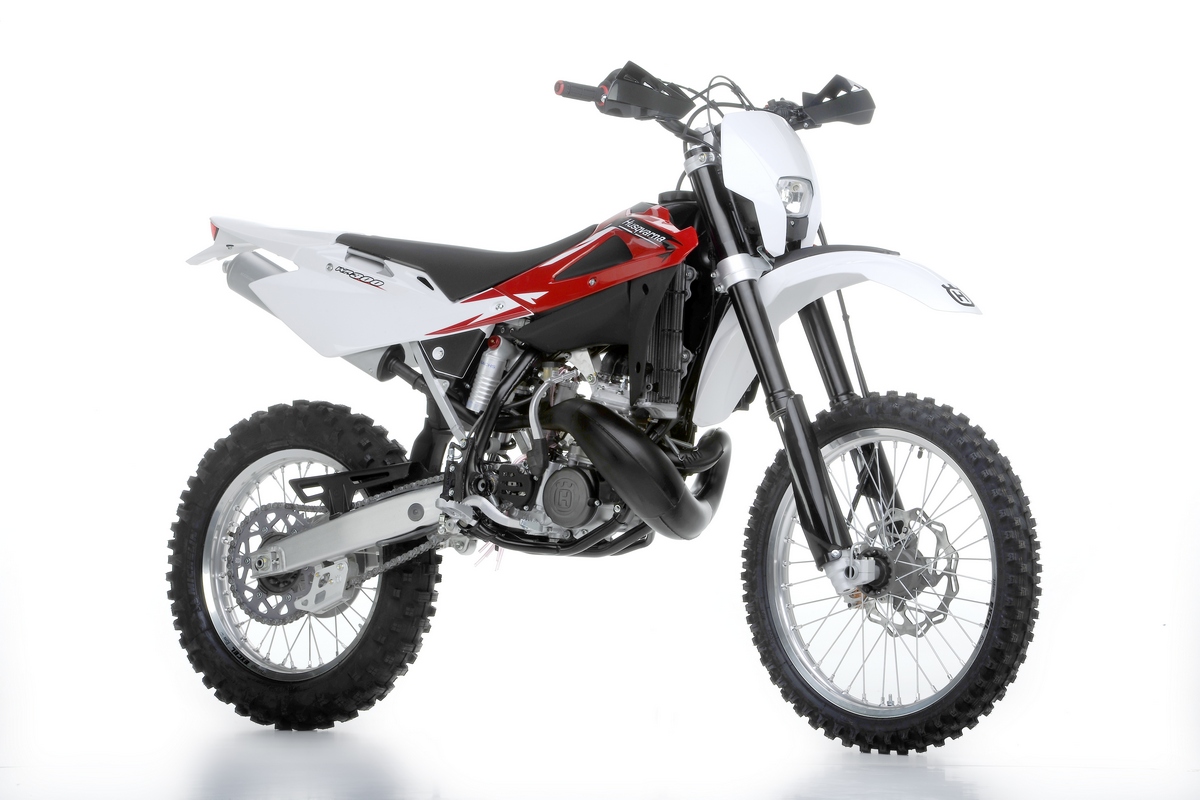
2012 Husqvarna WR300

WR300: the winning alternative!
One thing is sure: the Husqvarna CH
Racing Team riders like to go against the grain. The
WR300 is the bike of choice for Sebastien Guillaume.
A choice that might seem daring, but the French champion
– surrounded by big, powerful 500 cc four-stroke
machines - has for years taken his place on the podium
of the E3 class at the International Six Days Enduro
Championship. Guillaume likes his enduro tough, for
real men, and that means the Husqvarna WR300, designed
specifically on the basis of his experience at the
WEC. No longer is the Husqvarna "300" a
kitted up version of the WR250 but a fully developed
production bike in its own right. In 2008, when the
WR300 model launched it was immediately taken to heart
by professionals and fans alike.
Mechanical design in common with the 250
The WR300 and WR250 share the same mechanical design:
same steel tubing chassis, same swing arm and linkage,
same suspension. The 48mm Kayaba forks are adjustable
for both compression and rebound damping, the rear
shock is a Sachs. The 2012 version benefits from the
same updates common to the range: chassis painted
black, anodised silver Excel rims and redesigned graphics.
A new look for a bike that remains essentially the
same and technically unchanged, which says a lot about
how much work has already gone into fine tuning, testing
and finishing in the past. The WR300 and WR250 also
share a common layout and all component parts: Brembo
brakes - large diameter (260 mm) front daisy wheel
braking with twin piston floating caliper - while
the rear disc (220 mm) is floating and solid, as preferred
by Guillaume and other riders, to ensure maximum control
on muddy terrain.
Maximum two-stroke power
The new WR300 is the largest engine capacity 2-stroke
in the Husqvarna range, yet it has a surprisingly
linear and progressive power delivery. The engine
is powerful, always ready and responsive to minimum
throttle changes, but not so explosive as to be demanding
to the point that only a pro can handle it. In fact
it immediately became an alternative - light, manageable,
and more economic - for E3 class pro bikers and fans
of extreme enduro. The engine is closely based on
the crankcase of the WR250, but uses a larger bore
cylinder (72 mm, giving an engine capacity of 293.1
cc). All component parts are top of the range: Ducati
Energy digital ignition, Mikuni TMX38 carburettor
and V-Force reed valve are just the more obvious examples.
The five speed gearbox performs well across the engine
power range.
|