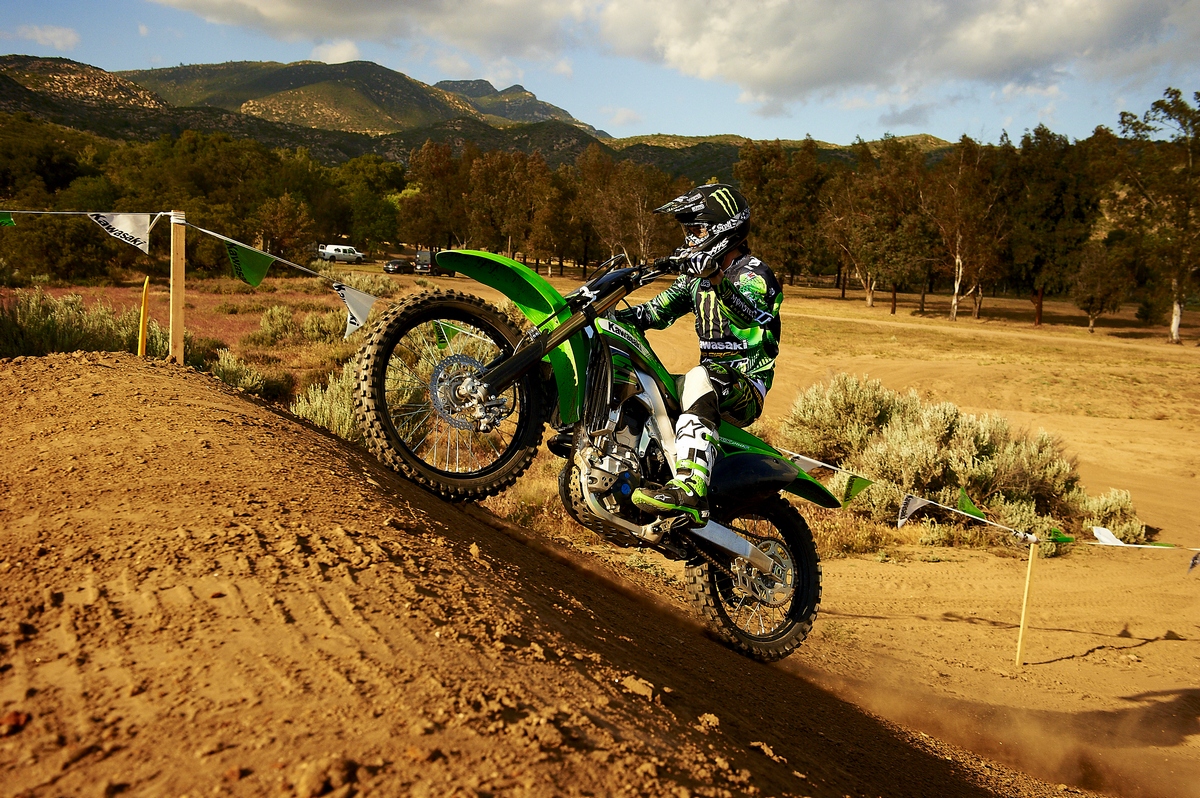
2012 Kawasaki KX250

RACE-PROVEN PERFORMANCE FOR
MID-EXPERT RIDERS: INTRODUCING THE “NEXT LEVEL”
OF POWER
The KX250F base package provides an
excellent platform for race-experienced riders to
win races in the top classes. Design of the highly
rigid aluminium frame, suspension components and settings
focuses on ensuring control is maintained during high-speed
riding – especially in straight lines –
to enable experienced racers to ride to their maximum
potential....and to deliver holeshot-winning performance
– a key factor that can mean the difference
between running up front and winning, or getting stuck
mid-pack – chassis geometry and the high-revving
4-stroke engine’s wide powerband were designed
to maximise rear wheel traction. A proven race-winner
and a potent track weapon in the hands of any serious
rider, the 12MY KX250F elevates its game with the
world’s first motocrosser with dual injection.
The new system takes the performance of the already
highly acclaimed engine to the next level, offering
power delivery gains that put the KX250F in a class
of its own.
KEY FEATURES
POWERFUL, HIGH-REVVING DUAL-INJECTION ENGINE WITH
FACTORY-STYLE TUNING
Tuned to best suit race-experienced
riders, the 249 cm3 liquid-cooled, 4-stroke single’s
wide powerband focuses on high-rpm performance and
extends way into the over-rev.
Highly acclaimed for its high output
and power delivery (thanks to race-inspired tuning
and parts like the
high-performance piston with bridged-box bottom),
the 2012 KX250F takes MX engine performance to the
next level with the world’s first dual injection
for motocrossers. The power increase – recognisable
by riders of any level – is complemented by
the smooth FI response of the 2011 model. Further
engine changes offer smoother shifting and increased
reliability.
The Next Level of Power: Dual
Injectors
Dual injectors – a world’s
first for motocrossers – give the KX250F a significant
increase in power. Power is greater at all revs, but
especially in the high-rpm range. Torque feeling is
reminiscent of a carburetted engine. The superb Kawasaki
FI response is unchanged.
The KX250F fuel injection system features
dual injectors: an injector downstream of the throttle
valve
(where injectors are located on standard FI systems),
and a second, upstream injector located close to the
airbox.
Unlike the dual injection found on supersport models
(where the upper injector operates only part-time,
providing additional fuel when necessary), the two
injectors in the KX250F fuel injection system have
different roles. The downstream injector is used to
ensure smooth, instant response while the upstream
injector is charged with providing power. As rpm and
throttle position increase, operation switches from
the
downstream injector to the upstream injector. (Depending
on whether in a low (1st, 2nd) or high (3rd, 4th,
5th) gear, the switch is gradual or almost instantaneous.)
The upstream injector’s greater distance from
the combustion chamber gives the fuel particles and
intake air more time to mix, as well as allowing the
mixture to cool before entering the combustion chamber,
both of which contribute to more efficient filling.
To ensure the high-rpm engine’s demand for a
high flow of gas in a short period is met, both injectors
feature larger holes than that used on the KX450F.
Although the upstream injector has a smaller body,
both are fine atomising injectors with 4 holes, dispersing
spray particles with a droplet size of 120 µm.
Fuel flow is
about 20% greater than on the KX450F.
The 43 mm throttle body makes use of
a progressive throttle link to deliver airflow in
much the same way as
would a FCR carburettor. Using two linked shafts,
the throttle body opens more quickly after the 3/8
open
position, delivering sharp response and excellent
power feeling.
Designed specifically for motocrossers, the fuel injection
system incorporates a small lightweight ECU and operates
without a battery to further eliminate unnecessary
weight. And of course, fuel injection eliminates the
need to adjust engine settings to suit track and climate
conditions.
Ensuring quick starting without a battery was a prime
directive for the KX fuel injection system. Using
only electricity generated by the kick starter, the
engine can be started with only three rotations of
the crankshaft. The system delivers electricity in
the following order:
1) ECU, 2) fuel pump, 3) injector.
With a warm engine, starting can be accomplished in
a single kick.
The compact, lightweight ECU, located just in front
of the steering head (behind the number plate), was
designed specifically for motocross use. To help cope
with the shocks and vibrations of motocross riding,
the fuel pump relay is built in to the ECU.
For 12MY, the ECU is slightly larger
to handle control of two injectors.
Fuel pump, located in the fuel tank, is a lightweight
aluminium construction. To ensure a stable fuel supply
during vigorous motocross riding, the fuel pump features
a unitised plastic fuel filter cover that wraps around
the inlet port and acts as a fuel trap. (Unitising
the filter cover, changing its material from rubber
to plastic
and eliminating the fuel return hose from the pressure
regulator contribute to weight reduction.)
Factory KX FI Calibration Kit
(option)
The KX FI Calibration Kit is the same
kit used by Kawasaki’s works teams in Europe
and the U.S. The kit enables expert riders to adjust
engine characteristics (by rewriting actual data maps)
to suit their preference, record riding data, and
analyse their riding data to further fine-tune their
settings.
The KX FI Calibration Kit contains
KX Racing software, an ECU controller, mounting brackets
and damper, harness and USB cable. In addition to
the kit, a PC and 12 V battery are all that is required.
While the kit is designed to satisfy
racers and expert riders, it is simple and hassle-free
to use:
- the ECU controller mounts behind
the number plate for easy access
- accessing the ECU is accomplished simply by connecting
to a PC via the ECU controller using a USB cable (no
additional switches are necessary)
- setting adjustments can be prepared in advance on
a PC, or done when connected to the ECU
- the kit’s user-interface is simple to understand
and easy to use
The KX FI Calibration Kit contains seven preset settings
that can be quickly and easily used to adjust the
ECU to suit track conditions. The provided settings
are shown below.
Richer fuel setting - fuelling 5% richer
than stock
Leaner fuel setting - fuelling 5% leaner than stock
Advanced ignition setting - ignition advanced 3o from
stock
Retarded ignition setting - ignition retarded 3o from
stock
Hard riding surface setting - ignition retarded, fuelling
richer
Soft riding surface setting - ignition retarded, fuelling
richer
Beginner setting - engine power suppressed: ignition
retarded, fuelling richer
For more advanced setting optimisation, the ECU maps
for volume of fuel injected (via the FI adjustment
window) and ignition timing (via the IG adjustment
window) can be adjusted for given throttle position
and rpm.
When connected to the ECU, the KX FI Calibration Kit
can be used to display the status of a running engine.
Information can be displayed in numeric form using
the Data Monitor, or in visual form using the various
display options offered by the Data Meter.
The KX FI Calibration Kit can also be used as a data
logger, recording up to six hours of data depending
on the number of parameters (engine rpm, angle of
throttle opening, etc) being recorded. After riding,
the riding
data can be viewed using the [Analyze] window. Parameters
to be recorded and displayed can be
selected independently.
The logged data can be lined up with the course layout
to check actual riding, enabling more efficient FI
settings to be determined. It also enables before-and-after
comparisons and comparisons between riders.
For more detailed information on use and functions
of the FI Calibration Kit, please refer to the KX
FI Calibration Kit Instruction Manual.
Smoother shifting
The following changes to the transmission
and gear change assembly contribute to smoother shifting.
Revised shift drum reduces the distance shift forks
need to travel to engage gears (5.3 mm - 5.0 mm),
resulting in smoother shifting.
Reduced surface roughness for the shift rods enables
the shift forks to slide more smoothly. (The rods
are also solid instead of hollow, contributing to
increased durability.)
Factory tuning and other performance-oriented engine
characteristics The engine was tuned such that the
torque curve follows the limit of running resistance
for as long as possible. (Unchecked, engine torque
can exceed this limit, resulting in wheel spin, which
does nothing to help forward momentum.)
Efforts were made to achieve the widest possible torque
band, so that traction efficiency would be maximised
for a greater part of the rev range.
High-performance piston, featuring the same design
used on our factory racers, contributes to improved
performance at all rpm. A short skirt, reinforced
external ribs and the industry’s only mass-production
use
of a bridged-box bottom, featuring fully flush internal
bracing, result in a lighter, stronger piston.
Tin plating and striation on the piston outer surface
ensure good wear resistance and oil retention for
minimal sliding friction.
Cylinder bores are nickel-plated, which offers stronger
plating adhesion to suit the increased engine power.
Lightweight titanium valves (IN: 31 mm; EX: 25 mm)
reduce reciprocating weight and offer high-rpm reliability.
The ultra-light valves have extremely thin valve stems
on par with those found in supersport machines. The
intake valves feature thicker heads for increased
strength and both intake and exhaust valves are formed
from a highly rigid, titanium material.
Spark plug protrudes deeply into the combustion chamber,
contributing to combustion efficiency.
Thicker crank web and stronger crank pin contribute
to increased reliability.
These changes increase inertial moment
2 kg.cm² but are offset by a new magneto rotor
with reduced moment (1 kg.cm2 lower). Total moment
is 1 kg.cm² greater.
Crank web design increases offsetting moment for a
high crankshaft balance factor. At approximately 60%,
the balance factor of the ’12 KX250F is on par
with our factory racers. The high balance factor contributes
to reduced engine vibration, smoother power delivery
and increased performance in the mid-high rpm range.
Connecting rod has a thicker stem, contributing to
greater connecting rod and big end bearing reliability.
32 mm thick, 117.8 mm wide radiators with wide fin
and tube pitch offer resistance to mud build-up while
maintain cooling performance. The radiators are strong
enough that the reinforcing brackets could be eliminated,
resulting in lower overall weight.
Sprocket-style chain drive roller helps smooth engine
braking by reducing the effect of driveline lash when
the rider gets off the gas quickly and play in the
lower side of the chain suddenly tightens. The additional
control facilitates corner entry.
HIGH-SPEED CHASSIS WITH FACTORY-STYLE COMPONENTS
AND TUNING
The KX250F’s slim aluminium perimeter
frame is a lightweight construction composed of forged,
extruded and cast parts. Chassis balance and settings
were all set to suit race-experienced riders. The
centre of gravity and key dimensions (swingarm pivot,
output sprocket and rear axle locations) were chosen
so that the rear
tyre would drive the bike forward (instead of causing
it to squat). Acclaimed for its high-speed stability,
the chassis is complemented by its Separate Function
front Fork (SFF), which offers greatly reduced friction
that contributes to increased riding comfort and improved
suspension performance. For 2012, changes to suspension
settings result in greater rear wheel traction, better
front fork top-out resistance and firmer rear
suspension feel.
Superior rear-wheel traction
The New Uni-Trak rear suspension system
mounts the suspension arm below the swingarm, allowing
a longer rear suspension stroke. The longer stroke
in turn allows more precise rear suspension tuning.
Extensive rider testing was conducted to determine
the ideal linkage ratios and rear shock absorber damping
settings to achieve maximum rear wheel traction.
Rear suspension tie rod arms have less rigidity, resulting
in a smooth suspension action with good
bottoming resistance that contributes to increased
rear wheel traction.
Race-ready suspension: Separate Function front
Fork
The KX250F is the only mass-production
motocrosser to feature Showa’s Separate Function
front
Fork (SFF), which separates damping and shock absorption
duties:
Left fork tube: damping assembly
Right fork tube: spring
The configuration offers both smooth
action and firm damping performance – a combination
difficult to achieve with a conventional fork.
With only one spring, the friction
generated between the spring(s) and fork inner tube(s)
is greatly reduced (approximately 25% less), resulting
in extremely smooth action throughout the fork stroke.
Being able to use a larger damper piston not only
enables smoother action, it also makes firm damping
performance possible.
Removing the damper assembly from the right fork tube
frees up space for a preload adjuster. Having a preload
adjuster greater simplifies the task of setting fork
preload or front height.
(With a conventional fork, only the
rear could be adjusted easily; adjusting the front
required fork tubes to be disassembled and the use
of collars and special tools. With SFF, both the front
and rear preload/height can be set quickly and easily.)
In addition to preload adjustment,
the racer-friendly SFF also facilitates other maintenance
chores like adjusting damping and changing springs.
SFF offers improved left/right balance,
which greatly enhances handling. Locating the heavy
spring in the right tube (and fine-tuning the left
and right tube strength) better offsets the previously
unbalanced weight of the brake caliper and disc on
the left side.
A restrictor added on the damper assembly side and
a joint rod comp added on the spring side ensure that
natural character is maintained. Placement of the
restrictor can be used to change damping characteristics;
it contributes to idealised damping character. The
joint rod comp ensures even left/right damping force
and contributes to ideal fork rigidity.
Stiffer main spring optimises fork performance.
A longer top-out spring (with reduced
spring rate) allows it to operate over a greater range,
resulting in a more gentle feeling when the top-out
spring starts to work, as well as a reduced chance
of topping out.
A super-hard titanium coating on the outer surface
of the inner fork tubes reduces sliding friction (and
stiction) and improves action, contributing to the
smoother ride. The increased surface hardness of the
dark navy blue coating also helps to prevent scratches
and damage to the tubes.
(The KX250F is the only motocrosser
in its class to feature this race-ready coating standard.)
Friction-reducing Kashima Coat on the inside of the
fork outer tubes contributes to smoother suspension
action (especially at the initial part of the stroke)
and a better ride feel.
Race-ready rear suspension
Stiffer rear shock spring and revised
shock damping settings (revised piston rod end and
revised plug bolt result in narrower oil passageways)
result in smooth, steady shock action that offers
a firmer feel and
increased setting flexibility.
The rear shock features dual compression adjustability,
allowing high-speed and low-speed damping to be tuned
separately.
The rear shock also features the Kashima Coat on the
tank cylinder. The reduced friction smoothes suspension
action.
Factory-style and other race-oriented components
Among the KX250F’s numerous factory-style
components are its front and rear petal disc brakes.
In addition to helping reduce unsprung weight, the
wave shapes of the petal discs help clean the brake
pads for more efficient braking performance.
Rear caliper guard protects the caliper from damage
A factory-style Renthal (standard-type) aluminium
handlebar is standard equipment.
Rib-less rear hub and butted spokes reduced unsprung
weight.
Rims are coated in black alumite –
just like our factory racers.
Fork and rear shock adjusters have
a blue alumite finish like our U.S. factory racers.
Oil cap and the two plugs on the generator cover have
a blue finish, further contributing to the
KX250F’s factory styling.
Factory-style graphics complement the KX250F’s
highly tuned performance.
Rider interface
Designed with rider ergonomics in mind,
bodywork components offer the rider a slim interface,
the natural position making it even easier for racers
to go fast. Formed using a double-injection moulding
process, 2-tone shrouds contribute to the slim package.
2-tone side covers are also formed using a double-injection
moulding process. Like the shrouds they
contribute to the slim package. A hole in the right-side
cover helps cool the silencer.
The frame widens at the ankles to offer the rider
better grip and narrows near the bend below the seat
to allow a slim riding position.
The seat uses a slip-resistant top surface for good
grip when seated and smooth sides for excellent rider
mobility.
Revised seat urethane helps maintain the original
shape longer.
Wide (front-to-rear) footpegs designed
to offer grip and superb feel at the pegs. The clutch
cable boot features a large quick adjuster, making
it easier for riders to adjust play in the clutch
cable.
Throttle grip has a unitised collar. The one-piece
unit provides additional stability during throttle
operation.
Lightweight short-length grips feature a pattern designed
to provide excellent grip.
Engine
On European models, pinched cut-outs
in the silencer chambers direct exhaust gases into
the glass-wool packing, helping to reduce exhaust
noise.
Chassis
The alloy swingarm uses a cast front
section, tapered hydroformed spars and forged chain
adjusters.
Large synthetic skid plate offers great protection
with minimum weight.
Other
Optional engine parts include magneto
rotors with different inertias (7.5, 8.5 kg.cm2; STD:
8.0 kg.cm2) and a 12T output sprocket (STD: 13T).
Optional chassis parts include handlebar holders for
a ø28.6 mm bar (STD: ø22.2 mm), aluminium
and steel rear sprockets (48-52T; STD: 50T), solid
petal brake rotors for wet races, and different springs
for the front fork (9.1, 9.5, 9.9 N/mm; STD: 9.5 N/mm)
and rear shock (49, 51,53, 55 N/mm; STD: 53 N/mm).
ADDITIONAL FEATURES
An FI indicator lamp (available as
an option) warns of any problem with the FI system.
|