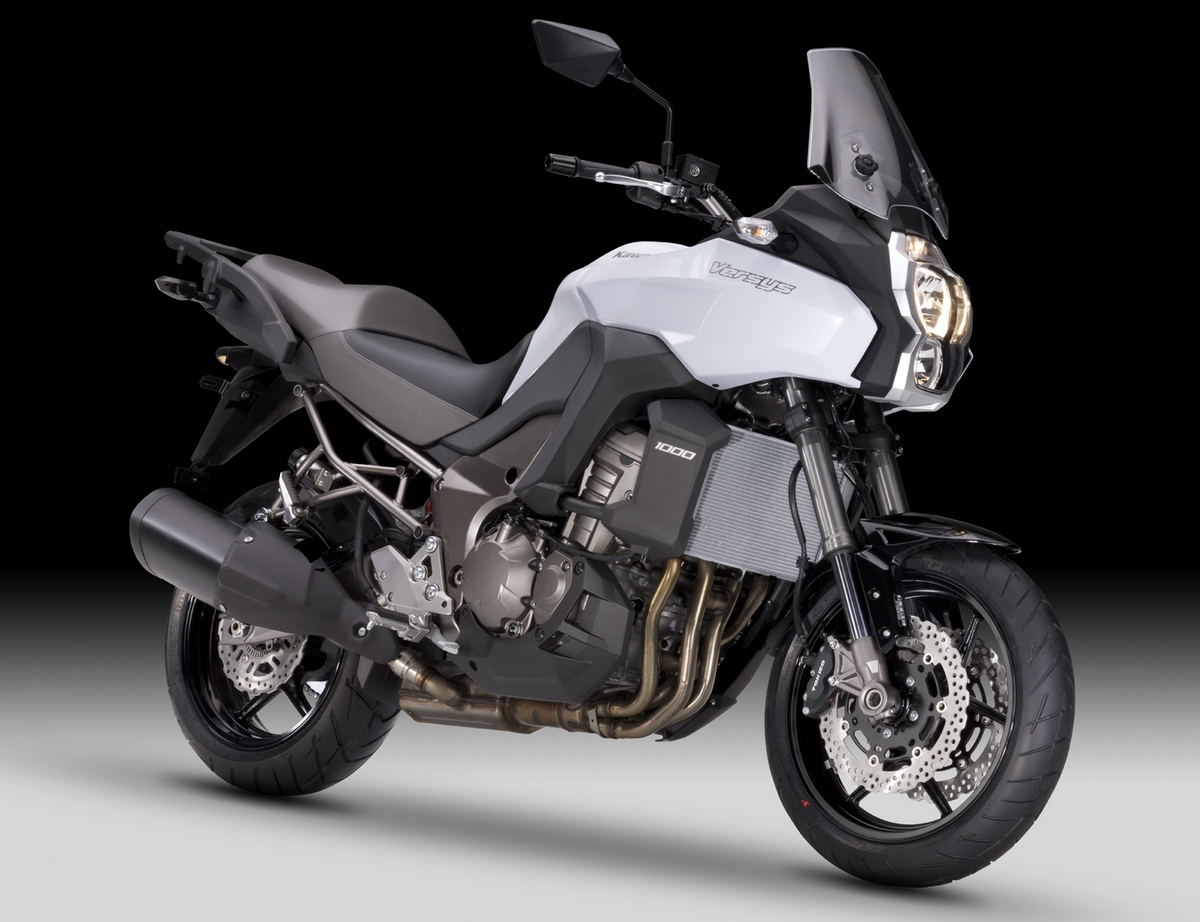
2012 Kawasaki Versys 1000

EXTENDING THE ANY-STREET PROMISE
TO THE LITRE-BIKE CLASS
Created as the long-awaited big brother
of Kawasaki’s mid-size any-road street surfer,
the new Versys 1000 is designed to enable the greatest
riding enjoyment in the widest variety of street riding
situations. Whether riding solo or two-up, around
the corner or around the globe, its unique combination
of a highly responsive In-Line Four engine tuned for
flexibility, and a nimble chassis fitted with dynamic
suspension will create a new reality for Kawasaki
riders in the multi-purpose category. With the Versys
1000, Kawasaki extends its any-street promise to the
litre-bike class.
“ANY-STREET ANY-TIME”
CHASSIS
When designing the Versys 1000, chassis
balance and suspension settings were all selected
to maximise rider enjoyment on the street. With its
superb control and feedback, the Versys 1000 offers
a high level of rider confidence in numerous street
riding situations and accommodates a variety of riding
styles. And because real world riding occurs on streets
that are often less than circuit smooth – road
imperfections (bumps, potholes) are far from rare,
and some streets are not even paved (cobblestone,
etc) – Kawasaki engineers chose long-travel
suspension to enable riders to carve corners with
aplomb.
While not designed for off-road use,
the long-travel suspension’s ability to cope
with less-than-perfect street conditions allows the
Versys 1000 to remain composed where bikes with stiffer,
sportier set-ups would need to back off the throttle.
The almost zen-like serenity is complemented by a
relaxed, upright riding position that offers a high
level of machine control as well as a good vantage
ahead. A nimble aluminium chassis and sporty 17”
wheels enable aggressive sport riding when the mood
suits.
Next-generation KYB 43 mm Inverted
Fork Fixing the cylinder inside the fork inner tube
allows a larger cylinder diameter to be achieved:
25 mm (compared to 20 mm on a conventional fork).
The larger piston
size contributes to a very composed suspension action.
Because the cylinder itself does not need to be as
rigid (fixing the head of the cylinder provides greater
rigidity), its walls could be made thinner (1.0 mm
vs 2.0 mm), resulting in a lighter fork (205 g lighter
per set).
The fork’s rebound (upper) and compression (lower)
dampers both use reverse damping-force assistance
(sub) valves in addition to standard check (main)
valves. These valves opposite the check valves ensure
that
when the fork direction changes (from compression
to rebound, or vice versa), oil flow in the reverse
direction is also controlled. Standard forks features
uni-directional check valves: controlling either rebound
or
compression damping. However, when oil flow reverses
direction, oil can flow through the valve unchecked
during the instant it takes for the check valve to
close completely, resulting in a temporary loss in
damping force. The reverse damping-force assistance
valves help to reduce this effect, enabling more consistent
damping performance, which translates to smoother
fork action.
Long travel of 150 mm contributes to
the fork’s excellent bump absorption and road
holding performance.
The fork is adjustable for rebound damping (right-side
only) and preload.
Fork outer tubes vary depending on the model colour:
they are gold on the GRY model, silver on the WHT.
Setting the caster angle at 27 degrees contributes
to a good balance of high-speed stability and a neutral
handling character that facilitates sporty street
riding.
Horizontal Back-link Rear Suspension Rear suspension
positions the shock unit and linkage above the swingarm.
This arrangement frees up space that would be taken
up by the lower linkage of a conventional Uni-Trak
suspension. This enables a larger pre-chamber, which
in turn allows the use of a shorter muffler, contributing
to mass centralisation.
The suspension is located far enough from the exhaust
that operation is not affected by heat.
The long-travel rear suspension has a stroke of 150
mm.
The high-spec shock unit features a
free piston that separates gas and oil for high-level,
stable performance.
A remote preload adjuster means changes to suit tandem
riding or luggage can be made quickly and
easily by hand. The rear shock is also adjustable
for rebound damping.
Relaxed, Upright Riding Position Wide, rigid-mount
handlebar offers easy control, especially for low-speed
manoeuvring. Positioned to offer a natural grip, it
allows the rider’s elbows to be slightly bent
when sitting
in a relaxed, upright stance.
The seat’s slim design and the knee grip characteristics
of the tank afford good freedom of movement, allowing
the riders to change sitting position should they
so choose. Thick urethane increases comfort and
contributes to a seat height that places the rider
in a position of fun controllability. The stepped
shape of
the seat also provides support for the rider when
accelerating.
Footpegs are positioned lower and further
forward (compared to the Z1000), contributing to a
spacious riding position.
Together, all these points result in a very natural,
relaxed position designed to offer the rider a high
level
of machine control. The upright riding position accommodates
a variety of riding styles (pushing it into corners,
in-line, or hanging-off), broadening the spectrum
of riding enjoyment and also offers a high level of
comfort, a great benefit for touring. This combination
of comfort and control is one of the things that make
the
Versys 1000 so much fun to ride.
When combined with the long-stroke suspension, the
upright riding position and higher seat height offer
a commanding view of the road ahead – especially
advantageous when navigating city traffic or winding
roads in the hills.
Aluminium Twin-tube Frame Aluminium twin-tube frame
design features frame beams that go over engine, allowing
a narrow construction that is easy to grip with the
knees.
Lightweight and highly rigid, the frame uses the engine
as a stressed member. The frame contributes to handling,
offering a firm, planted feeling, good stability and
light, nimble turning.
The frame is a 5-piece cast aluminium construction,
consisting of steering stem, left and right main frames,
and two cross pieces. The two main frame components
have open C-shaped cross sections and were die-cast
to ensure a smooth surface finish.
Reinforcing pipes join the engine hangers, offering
increased chassis rigidity to suit the long-suspension
frame configuration.
As much as possible welds were eliminated, contributing
to appearance.
The frame uses 4 engine mounts. All
engine mounts are rigid except the upper rear crankcase
mount, which is rubber. This, and using the engine
as a stressed member, is what gives the frame its
excellent handling characteristics.
Feeling from the engine is also transmitted more directly
to the rider.
Rear frame is steel pipe trellis unit
that enables the Versys 1000’s high payload.
Sporty 17” Wheels & Multi-purpose Tyres
Lightweight 6-spoke wheels measure
17” – ideal for sporty street riding.
Wheel colour varies with model colour: on GREY models
the wheels are magnesium coloured, on WHITE models
they are black.
Pirelli Scorpion Trail tyres are matched to the chassis,
offering excellent stability at highway speeds
and good grip on a variety of street surface conditions.
Triple Petal Disc Brakes with Latest-spec ABS
300 mm front petal discs gripped by
opposed 4-piston calipers offer strong stopping power
with good brake touch and feel.
At the rear a 250 mm petal disc is slowed by a single-piston
caliper.
ABS is a standard feature on all Versys 1000 models
The ABS unit is the D same ultra-compact
lightweight BOSCH unit used on the 2011 Ninja ZX-10R
– the
world’s smallest and lightest ABS unit. The
high-spec unit enables high-precision ABS control.
Like on the Ninja ZX-10R, front brake hydraulic pressure
is monitored to help control rear wheel lift.
True to the Versys 1000’s envisioned riding
environment, ABS settings are designed to facilitate
controlled braking in a variety of street riding situations.
IN-LINE FOUR EXHILARATION
To maximise the Versys 1000’s
fun factor, engineers wanted to provide the most exciting
engine possible. The engine needed to deliver more
than just performance figures. The engine they chose
was a 1,043 cm³ In-line Four, tuned for flexibility.
Superb throttle response, strong torque at all rpm
(especially in the low-mid range), and a seductive
intake howl ensure that every twist of the throttle
delivers a physical and aural sensation that riders
could easily find addictive.
Exciting Engine
Liquid-cooled, DOHC, 16-valve 1,043
cm3 In-line Four with a bore and stroke of 77.0 x
56.0 mm offers strong low-mid range torque with smooth
power delivery. Compared to the Z1000, the engine
delivers a stronger low-mid range with a slightly
reduced peak power. Both peak power and torque occur
at lower rpm than on the Z1000.
A number of key differences from the Z1000 engine
help achieve the lower-focused engine performance:
- Compression ratio is 10.3:1 (down
from 11.8:1) as a result of a new combustion chamber.
- IN/EX cam profiles have shorter duration
and reduced lift. Valves and springs are also unique
to the Versys 1000.
Downdraft throttle bodies allow intake air to travel
to the engine in the shortest possible distance, contributing
to performance. While downdraft throttle bodies often
use short intake funnels to maximise high-rpm performance,
the Versys 1000’s are longer to offer the best
power characteristics for street riding excitement.
Throttle bore is ø38 mm, chosen for low-mid
range response.
Oval sub-throttles are used to deliver
extremely smooth response. The oval sub-throttles
also help keep the engine slim – important since
the throttle bodies are positioned between the rider’s
knees.
An intoxicating intake howl contributes to the engine
feel and tempts riders to twist the throttle just
to enjoy the aural sensation when accelerating.
Good over-rev characteristics mean that power does
not drop off suddenly at high rpm.
Power delivery is quite linear and, thanks to FI settings,
response is both quick and silky smooth. Both characteristics
facilitate control (especially for low-rpm manoeuvres
or when rolling the throttle back on) and contribute
to sport riding potential.
Flexible engine character means the Versys 1000 will
be just as happy cruising along at low-rpm as it is
being ridden more aggressively in the mid-high rpm
range.
A secondary balancer, driven off a gear on the 6th
web of the crankshaft, eliminates excess vibration.
Of course, a certain amount of engine vibration was
desired as part of the bike’s character (vibration
contributes to the feeling of acceleration, increasing
linearly with rpm), so vibration was not totally eliminated.
Exhaust System
Large, oval-shaped connector pipes
join exhaust headers 1-4 and 2-3, contributing to
better performance at
all rpm. The reduced exhaust resistance results in
an ideal exhaust flow.
Under-engine pre-chamber contributes to a more centralised
mass by enabling a smaller-volume silencer.
Single side muffler offers lower weight than twin
mufflers.
3-way catalysers in the exhaust collector and pre-chamber
ensure strict emissions regulations are met.
Gearing
Gear ratios were chosen to accommodate
a wide range of riding situations, including sport
riding, highway cruising, and riding fully loaded
with passenger and luggage.
Compared to the Z1000, 1st and 2nd gears feel shorter
(the shorter gearing facilitates moving off from a
stop when fully loaded), while 3rd-6th gears are longer
(ratios selected to enable sport riding as well as
relaxed highway cruising).
RIDE LONG. RIDE FAR.
In addition to the riding excitement
offered by the nimble chassis and exhilarating engine,
the Versys 1000 offers the comfort and carrying capacity
to allow riders to ride long and far. A highly comfortable
seat and good wind protection complement the relaxed
riding position, making it easy to spend a long time
in the saddle. Passenger comfort is also superb, so
riders can easily share the fun. A high payload and
accessory luggage let riders get away for more than
a day at a time. And a large-volume fuel tank and
great fuel
economy allow a greater range between fill-ups.
Rider & Passenger Comfort
Thickly padded seat (about double the
cushioning of the Z1000 seat) provides the comfort
to enable 1000+
kms in the saddle.
The rear seat has even deeper cushioning, and is probably
Kawasaki’s most comfortable passenger perch.
Seat leather material was carefully selected and a
great deal of effort was spent to ensure a good fit.
The front seat uses different material than the sides
and rear. A two-tone design is used on our Pearl Stardust
White models.
Spacious riding position is complemented by footpegs
with (hollow) rubber coatings. Footpeg brackets are
also rubber mounted to further dampen vibrations.
Ergonomic grab bars provide comfortable passenger
grips.
Lightweight clutch springs reduce lever effort, contributing
to reduced rider fatigue.
Wind Protection
Adjustable windscreen has a stepless
range of approximately 30 mm. Height can be adjusted
without tools (using two knobs on the front of the
screen) to suit rider preference.
Functional bodywork was designed to offer increased
wind protection. Complementing the windscreen,
voluminous front cowling sides and flared side fairings
help protect the rider’s legs, further contributing
to rider comfort.
High Payload & Carrying Capacity Robust steel
pipe rear frame enables the substantial payload of
220 kg –
plenty for carrying two passengers and luggage.
A lightweight resin-construction rear carrier (6 kg
maximum capacity) is fitted as standard equipment.
Accessory top-case (and mount) can be fitted. The
top case is rated for 3 kg. In addition to the top-case,
specially designed large-volume GIVI panniers are
available as accessories. Each pannier can hold a
full-face helmet and is rated for 5 kg. Top-case and
panniers can be used simultaneously.
Taillight and rear turn signals are positioned for
good visibility even when using the top-case and panniers.
Large under-seat storage space has room for compact
rain gear or other small items. Tool kit is affixed
to the
bottom of the seat.
Accessory Support
High capacity generator develops enough
electricity to power a 45 W accessory DC socket. The
DC socket can be used to power small electronic devices.
Large-volume Fuel Tank 21 L fuel tank contributes
to the Versys 1000’s touring potential. With
engine and transmission settings, range (calculated)
on one tank could be up to 250 miles.
New-design fuel gauge inside the fuel tank enables
a very precise estimation of remaining range. By displaying
an average reading, slopes do not affect the reading.
High Fuel Efficiency
Advanced ECU programming contributes to the Versys
1000’s high fuel efficiency. Careful adjustment
of fuel volume and ignition timing when speed is constant
improves fuel consumption without compromising driveability.
ADVANCED ELECTRONIC RIDING AIDS
The Versys 1000 is equipped with a
number of systems designed to offer additional rider
reassurance. KTRC (the same traction control system
featured on our supersport flagship, the 2012 ZZR1400)
and power mode can both be set to suit rider preference
and conditions.
3-Mode KTRC (Kawasaki TRaction Control)
Featuring the same system offered on the 2012 ZZR1400
flagship, the Versys 1000 KTRC system combines the
best elements of Kawasaki’s two traction control
systems, S-KTRC and KTRC. Three modes cover a wide
range of riding conditions, offering either enhanced
sport riding performance or the peace of mind to negotiate
slippery surfaces with confidence.
Riders can choose from three modes.
Modes 1 and 2 prioritise maximum forward acceleration
(like the S-KTRC system on the 2011 Ninja ZX-10R).
Mode 3 is similar to the KTRC system offered on the
2010 1400GTR ABS, providing rider reassurance by facilitating
smooth riding on slippery surfaces. Riders may also
elect to turn the system off.
Compared to the three modes offered by the Ninja ZX-10R’s
S-KTRC (which was designed to allow riders to enjoy
experimenting with various combinations of settings
as they tune their bike for particular corners on
the circuit), the effects of Modes 1, 2 and 3 are
much easier to distinguish and cover a much wider
range of
riding conditions.
In Modes 1 and 2, highly sophisticated programming
allows a degree of slip – a certain amount of
slip is required to maximise acceleration. The ideal
slip ratio varies according to conditions. The system
looks at a number of parameters to get an accurate
real-time picture of what is going on: front and rear
wheel speed
(slippage) and various engine, machine and rider input
parameters are monitored.
Using complex analysis, the system is able to predict
when traction conditions are about to become unfavourable.
By acting before slippage exceeds the range for optimal
traction, drops in power can be minimised, resulting
in ultra-smooth operation.
Conditions are confirmed every 5 milliseconds, and
control via ignition timing allows extremely quick
reaction.
In Mode 3 (the most intrusive) the same logic and
control as in Modes 1 and 2 is employed during normal
operation. However, when excessive rear wheel spin
is detected, Mode 3 switches to three-way control
– governing ignition timing, fuel delivery and
airflow (via the sub-throttles) – and engine
output is reduced to a level that allows the rear
wheel to regain grip. It is the control of the sub-throttles
that enables smooth operation. This fine control results
in a very natural feeling:
engagement is smooth, on/off transition
is smooth, and stability is maintained during extended
operation. (While the KTRC offered on the 1400GTR
purposely delayed intervention to let riders know
the rear wheel was spinning, intervention in Mode
3 is essentially delay-free.)
In Mode 3, KTRC effectively enables riders to negotiate
both short slippery patches (such as train tracks
or manhole covers) and extended stretches of bad road
(e.g. wet pavement, cobblestone, gravel, etc) without
worry. Wheel spin is also limited when starting on
a slippery surface.
The system is also able to distinguish between torque
wheelies, which are smooth, and sudden wheelies, which
can be dangerous. In Modes 1 and 2, torque wheelies
are allowed as long as acceptable acceleration is
maintained. Sudden wheelies trigger system intervention.
In Mode 3, all wheelies are prevented.
The system uses minimal hardware but complex software.
Apart from the engine ECU, the system relies on only
front and rear wheel speed sensors – which means
minimal additional weight (none, in the case of ABS
models, which already have wheel speed sensors).
By default, KTRC is always ON when the engine is started.
(The mode will be the same as when the engine was
turned off, or in Mode 1 if the system had been turned
off.) Riders must consciously turn the system off
(using the on/off button on the left grip).
Power Mode Selection
A choice of Full Power or Low Power
modes allows riders to set power delivery to suit
preference and
conditions. Low Power mode limits output to approximately
75% of Full Power and uses a milder throttle
response. Reduction of both power and throttle response
varies according to engine speed (rpm),
throttle position and gear position.
Combining the various KTRC and Power Mode options,
riders have eight combinations from which to choose.
For example, an experienced rider on dry pavement
might choose Full Power and KTRC Mode 1 for sport
riding. On a wet and/or slippery road surface, Low
Power and KTRC Mode 3 might be selected.
Each system can be set independently to best suit
rider skill/preference, riding location and road conditions.
Instrumentation
Tough-design multi-function instrumentation
includes an analogue-style tachometer and LCD with
speedometer, fuel gauge, odometer, clock, dual trip
meters, current and average fuel consumption, remaining
range, and external air temperature.
KTRC (3 modes + OFF), Power Mode (2 modes) and the
various LCD modes are all controlled using the multi-function
button located at the left handle.
The Economical Riding Indicator appears on the LCD
screen to indicate favourable fuel consumption. Paying
attention to conditions that result in the mark appearing
can assist riders to maximise their fuel efficiency.
This handy feature is active all the time, although
to be effective, the rider must ride in a gentle manner:
less than 6,000 rpm, less than 30% throttle, under
160 km/h.
|