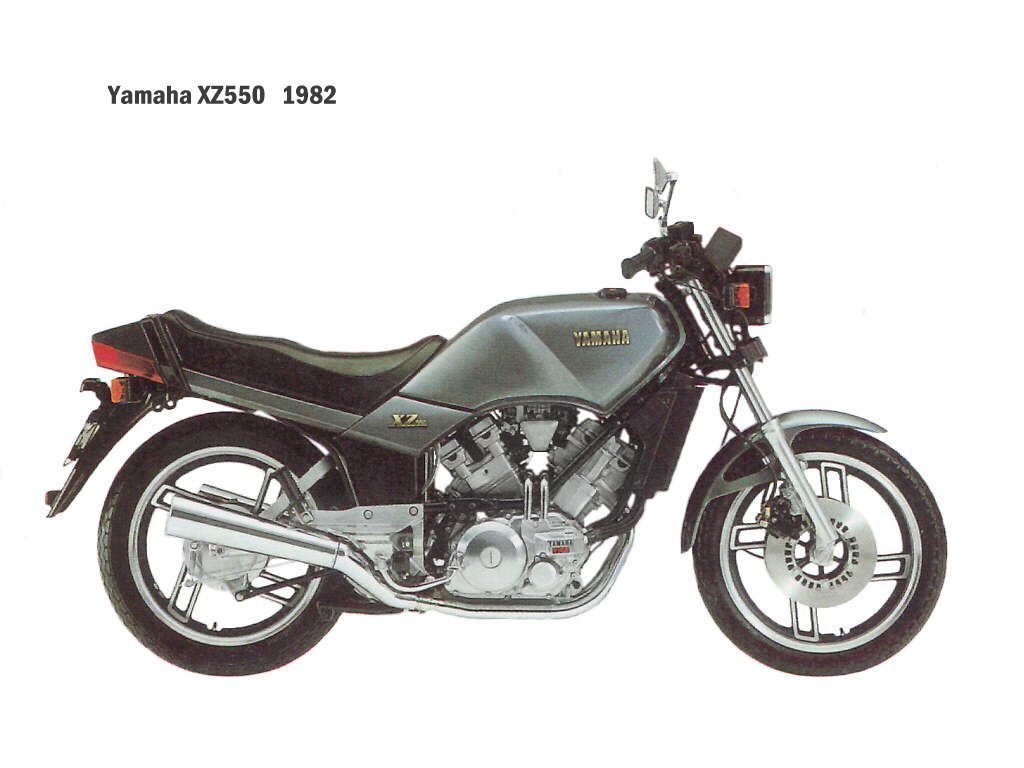
Yamaha XZ550S Road Test

Nov 89
"Me want first ride." I remember pleading.
When we did eventually get the bike on test, I was
glad I hadn't held my breath in anticipation. The
feeling was one of distinct anticlimax. But even
in late 1983, the idea of a v-twin middleweight shafty
still appealed, and the arrival of the XZ550S. with
a new colour scheme and integral fairing brought renewed
enthusiasm on my part.
The XZ engine is so full of technical innovation,
narrower than the larger, air-cooled versions. A narrower
angle, while keeping the overall engine dimensions
tight, is prone to producing plenty of primary vibrations.
But. clever people that they arc. Yamaha's engine
designers havecompen-sated for such bad manners by
placing the balance shaft, driven by two spur gears
with small shock absorbers, in front of the cases.
If, having digested this serving of the XZ engine's
techno pedigree, you're left feeling a touch bewildered,
what it means in rider terms is that the XZ550S will
pull up the 10,000 rpm blood in each of its five gears,
with virtually zero vibration. The finest testimony
to the bike's smooth ride arc the well-designed mirrors
which not only give excellent rear viewing, but rarely
blur at all. whether during hard acceleration or cruising.
Indeed, open road motoring for the 553cc engine is
effortless, slipping easily up to an indicated 100
mph. Mid-range muscle exertion is taken care of by
the famed Y1CS, Yamaha's system of catching the gases
in a chamber connected to the inlet tract then,
as the valve opens, sending them swirling in the cylinder,
resulting in improved mixing combustion and instant
With such an impressive array of attributes, you
could be forgiven for wondering if there's a bad apple
in the barrel. Unfortunately there is. The culprits
are a brace of Mikuni downdraft carburettors. These
36mm items accept fuel via a trioofjets and an accelerator
pump, then pass the juice through a highly —
and somewhat temperamentally-controlled set of bleeds
adjacent to a throttle butterfly designed to squirt
precise amounts of fuel into the system at pan throttle
openings. The basic XZ550 uses a flap in the air box
to control air flow to the carbs. By replacing the
flap with a diaphragm on the XZ550S. Yamaha has attempted
to ration the air to the hungry twin-choke carbs at
a steadier rate, to give snappier response when the
throttle is open.
Judging by the results, Yamaha would have been better
advised to redesign the entire system, 'cos no matter
what gear you're in (pulling a passing manoeuvre on
the motorway or lane-swapping in town), the response
to cracking open the throttle is about as snappy as
a month-old packet of crisps. After the initial hesitation,
progress is consistently rapid without being in the
neck-breaking urgent league, but, as with the original
XZ550, there's a flat spot between 4000 and 6000rpm.
For a middleweight with over 64 horses on tap,
you might expect a little more frenzied activity at
medium gallop speeds.
In-keeping with this laid-back power delivery, the
gearbox and shaft drive transmission don't react kindlv
to too much hurry up either. Under hard acceleration
the final drive clunks in protest then settles down
to a steady whine. Jumping from first to second on
the five speed box is as smooth as making love to
a roll of sandpaper, yet, by complete contrast, the
three higher ratios are decidedly slick in comparison,
whether changing up or down. Clutch action is light
and responsive, coping admirably with any amount of
stick you care to hand out.
|