BAT No. 2 Classic Bike
  
Among the early British pioneers, Bat
was perhaps the first to make a serious effort to
exploit the publicity available from racing and record-breaking.
But their impact was much deeper than this, for the
firm produced some of the most technically sophisticated
bikes of the era, setting standards that others were
soon to follow.
The company, based in Penge, South London, was founded
in 1902 by a Mr Batson, after whom the bikes were
named. The company's Model No. 1 was built using a
2 3/4hp De Dion engine and although it was basically
a sound product, poor sales resulted in the founder
selling the company within two years to Theodore Tessier,
a very able rider. From the outset, Bat motorcycles
showed their maker's desire to advance the state of
motorcycle engineering, dispensing with the pedalling
gear, fitting a clutch and patenting a fully sprung
suspension system. The saddle and footrests were carried
on the subframe, which was also suspended on springs.
Sales began to boom after Tessier took over, partly
because of the quality of the products but also because
Tessier was a skilled publicist. Launching a single
cylinder 3 1/2hp model in his first year, he set about
racking up a score of over two hundred wins and speed
records. V-twin bikes using engines supplied by the
Tottenham firm JAP followed with 650, 770, 964 and
980cc engines also fitted. Tessier rode a Bat in the
very first Isle of Man TT in 1907 and although it
failed to place, the next year's Bat entrant W H Bashall
took a second in the twin-cylinder class. Bashall
also scored the lap record of 42.25mph. Two years
later, in 1910, H H Bowen upped this to 53.15mph -
but although Bats were regularly entered prior to
World War I, this would be the last time they entered
the TT record book. Reliability was probably their
great weakness for they were technically very competent
and of proven high performance.
The year 1911 saw the introduction of the mountain
section at the TT, in response to which manufacturers,
including Bat, offered a two-speed bike as an alternative
to the direct belt drive used previously. Both systems
were then used in parallel for two years.
By 1913, Bat machines had become more conventional.
The spring frame was dispensed with and models had
a combination of gearbox and belt drive to the rear
wheel. World War I then intervened and contrived to
dent Bat's fortunes over some machines supplied to
the Russian army, for which they were never paid.
This left Bat in a poor position to fully exploit
the post-war demand for cheap motorcycle transport.
Even so, Bat were in a much better position than
the fledgling Martinsyde company, which built its
first bikes in 1919, but foundered in 1923. Bat took
over the company and started to sell Bat-Martinsydes
for the next three years. Finally, underfunded and
in the face of too much competition, Bat itself succembed
to the inevitable in 1926, after almost 25 years in
which they helped to establish the motorcycle in its
modern-day form.
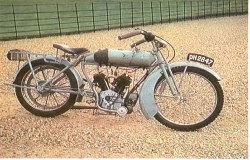
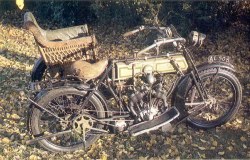
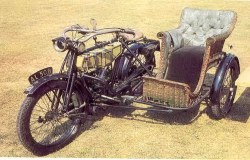
Bat No, 2 (1913)
- Engine - V-twin side-valve four-stroke
- Bore and Stroke - 72 x 78mm
- Capacity - 770cc
- Compression ratio - 5.5:1
- Top speed - 75mph
|