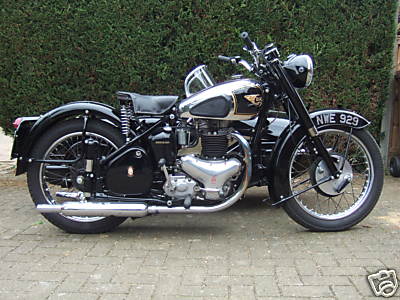
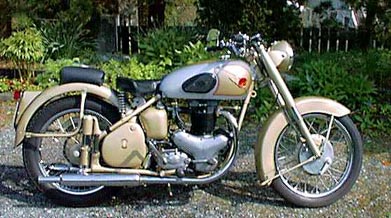
BSA A10 Golden Flash
  
BSA's post-war parallel twina owed an
obvious debt to Triumph's trend-setting Speed Twin
on the 1930s, but in every detail the design was a
true original. In its own way, BSA was as influential
as Triumph in making the layout such a staple of the
British motorcycle industry in the 1950s and into
the 1960s.
There was a further link with Triumph,
since some of the earliest design work on what would
become BSA's twin was carried out by Val Page, the
engineer responsible for the Triumph parallel twin,
the 650cc 6/1. More design studies were carried out
by Edward Turner, designed of the Speed Twin, during
some time spent at BSA in the war years . Most of
the detail, however, was the work of BSA chief designer
Herbert Perkins, who had been with the company for
many years. Near retirement age, he laid down the
basis of the 500cc BSA A7, which was launched in 1946.
Among notable differences from the Triumph
design were the use of a single camshaft with four
lobes, carried behind the engine, instead of separate
ones for exhaust and inlet.
Some minor problems with the transmission
and other features such as the lubrication were tackled
in the ensuing years to make the A7 into a competent
and reliable bike, though not one with a particularly
high performance.
Much of the work involved in refining
the design was carried out by Bert Hopwood. He soon
had a further brief when news of Triumph's plans for
a larger version of the twin leaked out; BSA decided
to follow suit, with a deadline of October 1949, the
Earls Court Show. Starting in May 1949, the design
work was carried out in around four weeks and the
model was in prototype from inside five months. The
rush job proved to be worth it as the A10 Golden Flash
was a success from the start, with few problems. The
Golden Flash name referred to the paint scheme, applied
overall, although black and chrome was offered as
an option. The new ironbarralled engine gave a useful
35bhp and the then new plunger suspension system added
to rider confort, although at the expense of handling
as the plunger wore.
Improvements and enhancements were made
on both the A7 and A10, including sports versions
with high-performance carburettors and tuned engines.
The first major change came in 1954, with a new frame
and swinging arm rear suspension. This necessitated
a change to the transmission. Alloy brake drums followed
early in 1956, with a corresponding improvement in
stopping power which was needed even more by the sports-tuned
Road Rocket, introduced that year and was good for
110mph.
The Golden Flash itself went on year by year earning
a reputation for dependability that endeared it to
a generation of riders. As fashions changed, so BSA
developed hte unit engined A65 model and the A10 was
phased out in 1961, although the more sporting Super
Rocket was to continue until 1963. That last year
saw the introduction of the definative sporting derivative,
the Rocket Gold Star. This used a tuned 650cc sports
engine in a Gold Star frame - a hybrid that worked
so well that it overshadowed BSA's own replacement
for the pre-unit 650cc twins, it was a fitting swan
song for a much loved model.
BSA A10 Golden Flash
- Years in production - 1950-61
- Engine - twin-cylinder overhead valve four-stroke
- Bore and Stroke - 70 x 84mm
- Capacity - 646cc
- Compression ratio - 6.5:1
- Power - 35bhp @ 4500rpm
- Gearbox - four-speed
- Weight - 395lb (plunger)
|