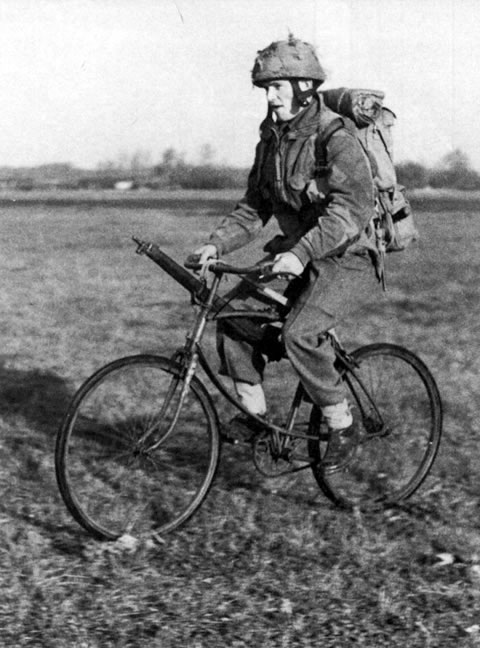
The BSA airborne
bicycle
 The
BSA airborne bicycle was used in battle, but
not as much as originally planned. The
BSA airborne bicycle was used in battle, but
not as much as originally planned.
The plan appears to have been that the bicycles
would be mass produced and make the airborne
soldiers mobile once they had landed. It was
better and faster than walking.
AIRBORNE
The British Airborne Forces used a few on operations,
but as larger vehicles such as the jeep were
available by June 1944, the bicycles were far
less important.
Some of these bicycles are reported to have
been used on the first airborne raid into Norway,
as some are reported to have been found in the
wreckage of the gliders.
A few of these bicycles appear in memoirs about
the battles of 1944-45 and a few show up in
photographs - but only a few. Most photographs
show them being used in training.
Ironically, when the airborne did use bicycles
in great numbers on the advance to Wismar in
Germany in 1945, they had to use captured bicycles!
COMMANDO
Photographic evidence shows that a few of these
bicycles were carried by Commandos on raids.
On D-Day, June 6, 1944, each Commando unit appears
to have had a bicycle platoon though the bicycles
seem to have been discarded within a few days.
INFANTRY
Ironically the greatest use of the BSA airborne
bicycle in action was by British and Canadian
infantry on the invasion Normandy, France (D-Day
1944 June 6) in the second wave. Some had been
used on the invasion of Sicily in 1943 by Canadian
infantry (Hastings and Prince Edward Regiment
"Hasty Pees" re: Farley Mowat).
ARMOUR
Photographic evidence shows that some Canadian
and British troops in armoured vehicles acquired
BSA airborne bicycles and hung them on their
vehicles, apparently for use as runabouts when
time and circumstances permitted, just as owners
of Recreation Vehicles (RVs) park the big beast
and use smaller vehicles to running about on
errands.
AIR FORCE
Some BSA airborne bicycles MAY have been taken
into combat zones by air force personnel as
bicycles are very useful items to have around
airfields
|