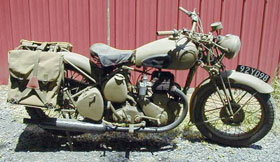
BSA M20
When World War 2 began, BSA was Britain's
major motorcyclle factory, with the proud boast that
'one in four is a BSA'. The firm had supplied the
armed forces in World War 1 and as befitted a company
that began as an armament manufacturer, had geared
up to produce munitions as early as 1935. They would
go on to become the biggest supplier of motorcycles
to the forces, in the unlikely form of their model
M20.
Originally launched in 1937, mainly
as a sidecar model, the M20 used a 500cc side-valve
engine in a heavy frame. BSA had been supplying the
War Office with a variety of models for evaluation
and in some cases purchase, since the late 1920s.
The company originally submitted the M20 in 1936,
only to see it fail, owing to heavy engine wear. Resubmitted
the next year, it passed and a small batch was purchased
in 1938.
The War Office then issued an official
policy that favoured the machines already in service,
whose reliability was well known, principally the
Norton 16H and M20. Large quantities of the BSA model
were bought. Heavy, bulky, slow and with limited ground
clearance, the M20 had far from an ideal specification
but it was rugged, generally reliable and was easily
repaired. Special fittings included a long, spiked
propstand for field use and a large headlamp, fitted
with a blackout mask. In 1942, a shortage of rubber
led to rubber hand grips being replaced with canvas
fittings and footrests with simple metal ribs. A large
air filter mounted on the tank and coupled to the
carburettor by a hose was fitted for use in climates
such as the African desert. As a result part of the
rear of the tank had to be cut away.
Purchased for despatch and escort duty,
the M20 served in many theatres of war. Over 125,000
were purchased by the armed forces. The finish consisted
largely of applying khaki paint livberally, including
the engine, tyres and even the saddle, with different
camouflage schemes in various countries. Vast numbers
of M20s were discharged at the end of hostilities
and after gaining a new coat of paint they were snapped
up by a transport-hungry public.
However, the model stayed in service
in smaller numbers for many years in some cases as
late as 1971. The vast quantities built mean that
ex-WD M20s are still in use in many parts of the world
and it is even possible to find that new spares are
still available. The civilian model was manufactured
until 1955, with its 600cc cousin the M21 soldering
on until 1963, the last side-valve built in Britain.
|