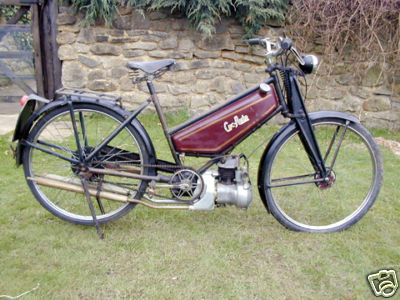
Cyc-Auto
Autocycles
The Cyc-Auto has an important place in
British motor cycle history because it
was the original autocycle. The road taxation
system in Britain after the Great War
did not encourage the production of really
lightweight machines like those produced
on the Continent. It was only after Philip
Snowden's Budget of 1931, which introduced
a tax concession for machines under 100cc,
that it became worthwhile to produce a
motorised bicycle. Mr Wallington Butt's
Cyc-Auto was the first on the scene.
Announced in March 1934, the Cyc-Auto
was the machine that started the autocycle
boom. It was, however, quite different
to all the subsequent makes of machines
that appeared on the market. The crankshaft
of the 50mm×50mm, 98cc, two-stroke
engine ran fore & aft and drove the
final drive chain by way of a worm &
wheel in the bottom bracket. Cyc-Auto
Limited built the machine in Abbey Road,
Park Royal, London NW10. The company later
moved to Bashley Road, Park Royal and
then to 107 Westbourne Grove, W2. Despite
being so different to other manufacturers
machines, it was nevertheless the starting
point of autocycle development and many
of its features were taken up by the Jones
prototype autocycle, which, in its turn,
led to the standard pattern of autocycle
that followed.
The first model, Model A, had a frame
that, apart from the oversize bottom bracket,
was virtually a standard bicycle frame.
The saddle was at normal bicycle height
and it had a normal bicycle chain-wheel:
features that indicate that it was designed
as a bicycle with motor assistance rather
than a motor cycle with pedal assistance.
The engine of the earliest models was
built by the Cyc-Auto company and had
a cast aluminium beehive silencer behind
the engine. The crank-case was enlarged
at the front to enclose a flywheel. There
was no clutch or lighting and the fuel
was carried in a small cylindrical tank
mounted behind the saddle on the front
of the carrier. Ignition was supplied
by a Wico magneto mounted ahead of the
engine and it had an ETC carburettor.
A dog-clutch allowed the engine to be
disconnected. In 1935 a second model,
Model B, joined the range. This was a
lady's model with an open frame. These
models were replaced by models C and D
in 1936. The main change was the alteration
of the frame geometry to lower the saddle.
The new frames were two inches [50mm]
lower than their predecessors. On the
gent's Model C this meant that the top
tube joined onto the headstock about half
way down and on both models the new design
permitted a riding position more suitable
for a powered machine. There were other
changes, including oil lubrication of
the worm & wheel instead of grease
and a Burgess silencer and tailpipe added
to the exhaust system. At the same time
there were also four sidecar versions
offered. The S1 had just the sidecar chassis,
the S2 had a commercial box carrier, S3
was a child's touring sidecar and S4 was
a child's sidecar of air-flow design.
All the sidecar models used a modified
form of the Model D lady's frame and Cyc-Auto's
own sidecar chassis. This was a banking
sidecar that could be quickly detached
without tools by removing the hinge pin.
The sidecar wheel could pivot with a castor
action to reduce tyre wear and to make
cornering easier. An adjustable damper
was provided to prevent the wheel from
wobbling on poor road surfaces. The S
models had special attachment points for
the side car and Cyc-Auto's literature
warned that Models C and D were unsuitable
for sidecars. Cyc-Auto also warned that
The fitting of any sidecar other than
those supplied by Cyc-Auto Ltd. invalidates
our guarantee.
A new engine was introduced for 1937
and the models using it were designated
CV and DV. The magneto was changed for
a flywheel type so the design of the crank-case
was also changed because it no longer
had to contain a separate flywheel. The
reason for the change was that the engines
were now being made by Villiers (hence
the V in the model names) who fitted their
own magneto rather than the Wico unit.
Despite the change in manufacturer, the
external appearance of the rest of the
engine was unchanged and the exhaust arrangement
remained the same. The same models continued
into 1938, but in that year the Cyc-Auto
company sold out to Scott Motors, Saltaire
Ltd. The Cyc-Auto Works Company's office
moved to 381 Uxbridge Road, London W3.
Scott produced its own engine for the
Cyc-Auto but for a while continued to
produce Villiers-powered machines as cheaper
models than the Scott- powered ones. Although
the Scott engine followed the same general
layout it was quite different in its detail
design. It still had an aluminium expansion
chamber for the exhaust but this now led
into two tail pipes. The Scott take-over
saw some long overdue additions to the
machine: a clutch and a rear stand. They
also introduced the option of a hub brake
on the front wheel, all previous models
having had a stirrup brake.
For 1939 there was a range of five models:
a gent's and a lady's, both available
in Standard and de Luxe versions, and
a tradesman's carrier model. All models
were powered by the Scott 98cc engine.
The fuel was carried in a 5 pint [2.8
litre] cylindrical tank that was mounted
behind the saddle. The standard models
still had a rigid front fork and stirrup
brake on the front wheel but the de Luxe
specification included a spring fork and
front hub brake.
The outbreak of World War II ended further
development for the duration. For 1948
there was only one model, which was basically
the same as the pre-war lady's Deluxe
except that the post war engine had its
twin exhausts emerging from the front
of the cylinder. This model continued
in production until 1958.
| Bike |
Image |
Description |
| 1941 Cyc-Auto with Scott
98cc engine |
 |
|
|
|