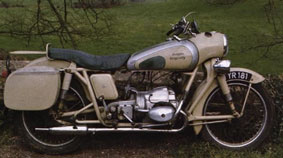
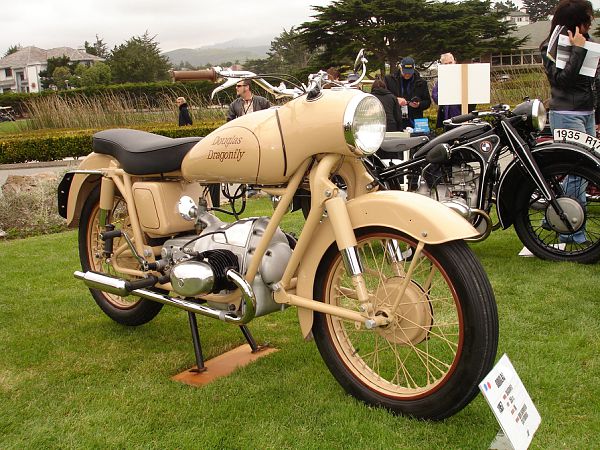
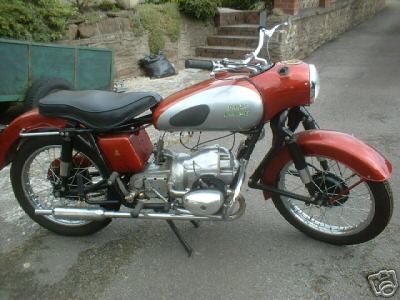
Douglas Dragonfly
Against a background of financial uncertainty,
the Douglas factory was always willing to rise to
the challenge, pioneering innovative designs and styling.
In 1954 they launched a sophisticated and original
looking design at the Earls Court show.
Developed during 1953, the model was
intended to supersede their rather dated range and
take the company into a new era. Many of its features
foreshadowed those of the slightly later BMW, which
went on to achieve considerable success.
Douglas' new engine design was a 350
based on their previous engine - although it also
borrowed heavily from an interesting 500cc prototype
shown in 1951. The engine had been strengthened internally
and cleaned up externally, with a streamlined appearance
and a crankcase that housed the electrics and other
ancillaries, while the gearbox was attached to the
rear. A single Amal Monobloc carburettor fed both
cylinders. Coil ignition and alternator electrics
were among the model's advanced features. Most of
the cycle parts were bought in. The frame was completely
new, made by the Reynolds Tube Company. A swinging
arm with twin dampers looked after the rear suspension,
while the front suspension used a design patented
by Midlands engineer Ernie Earles and built by Reynolds.
This used a long swinging arm, controlled by twin
dampers. A similar design was used by BMW on their
production bikesm while MV Agusta, among others, tried
it for racing.
The other main styling feature was the petrol tank
and light unit. Containing a massive 52 gallons, the
tank pressing continued forward of the steering head
to house the headlamp and instrument panel, which
did not turn with the steering. Originally called
the Dart, by the time of the show the model was called
the Dragonfly. Finished in a cream shade called light
stone with toning green panels or black and gold,
it was an attractive if unconventional machine.
Unfortunately, after its much-vaunted show launch,
Douglas was unable to offer quantity production for
another nine months. Despite a favourable road test
in April 1955, the price had gone up by almost 10%
by August and a less favourable road test followed.
Its handling could not be faulted, although the brakes
were rather poor. But ultimately the problem of the
Dragonfly came down to a mismatch of its capacity
and its presentation. With the styling and fittings
of a tourer, it has an engine that was pushed to top
75mph and cruised at considerably less. It found few
customers - only around 1500 were made - and Douglas'
shaky finances restricted both manufacturing and marketing.
Towards the end of 1956, the company was taken over
by the Westinghouse electrical group and motorcycle
production ended in March 1957.
Douglas Dragonfly
- Years in production - 1953-56
- Engine type - horizontally-opposed twin-cylinder
four stroke.
- Bore and Stroke - 60.8 x 60mm
- Capacity - 348cc
- Ignition - Coil with Miller alternator
- Carburettor - Amal Monobloc
- Weight - 365lb
- Top Speed - 75mph
|