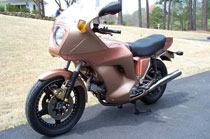
Hesketh Vampire

By the late 1970s it was obvious to all that the
British motorcycle industry had been in terminal decline
for some time. So when it leaked out that someone
was preparing to invest substantially in a completely
new model, it was greeted with enthusiasm from many
sides.
Tha man behind the machine was Lord Hesketh, a fully
fledged baron with an impressive estate in Northamptonshire,
In 1973 Hesketh, then aged just 22, ran a Formula
One car-racing team and in 1975 came forth in the
World Championship. Financially, however, things were
not going well and in 1974 Hesketh decided to develop
a motorcycle to capitalise on his racing record and
supplement the company's income.
Several ideas were floated, including buying the
near defunct Norton factory or making frame kits for
Japanese bikes. But motorcycle sales were enjoring
a boom and European twins were growing in popularity.
In 1977, Hesketh began talks with engine specialists
Weslake that would result in the development of the
company's own 1000cc V-twin, a classically British
type of engine that was proving to be a great success
for Ducati.
Unfortunately the project soon ran into trouble,
much of the trouble stemming from the conflicting
demands of Hesketh's largely car-based team of designers
with Weslake's own engineers. But restrictions on
the design meant there had to be many compromises.
Despite the problems, an enthusiastic press launch
went ahead in the spring of 1980. The bike was traditionally
styled, with a small cockpit fairing and handsomely
plated frame. Its layout was similar to the contemporary
Ducati 90 degree L-twin, although at over 500 lb,
its chunky looks were a world away from the little
Italian. As no existing factory was able to take on
quantity manufacture, Hesketh set up his own at Daventry
and the process of V1000 production began.
In 1981 press reports criticised the clunky gearchange,
engine noise, handling and price. Urgent revisions
were put in hand, but Hesketh was short of money and
only 100 or so were sold before the company was wound
up in August 1982.
The postscript was not long in following. Hesketh
and partners had formed a new firm, to sell a package
of modifications for the existing machines, at the
same time developing a new fully faired tourer, the
Vampire. But the gearbox faults, which included a
host of false neutrals, persisted, while the engine
was noisy and the fairing restricted the turning circle
without giving any adequate protection.
After a couple of years only a handful had been sold,
and there were further lay-offs. While members of
the enthusiastic team continued their own development
work, it was the end for Hesketh himself and yet another
last hope for the British industry.
|