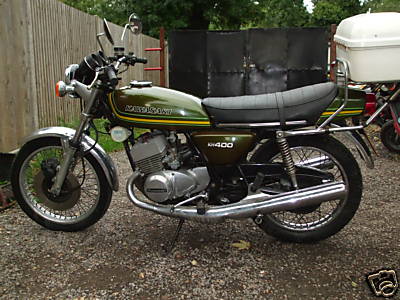
Kawasaki
KH400 Test
Motorcycle
Mechanics 1977

AS the legendary 500 triple writhes in its
final death throes, if it hasn't already sunk
from sight altogether, the 400 takes over as
Kawasaki's top of the line two-stroke. After
the evil violence of the first Mach 1, it does
seem a strange situation for big K to find themselves
in, but then the 400 is the only one left with
a hint of mean about it.
The exhaust note and the pick-up in the first
three gears bear witness to its pedigree but
much of the old character has been muted away.
After riding the KH400 it's hard not to think
of it as a lightweight, a machine which performs
like most people want their 250s to. It's equally
hard not to think of the H1's or even the really
malevolent H2 which paved the way for this survivor
of the legislative 70s. Kawasaki's shop manual
covers the KH and the S series — including
the early 250s and the S2 350, the first of
the slimmed down, domesticated triples. The
350 only appeared briefly in this country and
hasn't been seen since the 400 first arrived.
It's an odd state of development because the
350 was a much nicer bike. It was quicker, it
handled really well, fuel consumtion was no
worse and it had lots of good detail design.
I don't remember it being significantly noisier
or smokier than the 400, which makes it hard
to see why the slightly larger machine should
be preferred.
These reminiscences aren't entirely irrelevant,
if only as a basis for comparison. Briefly you
could sum the machines up by saying that the
KH400 is not quite as good as the RD400 while
the S2 was that much better than the Yamaha.
It isn't just subjective opinion either, Kawasaki
list the output of the S2 as 44hp at 8000 while
they only claim 36hp at 7000 for the 400, with
better claimed fuel consumption for the 350.
Other differences are that the 350 had a shorter
wheelbase by some 2 inches and weighed 30lb
less.
Although the 400 isn't as quick as the 350,
the handling is worse. Initially our model had
a tendency to fall into slow corners —
which was cured by playing around with the tyre
pressures — and would weave rather too
eagerly on long fast bends. The wide open spaces
at the track made this much more noticeable,
in the generally slower conditions on the roads
the 400 felt a lot better.
Originally, with heavy steering caused largely
by soft tyres, the triple was bad in slow bends
and really had to be driven through bends and
really had to be driven through, making pretty
hard work of it. Suspension ravel is quite short
and although the springs t-d damping give a
fairly comfortable ride, handling in general
felt sloppy and unprecise. After increasing
both pressures at the front and 2psi at the
rear, the fault condensed into a more definable
weave. This is exactly the same as our 500 racers
— each inprovement tightened up the weaving
until we were left with a reasonably firm feel
and a minor weave at high speed.
On the 400, it seemed that this is as far as
you can go without changing the swinging arm
— by Trying to twist the wheel in the
frame you can actually see the swing-arm flexing.
NGK B8s are recommended but because we run the
motor pretty hard on track and on the dyno we
asked for a set of B9s, just in case they were
needed. The day we picked the bike up we took
it to the track and it just wouldn't pull full
throttle — the plugs were a bright yellow.
Having just collected the bike, we didn't know
what fuel was in it (it turned out to be four-star)
so couldn't tell if the plugs were fuel-fouling
or just running too hot. Either way it seemed
safer to stick the B9s in — it then ran
perfectly up to peak revs in top and we left
the plugs in for the entire test period. Even
then, running it on 2-star fuel, in traffic
and so on, there was no sign of any gassing
up and cold-starting was invariably a second-prod
affair.
The latest 400 A3 uses GDI ignition with no
contact breakers. The only snag with cold starting
was the warm-up. The triple needed bursts of
choke tor two or three minutes after firing
up. In theory this is no problem because the
choke -•s a spring-loaded lever under
the left rwistgrip. In practice it is not easy
to work the choke, the clutch and hold out of
the garden gate the motor would splutter and
sulk, leaving the rider with a choice of grabbing
the clutch and coasting info the road with a
dead engine or jabbing the choke and risking
a sudden burst of revs which would propel the
bike forward with a great surge. The old S2
had a choke control positioned so that it could
be used with the clutch — unless my hands
have changed — and this retrograde development
is in many ways typical of the 400.
The torque peak is spread from 5000 to 8000,
which gives an ample spread of performance as
long as the gears and revs are used. If the
motor falls below 4000rpm it takes a long time
to respond to the throttle and build up speed.
With a normally seated rider it will comfortably
hold 80 to 90mph although above this speed the
force getting to the back wheel drops sharply
and makes top speed sensitive to wind, riding
position and so on. Wearing an oversuit and
sitting upright it was usually difficult to
coax the Kawasaki much above 90mph. In leathers,
getting flat on the tank, we ran it up to 101mph.
During the track test it didn't feel particularly
quick and the handling seemed indifferent. This
changed considerably when the 400 was used on
the road — it was much more pleasant to
ride, emitting the nice noises that only a triple
can make. The handling felt quicker and matched
the motor's smooth pick-up, the Kawasaki suddenly
became fun to ride.
Only a few minor flaws marred all this. Second
gear was a bit too low — or the top three
ratios a bit too high —which made acceleration
through the lower gears harsh and jerky. This
shows up clearly on our road-load "cascade"
curves, where second gear is set back from the
lines of the other gears.
There was also some vibration from the theoretically
smooth engine — felt mainly through the
handlebar at middle-rpm but enough to make the
left hand exhaust lose one of its retaining
nuts.
The front disc is powerful enough but developed
a squeal which steadily got worse as the test
progressed and the combined horn/headlamp flasher
was difficult to use.
Finally the fuel consumption averaged out at
less than 34mpg; it was easy to get below this
and hard to get much above it without a total
sacrifice of the 400's performance. Oil consumption
was better, on the whole the triple would give
more than 200mpp. The crippling aspect of the
fuel consumption was that the total range of
the bike was only about 100 miles, including
its reserve. Cruising at 70mph on a motorway
would mean a fuel stop every hour or so.
Despite these niggles there was enough character
about the KH400 to make it likeable, not very
practical, but likeable. In a way the fact that
the Kawasaki could ever be produced sums up
the nature of motorcycling; as a mode of transport
it doesn't score. But to a motorcyclist it still
has that hard to define character which is all
to do with romping along country lanes, swinging
through roundabouts and buzzing lively motors
up through their gears. This the Kawasaki does
very well indeed.
Please e-mail the webmaster if
you have a picture worth adding to our database,
e-mail: webmaster@motorbike-search-engine.co.uk
|