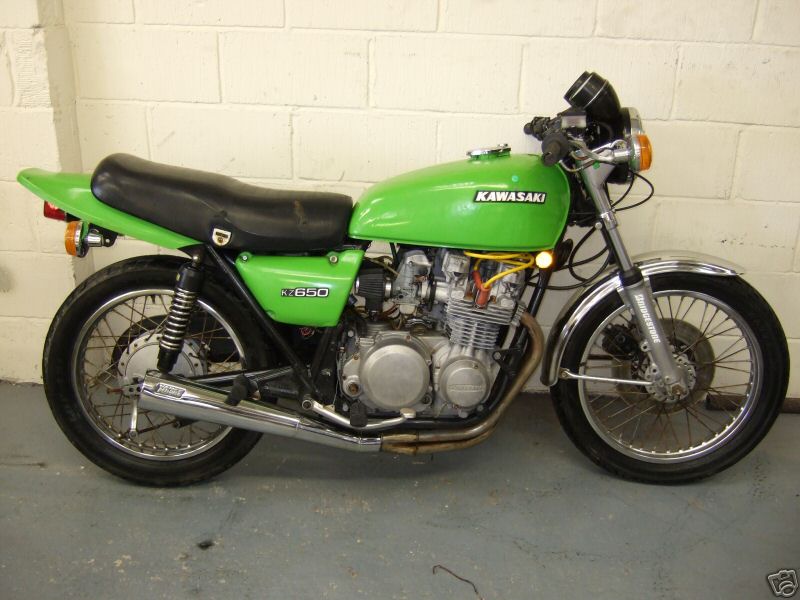
Kawasaki
Z650 Test
Motorcycle
Mechanics 1977

A little more than a year ago when the Z650
was first announced it was greeted as one of
the best bikes Kawasaki — or Japan —
had produced.
It wasn't quite as quick as the 900 and 1000cc
fours but it was lighter and generally easier
to handle. Only the 550 Honda had the same elusive
nurture of performance and rideability, in the
same price range, and the 650 was the more powerful
of the Since then more machines with similar
qualities have appeared, tending to overshadow
the original trendsetters. So it was nice to
find that the 650's attributes weren't merely
rose-tinted memories; the reality was as comforable
and sure-footed as ever.
Probably the first and most lasting impressions
of the Kawasaki are of its comfort and the relaxing
way in which the handling blends with the willing
motor. It goes easily and it goes fast. It also
has quite an amazing spread of power, on the
dyno we wound it down to 1700 rpm pulling full
throttle. From there it pulled on up to its
peak and carried on to 9600 rpm and the power
still didn't fall off.
The torque peaks at 7000 rpm, the power peaks
at 8000 and then stays up there giving almost
the same horsepower right through to 9500. And
the motor, a conventional DOHC four, with a
shell bearing crank, is unofficially claimed
to be reliable to well over 10,000 rpm. This
much is borne out by the long distance records
set by American Kawasaki 650s.
The wide spread of torque makes the choice
of gears less critical but the five-speed box
nevertheless gets the most possible from
the engine's output. As the load tails off in
each gear an upward shift takes you right on
to the peak load in the next gear.
Rapid performance and a smooth pick-up, particularly
when switching from overrun to power, make the
engine unit as impressive on the road as it
was in the test house. And when you need to
be careful on wet and greasy roads the same
characteristics make the Z650 easy to handle.
As soon as you sit on the Kawasaki it feels
comfortable, a bit big and heavy perhaps but
there is a reassuring firmness to it which stays
with the bike once it is moving. Starting is
more awkward than it need be because the starter
has a lock-out switch operated by the clutch,
and the clutch needs to be pulled in before
the starter will turn, even when the gearbox
is in neutral. As there is existing wiring to
light up the green neutral light it ought to
be easy to isolate the lockout switch when
the machine is out of gear. Our model's cold-starting
was a bit hit-or-miss. Sometimes it would fire
up straight away, sometimes it needed several
short bursts on the starter. Then it needed
quite a long warm-up period before the motor
would respond normally.
After our 24-hour test of the 650 last year,
and despite the foul weather conditions, we
could find very little wrong with the bike.
We thought maybe this only related to highspeed
track performance but the Kawasaki is just as
sweet under normal road conditions. There
were three or four complaints, the worst
of which was clutch judder when pulling away
quickly — this got worse during the test
until it prevented rapid take-offs altogether.
The front disc brake failed at low speed —
below 30 mph — during heavy rain; it was
OK above this speed or if the brake was used
frequently enough to keep it hot. In the dry
the brake was good, with plenty of feel to the
control although it didn't seem as powerful
as the optional double-disc. In all conditions
the rear drum brake was sensitive with just
enough power to make it usable without locking
up too easily.
A lot of the controllability of the Kawasaki
comes from its good riding position, particularly
the seat-to-footrest relationship. This lets
the rider take as much force as he wants through
the footrests, making control under acceleration
or over sudden bumps, a lot easier. And even
if you're taking all your weight through the
footrests it's still easy to operate both control
pedals.
The suspension gives a comfortable ride but
this has always been a weak point with big Kawasakis
and the 650 still has its problems. The
front forks with some 5.5 inches of movement
do a pretty good job, smoothing out the
bumps without any pitching and even coping with
heavy braking over bumpy surfaces.
The rear suspension with roughly the same spring
rate as the front, only has about three inches
of movement but the dampers just don't have
enough control over the springs. Deep into long
fast turns the Kawasaki would start to wallow,
and bumps in a corner would set up a weave as
the rear end started to move about.
In normal road conditions this weaving was
barely noticeable though, and generally the
handling was good with more than enough feel
to cope with wet roads.
In fact the overall character of the bike makes
it very easy to forgive the few faults it does
show. The motor is amply powerful but flexible,
giving exciting acceleration at the top end
without losing the ability to potter slowly
and silently at the other. The handling, ride
and braking are about as good as you can get
anywhere else; as a sports bike it is fun, as
a tourer it is more than capable and even as
a heavy traffic commuter it is still easy to
handle. Economy is not a particularly strong
point. If you use the performance the fuel consumption
drops into the mid-30s, but a typical crosscountry
run will give maybe 50 mpg and a range of about
160 miles before needing the tank's reserve.
The four-cylinder motor, with its four-into-two
exhausts follows conventional practice. Power
is taken off the centre of the crankshaft through
a HyVo chain to an idler shaft which drives
the clutch. Normally smooth in power delivery
and in general running, the 650 had a patch
of tingling vibration between 5000 and 6000
rpm, which is, unfortunately the speed at which
the engine spends most of its time.
With some 50 bhp getting to the back wheel,
road performance is about as rapid as you want
to make it. The gearing, shown by our graphs,
gives an ample reserve of power up to 100 mph
and more. With a practical top speed of around
115 mph, the go wrth all this, detail design
is on the good although the Kawasaki is let
down by underpowered lighting with its standard
headlamp. The alternator is the type first used
400 twin and makes a compromise the simplicity
of the permanent type and the controllable power
of a field coil. A field coil is mounted inside
a cast rotor carried on the lot the crankshaft.
Performance & specification
Track Conditions:
Wet, no wind. All engine tests run on a Heenan
Froude DPX3 chassis dynamometer fay Lines Engine
Development, School Lane, Baston, Lines.
- max speed.......................................
116 mph
- ss '/4-mile.................. 13.9 sec at
101 mph
- braking from 30 mph..............................
27ft
- fuel consumption;
- average over test..........................
50 mpg
- speedo error........... 5 mph fast at 70
mph
- ENGINE:
- DOHC in-line four, wet sump, four Mikuni
VM24SS carburettors, twin coil and cb ignition,
12V lighting from alternator and lOa-h battery.
- displacement....................................
652 cem
- bore x stroke...............................
(2x54 mm
- compression ratio..................................
9.5: t
- claimed output............ 64 hp at 8500
rpm
- TRANSMISSION
- inverted-tooth chain and spur primary
drive, multipiate clutch, five speed gearbox,
final drive by chain.
- primary reduction...................................
2.55
- (27/23 x 63/29)
- final reduction.........................................
2.63
- gearbox ratios: 2.33; 1.63; 1.27; 1.04 and
0.89
- CHASSIS:
- telescopic front fork with 5.5 inch stroke,
rear swing arm, five pre-load position dampers,
3.15 in. stroke. Hydraulic disc brake front,
sis drum brake rear.
- front tyre...........................................
3.25H 19
- rear tyre............................................
4.00H 18
- wheelbase.............................................
55.9 in
- castor.....................................................
63 deg
- trail........................................................
4.25 in
- overall length....................................
.87.4 in
- overall width......................................
33.5 in
- dry weight.............................................
465 tb
- test weight.............................................
488 Ib
- fuel tank................................................
3.7 gal
- oil tank................................................
.6 pints
- PARTS PRICES inc VAT
- front mudguard....................................
£19.45
- handlebar.................................................
£5.94
- speedo cable...........................................
£1.99
- cb points (two)......................................
£6.24
- pistons/ring set...................................
£54.39
- exhaust system, complete.................
£75.73
- list price...........................................
£1199.00
- warranty.............. 6 months or 6000
miles
|