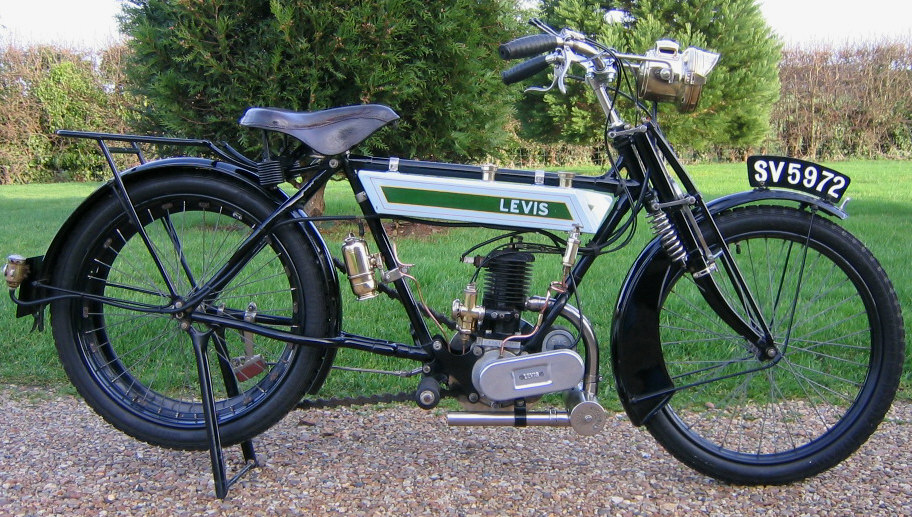
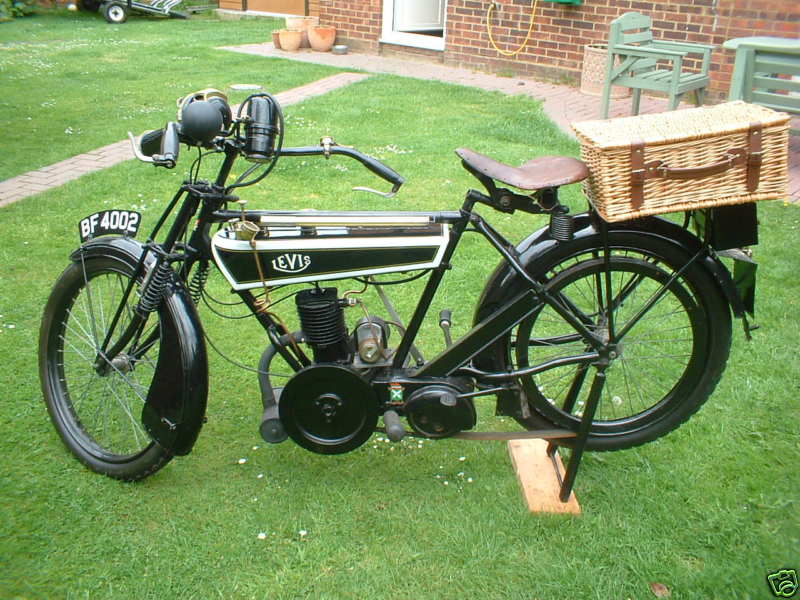
Levis Popular
Simple and cheap, Levis' lightweight
was typical of the bikes that provided everyday transport
for the masses in the years just after World War 1.
But with its quality of engineering, it was also perhaps
the best of its kind and the name Levis went on to
become a byword for two-stroke bikes that were reliable,
light and quick.
Levis motorcycles were made by Butterfields Ltd,
a Birmingham engineering firm started in 1906 by two
brothers, William and Artur Butterfield. In 1910,
they successfully tested their own two-stroke engine
and produced their first bike which was only a little
more substantial than a bicycle. With its 196cc two-stroke
engine and direct belt drive to the rear wheel, it
was capable of some 35mph. For their slogan, Butterfields
adopted the Latin phrase Levis et celer meaning
light and fast and took the name Levis for the name
of the motorcycles.
When the bike went into production as the Levis Model
1, the engine size had been increased to 269cc, there
was also a 211cc version, the Baby Levis. In the years
before World War 1, Butterfields went on to offer
a number of versions of these models, together with
a 349cc De-Luxe. In 1914, the 211cc Levis Popular
was introduced, along with a 175cc Levisette.
The war, of course, put paid to much further development,
although the firm experimented with engines for the
aircraft industry. But in the years immediately after
peace returned, there was an urgent need for cheap
transport, which Levis motorcycles stepped in to fill.
Levis had also begun racing and in 1920 entered 250cc
bikes in the Junior (350cc) TT, which included a newly
introduced trophy for bikes of 250cc or less in which
they took first, second and third.
Among the bikes that provided Levis' bread and butter,
the Levis Popular was perhaps the most important.
It had a simple construction with a light frame and
forks and a transmission consisting of a belt looped
around the engine pulley, driving the back wheel.
With no kickstart or gears, starting was by pushing
off, using a decompression lever to help the engine
turn over easily. A large external flywheel kept the
engine running evenly, although it might slow to a
slow or fast walking pace when pulling uphill. Brakes
were simple with a bicycle-type stirrup brake on the
front rim and a heel-operated rear brake.
But such simplicity did not mean crudeness. The Levis
was well engineered and simple to repair. It even
included such sophistication as separate oiling, at
a time when most two-strokes relied on a premixed
petrol. It was a formula that kept it in production
until 1924 - a run of over a decade - when more apparently
sophisticated models from both Levis and their rivals
had come and gone.
Levis Popular
- Years in production - 1914-24
- Engine - single-cylinder two-stroke with drip
feed lubrication
- Bore and Stroke - 62 x 70mm
- Capacity - 211cc
- Carburettor - Amac
- Tyres (front/rear) - 2.25in x 24in/2.25 x 24in
- Weight - 118lb
- Fuel consumption - 150mpg
- Top speed - 35mph
|