Mini Motor
The Mini Motor was one of the best-known of
the British clip-on engines, and was introduced
in Great Britain in 1949. Though rarely referred
to as such, the Instruction Book for the Mk
5 model (the last of them) describes it as a
Gearless Cycle Outboard.
The Trojan Minimotor was originally designed
by Vincent Piatti in 1946 as a unit to power
portable lathes; he saw its advantages as a
cycle-attachment and introduced it in Italy
as the Mini Motore.
Five models were produced in Britain at Trojan's
Croydon factory, from the Mark I in 1949 to
the Mark V in 1955. The improvement for 1951
was a decompressor added to the cylinder head
to aid both starting and stopping.
The engine sat above the bicycle rear wheel,
which it drove with a friction-roller on the
left-hand end of the crankshaft. On the right,
there was a Wipac flywheel magneto, and between
this and the roller, a crankcase with bobweight
flywheel and a horizontal iron barrel. An alloy
head closed this, and the capacity was 49.9
cc for the conventional two stroke unit. The
petrol tank went over the engine with the number
plate fitted behind it. A means of lifting the
roller clear of the tyre was provided .
The unit could drive a bicycle at 30 mph, which
was probably as fast as you'd want to go on
a normal cycle under normal road conditions.
In a postwar Britain with a shortage of new
vehicles, motorists found them ideal for short
trips, commuting to the station or the office,
or to the shops to fill up the front basket.
Some were even fitted to tandems, where they
proved equal to the task of hauling two people
along at 20mph.
| Bike |
Image |
Description |
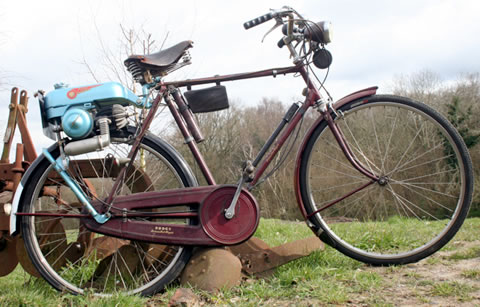
1949 Trojan Minimotor Mk 1
on Gents Rudge de Luxe Cycle |
 |
This is a rare early model of
the popular Mini Motor, registered
soon after they went on sale in
Great Britain. It is fitted to a
period Rudge Gents de Luxe cycle
in good condition with 4-speed dynohub.
|
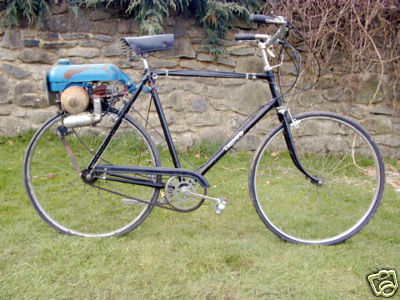
1954 Mini Motor |
 |
This Minmotor is fitted to a Triumph
bicycle. |
|
|