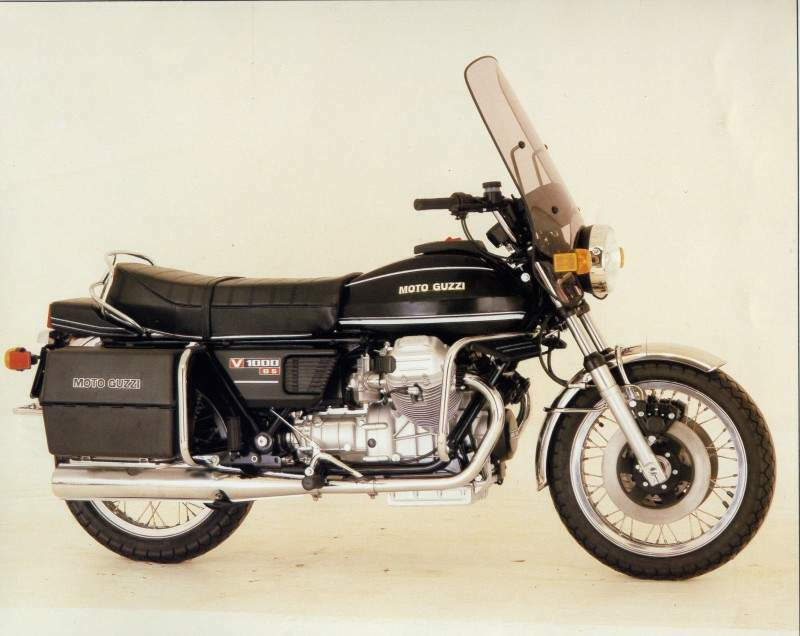
Moto Guzzi V1000 Automatic Test

Motorcycle Illustrated 1975
New experiences in motorcycling are rare. Extensions
of existing qualities are common enough, such as those
provided by last month's impressions of the Editor
on the Benelli "Six"; an undeniably fabulous
bike, but entirely conventional in every respect and
unlikely to be remembered by tomorrow's historians,
as much more than a magnificent piece of ostentation.
By conforming to existing standards, unless one assumes
that they have been broken by the adoption of two
extra cylinders, it slots in nicely with the rest
of the world's production roadsters, even though it
might well be at the head of the ever growing queue.
It could also be argued that even Honda's "Gold
Wing", crammed full of most of motorcycling's
most beneficial requisites, such as water cooling,
four horizontally opposed pistons and shaft drive,
etc, etc, is also part of the ordinary scene. If it
is not, then the logical conclusion must be that accommodation
of a magnitude of proven genre into a corporate
whole, warrants reclassification of the ultimate product.
As both John McDermott and I discovered during our
few hours jaunt in the Isle of Man during TT week,
the Gold Wing is a machine of unparalleled performance
style, but for its merits, it contributes nothing
towards the real advancement of either motorcycle
design or ride. It has merely improved, maybe to perfection,
who knows, existing mechanics.
How very different is the Moto Guzzi V1000. Less
sublte than the previously mentioned pair, its concept
is unique in motorcycling, because for the first time
a factory has admitted the weakness of the human partner
in the vitally close relationship of the machine and
its rider, and has attempted with staggering, first
time success, to place greater responsibility on the
motorcycle for the safety and convenience of its master.
The first hint of this arose during last month's
ride on the 'Guzzi 750 Sport when I discovered to
my chagrin that coupled brakes provided me with more
secure braking under all conditions than I could reliably
provide myself on the vast majority of occasions.
Witness John McDermott's concern over "his"
Benelli Six's braking power. More powerful undoubtedly
than the coupled brakes of the 'Guzzi Sport, but due
to purely inadequate reactions on his —
or mine or yours or anyone's part controlling the
fine balance between situation appraisal, applied
power and tyre adhesion — braking became a major
worry and must have in some way contributed to a partial
breakdown of that vital rapport, and thus have affected
other performance areas. Drop a pebble into a smooth
pool and watch the ripples spread, the fish start,
the reeds agitate.
Still within this fascinating circle of relationships,
consider the transmission. Although hastily dabbed
"automatic" in fact it is nothing of the
soft, this implying an involuntary change of gear
ratios, whereas power is actually transmitted hydraulically.
As loading is applied to the machine, whether it be
in the form of pillion passenger, hill or headwind,
so the fluid coupling encourages "slip"
between the engine and final drive relationship.
With only a modicum of common sense required to operate
the throttle control, the consequence is that a rider
is virtually relieved of the entire transmission and
engine speed coordination responsiblity, something
normally requiring a large proportion of his riding
concentration.
Until actually experienced, the freedom from constant
mental application normally required when riding is
difficult to envisage, but think of the implications
involved, both personally for the rider and also for
the rest of the manufacturers, all of whom are undoubtedly
taking great interest in the success or otherwise
of the V1000. In the first case, life on two wheels
becomes less fraught with potential disasters caused
by the inability to either absorb or react to the
vast quantity of stimuli present today. And in the
second, there's no doubt that the successful (in my
opinion) acceptance of the V1000 is going to
force other manufacturers' hands into following suit
by one means or another, but none by 'Guzzi's method
because I have no doubt at all of De Tomasso's patent
right over it. The new rumoured hydraulic drive Honda
is doubtless along these lines though.
Construction of the bike is simple enough, running
parallel to all big 'Guzzi traditions currently in
vogue. Frame is that developed by 'Guzzi immediately
after the introduction of the old 750 "Ambassador
in 1970 when, for a couple of years, the factory carried
out a pretty intensive production - cum - endurance
racing exercise in order to prepare the ground for
the planned new sportster. To the credit of the factory,
instead of carrying on with the original old touring
frame, good though it was, once the latest range was
introduced, it came complete with all the racing pedigree
of the competition machines behind it.
Accept that you might as well relax about high speed
stability, or at least your concern about it, because
to say that it amply covers whatever speed and power
the V1000 puts out is understating the situation
completely. To attempt to describe how well it held
a line would be to waste space, because I could not
fault it, and high speed scratching is not the job
the big twin was built for anyway.
Merely sitting on the thing evokes powerful suggestions
of cruising long highways under new suns with a girlfriend
of long standing up behind. You licking the dust from
your lips as you peer through your Polaroids for the
next pub along, she lounging back comfortably
into a great pile of untidily lashed, discarded riding
apparel. Both of you relaxed, almost wallowing in
the luxurious, undemanding ease of the last 200 non-stop
miles, and without a single ache or pain between you.
The best of it is that the first impression is no
dream because that's just the way it is.
Firing up gives the first hint of what's to come,
even on a cold morning, by the manner with which the
twin Dwell Orto carbs (but I would much have preferred
a single, constant vacuum instrument for its vastly
superior smooth operation) are equipped with starter
jets which do not increase engine speed.
As the twist grip is eased open, the reason for the
use of such a cold start device is obvious, for a
normal fast running choke would cause the hydraulic
drive to engage unless the standard flywheel clutch
is disengaged by the entirely ordinary system of left
'bar lever and cable.
Anticipating some sort of positive drive engagement
somewhere along the line, my exploratory pull-offs
were pretty guarded, but I quickly discovered that
regardless of how brutally the twistgrip was wound
open, take-up was smoother and more progressive than
any lockable type of drive could ever be.
Once familiarity had given me a measure of confidence,
my next discovery was the tremendous accelerative
powers of the machine. Even in the normal ratio the
manner in which the 7561b (gross weight including
rider) two wheeler leapt ahead was indicative of just
how much time is wasted by the average rider during
clutch dropping and gear changing. Wheelspin was practically
impossible no matter how quickly the twistgrip was
whacked open, so despite the obviously slower acceleration
of the V1000 compared to a conventional bike, with
its power train fully engaged, there was no loss of
impetus, a factor which virtually counterbalanced
the one apparent weakness of the fluid drive.
As the engine responded to the widening throttle
opening, so it naturally enough increased its speed,
and thanks to the fluid coupling, did so without directly
affecting the rear wheel. As the fluid between the
front and rear drive units was activated so the transmission
began to operate in ever increasing sympathy to engine
speed. All the while road speed increased, but with
the engine already spinning freely initially, the
revs remained more-or-less constant as the fluid drive
compensated automatically to allow for necessary ratio
changes between the engine and the rear wheel on applied
loads.
Until I became used to it, the whole system felt
uncanny, rather as did the effect of using the coupled
brakes at first. I felt I was ancillary to the machine,
less of a vital component and more of a passenger,
which in a manner of speaking I thankfully was, but
then I began to appreciate the advantages of my re-organised
riding life.Mind you, there were a few slight disadvantages.
Engine braking under 50 mph was considerably less
effective than is usual, although above that speed
it was no less apparent This ratio is some 20.76 per
cent lower than the normal one. Stating exactly what
either of them are is impossible, due to their operational
nature, so a percentage drop will have to suffice,
I think it is principally because it utilises the
characteristics of all fluids to take on the nature
of a solid constitutent under progressive speed/pressure
increases. Consequently, the "soft" response
of the drive medium at low engine speeds in high
ratio, gives way to something considerably more positive
and resembling a conventional coupling, in the lower
one. With this engaged during a trans-London crossing
both ways during morning and evening rush hours one
day, I enjoyed a performance very similar indeed to
the type of thing I might have expected from the 850,
for instance.
For an identical reason, deceleration on engine braking
alone is improved at high engine speeds. In my opinion
it is for this that 'Guzzi have incorporated the low
ratio, rather than for any inherent inability of the
system to cope with low speed emergencies. I discovered
this during a trip to a pal with a hill farm in South
Wales, just on the edge of the
Brecons. He lives one mile down a track so severe
he requires a Land Rover to cover it. It isn't that
he prefers a Land Rover so much as the dire necessity
for one. Mud, shale and rocks; sheep and tree roots.
It's tough. With my wife aboard, plus a little luggage
our all up weight was 9031b (eight cwt). Going down
I hit low and left it there, barely requiring the
brakes. During the journey up, which includes some
inclines of a measured 1:4,1 experimented. Satisfied
that the low ratio could cope with whatever was
thrown at it, I stopped and engaged high. The bike
pulled away as though it was a main road incline.
A few more revs than usual perhaps, and a deeper bark
to the induction roar, but with no more appreciable
effort than was displayed by the low drive.
We crawled on the bad bits and speeded up on the
smooth ones, yet all without me doing a thing to help.
I sat there, behind the windscreen, in the fat dual
seat with my feet flat on the footboard, my wife snuggling
comfortably behind and let the big tourer extract
itself from a situation that has brought an R90/6
and a CB500 to their knees solo!
It would seem apparent that this time the tractive
efficiency of the bike is owed entirely to the fluid
drive, which refuses to transmit the traction breaking
power impulses of each combustion stroke. As you might
imagine, this led to experiments on greasy roads afterwards,
and with the same happy result.
As a journalist, I am constantly having to revise
my opinions, hence the reason for my continually changing
list of preferable machinery, which confuses so many
readers, I gather, but which should indicate a flexible
attitude, I hope. Once again, I have been forced to
change them. Without having to worry overmuch about
dangers from rear wheel skidding due to applied engine
power, wet road riding lost much of its nerve racking
associations, just that. Now then, couple it to the
amazing stability afforded by the coupled brakes and
you might, I hope, begin to appreciate my claim about
'Guzzi's powerful contribution to safety because they
have removed much of the skill required to master
a big bike by a rider and handed it over to the machine
itself to cope with.
As with the 750 Sport, braking on the footbrake alone,
with my hands braced against the tank filler cap and,
in this case also the pillion strap, was wholly safe
for 100mph. The right disc I used only for low speed
manoeuvring when foot paddling was required, although
because of the greater weight of the V1000, I was
conscious of the heavier foot pressure required to
provide similar braking distances.
The stability of the luxury express broke new ground
for me. Exactly why still leaves me a little puzzled,
principally I think because it emanated from so many
sources, defying simple explanation. It was present
when I braked, when I cornered at high speed, when
I forced on through strong cross winds, or when I
cut through rat packs of city traffic.
I was reminded of the delightful low speed characteristics
of an Electra-Glide on occasions; when weight, although
present, is so well distributed that it does not intrude,
and even affords a certain measure of confidence due
to its solid assurity. What its contribution was to
out of town riding was, I'm not able to pin-point
accurately because a good many heavy bikes feel rock
sure as well, but most of them are unable to cope
with much more than a cat's eye before lurching into
protest, terrifying their unsuspecting rider.
Soft suspension maybe, even, judging by the static
compression of the front and rear units, overloaded
suspension that could be improved with variable rate
springs and a hydraulic damping action which successfully
disciplined any chance of wallowing. But I was, and
am, still slightly mystified. Together the various
contributions present a very ordinary list race developed
frame, steering geometry and suspension. A low centre
of gravity. Good, if high, weight distribution. Hydraulic
steering damper. A good set of tyres. Just one chance
possibility remains.
But at the top of the front crash bars were, on each
side, small downward inclined flaps, maybe eight inches
long and four inches deep with an almost still air
trap to sit in behind it regardless of weather or
wind direction "outside", forever giving
me the impression I was riding at a leisurely pace
ahead of a strong tail wind.
Without it, the rest of the luxury riding style would
fail dismally, for then relaxing with feet forward
on the floorboards, with hands loosely resting on
the very comfortable handlebar bends would be impossible.
Eileen, my wife, a pillion passenger and sidecar passenger
critic par excellence in the manner of most riding
journalists' wives, considered it to be the most comfortable
bike she had ever passengered, pronouncing it more
comfortable than our Fiat 127, a comment including
trips over local unmade farm tracks, and one enr couraged
no doubt by the six to eight inch deep and 14 inch
wide dual seat. As the thing was 31 inches long from
tip to tail the amount of room available for long
journey position changing was unbeatable.
All these characteristics and items contributed to
a machine which, despite having a top speed of no
more than 110 mph, enabled extremely high average
speeds to be enjoyed in utmost luxury, a word I used
quite deliberately. Personally I found something around
85mph to be about best, because at that speed economy
was still good, it was slow enough to enjoy the physical
cosseting afforded of the big beast, and wind noise
did not spoil the otherwise quiet ride, although I'm
afraid the old bogey of induction roar spoiled the
overall effect completely, especially as it was echoed
back by the 'screen. It really is about time the factory
cured that completely unnecessary problem, especially
on a bike of this calibre.
All was not perfect though, and much as I admire
what must be De Tomasso's determination the meet and
beat the Japanese in a head on clash, such as Wilkinson
did with razor blades in the USA against all advice
a few years back, he has a lot to learn about the
finer points of motorcycle engineering, something
which has always been the Achilles heeUof the Italians.
Firstly, the footboards must be either rubber mounted
or the, long frame tubes they are attached to must
be anchored at a central point to stop them resonating,
because while low speed shakes are not worrying, high
frequency vibration is, and is wrongly indicative
of a vibratory power unit, the last thing this bike
deserves as a reputation.
Secondly, the complete electrical switchgear system
must be improved, especially the diminutive turn signal
button and the so called "safety" ignition
cut outs on the hand clutch and prop stand which deny
starting until the stand is correctly returned up
and the clutch lever is pulled. In my case the clutch
cut out switch failed, leaving me stranded with an
otherwise perfect motorcycle.
The prop stand mounting, which incorporates
a very useful parking brake applied as the bike leans
onto it by mechanically closing the rear disc
brake pads via a simple lever, requires strengthening.
It was the partial collapse of this that caused
the stand switch to fail.
Thirdly, improved information warning lights
are vital. None of them were visible during daylight
hours, and a quartz halogen headlamp is necessary.
In other words, Guzzi's most important task, now
that they have proved their ability to lead motorcycle
progress, is to tidy up around the edges. It will
cost very little but it means so much to the kind
of people who will be buying the machine.
The V1000 is a motorcycle of memorable performance
and significant concept. Others can only follow it.
|