Moto
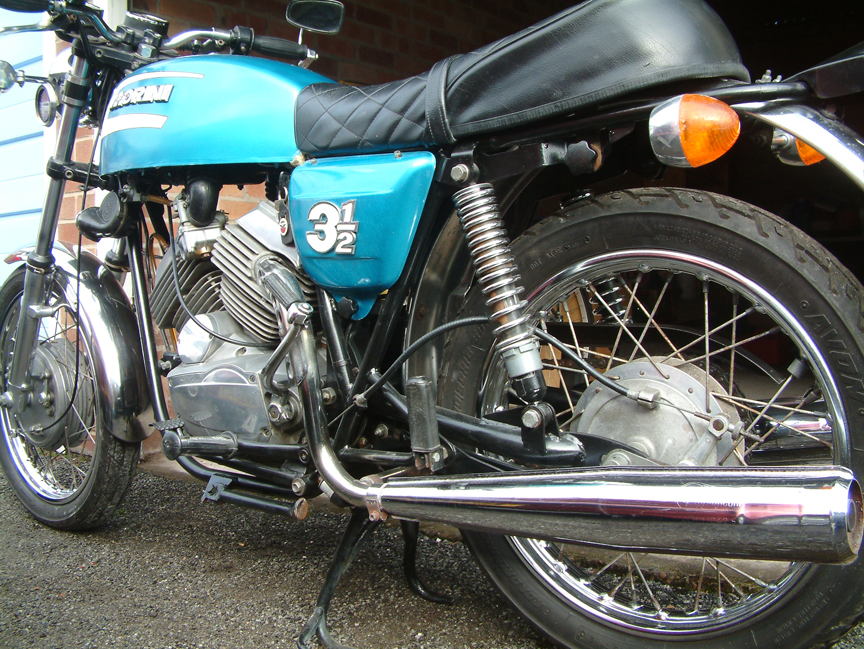
Morini 350 Strada Road Test - 1975

It happens every
time we get a good 350: once more we rediscover
the "ideal" package, where the virtues
of small and large machines meet in one gutty,
handleable package. Yet it is never quite the
same on each occasion: slowly the performance
offered by the really usable 350s has been rising
- and the speed limits dropping. The Morini
Strada is the milder of the two Morinis currently
imported by Harglo (the Batayus people). The
Sport was the subject of a road test some months
ago, and really the differences between the
Strada and the Sport are hardly 'enough to discuss
at any length. The Sport has clip on handlebars,
a humped rear to the seat, and one or two minor
styling changes. The front brake is a double-sided
unit, and the pistons give a slightly higher
compression ratio than that accorded the Strada:
a camshaft to suit completes the "Sport"
variations. The Strada has a neat twin leading
shoe, single-sided front brake and a rear set
of straight bars. The seat is flat and squashy,
and proves just sufficient for two people. The
front forks are by Marzocchi, and have a firm
and effective action.
The front wheel
has a steel 18" wheel rim fitted with a
3.25 section Pirelli. The front mudguard is
chromed, but the test bike was already beginning
to see it flaking away. The single-sided 180
m.m. front brake had had the leading edges of
the shoes chamfered, and gave a delightfully
progressive and powerful action which remained
thankfully invariant through rain and hail -
unlike a disc unit. The speedometer drive is
taken from the front wheel, and actuates a tremendously
inaccurate instrument visible to the driver,
who should deflate its strident claims by a
healthy margin if he really wants to know how
fast he is travelling. The headlamp is mounted
on a pair of those neat cenami rubber-isolated
mountings. The test machine has pretty poor
lights which are roughly on a par with those
of a Zl Kawasaki (i.e. quite inadequate): current
models on sale have a revised and uprated set
of lighting equipment. The control panel is
mounted on the top fork yokes, and the twin
dials of revmeter and speedometer are mounted
on rubber bellows which absorb much of the vibration.
The revmeter is an electronic unit, which did
not stop the needle dancing a tango on many
occasions. Below the dials are three warning
lights, all far too bright for night use. A
red ignition warning light, a mainbeam warning,
and a warning that any lights are on.
The throttle grip has a twinpull chain action
with an ideal total angle of twist: a friction
adjuster is included. Both clutch and brake
lever assemblies are excellent, with adjusters
that really can be adjusted by gloved hands
and rubber bellows to stop water ingress.
A steering lock is fitted, but as no key was
supplied with the test machine we cannot comment
further. The horrid Italian version of a "switch"
is supplied to give a hit-and-miss actuation
of the indicators, and a thoroughly confusing
set of buttons with which to attempt to control
the lights and horn. The horn itself has a nice
note, and although it sounds unimpressive seemed
to be heard by those whom I was trying to to
warn by its use. One piece of electrical equipment
which attracts no more than praise is the solenoid
actuation for the fuel flow. Once the ignition
is switched off this solenoid clicks shut and
foils any of that infuriating petrol leakage
that can so mar one's relationship with a machine
if parked overnight in an integral garage!
The fuel tank claims to hold well over 3 gallons
of fuel. Well it might, but when I ran it from
overflow - full to bone dry, it only accepted
3.05 gallons of fourstar petrol. Be warned:
the reserve was only 2 miles! The Strada doesn't
have the steering damper fitted to the Sport,
and simply doesn't need it. The fuel tank cap
is the same as that on most Ducatis (not the
only point of correspondance between the breeds),
and was starting to corrode. It did not seal
as well as it might, but only once misbehaved:
an isolated occurence no doubt. The tank is
nicely sculpted, but the neatly chiselled lines
have now been superseded by the smooth contours
of the Sport for both models. The seat is extremely
confortable, and - although very short for two
people, provides a quite un-Italian degree of
comfort and resilience.
The frame includes a lifting handle on the
left hand side of the top rear rail (Surprising
isn't it? It's the correct side for our country,
but the offside for the home market and almost
all the export markets for Morini: yet —
like most motorcycles - the stand foot engagement
bars and the lifting handle are both on "our"
side, I wonder why?). The rear suspension units
are — like the front forks - by Marchozzi,
and give a firm, damped ride.
The electronic ignition trigger nestles between
the bases of the two cylinders, and is once
again a Ducati component.
The engine is of course the centre-piece of
this machine, but I would like to draw attention
to the remainder of the Morini for a little
longer. The well gusseted double loop cradle
frame, the Marchozzi suspension, the comfortable
seat, splendid riding position, and excellent
front brake all add up to a singularly attractive
rolling chassis in its own right The Vee twin
or a centred single are surely the only eligible
power plants for this slim and robust chassis.
The Ducati has (until very recently) gone for
the single, the Morini has chosen the Vee twin.
The ISDT Morinis of a couple of years ago looked
very similar to the present 3y Vee twin. The
similarity is no coincidence, as the 3y is the
first of what is undoubtedly an expanding range
of Morinis, all based on common tooling. The
Vee layout and the other dimensions provide
for a 175, a 250, 500 and even further variants
without much new tooling. The 350 size is ideally
matched to the chassis currently in use. The
overall weight is roughly 3301b (damp), which,
with a claimed 38.6 b.h.p. and 261b.ft gives
a very strong performance that is totally usuable.
The bore x stroke of 62 x 57m.m. suggests high
rpm. -correctly: the peak power of the Strada
is at 8,200 (200 rpm. beyond the marked red
line), and peak torque at 5,900. Peak torque
is top gear is almost exactly 70 mph., and although
the speedometer tries to tell you that this
corresponds to about 130-40 kph., the sweetness
of the running of the engine confirms the tachometer
indication. The combustion chamber is of the
Heron type, with a flat head and a heavily machined
piston within which combustion occurs. The Rover
and Audi Heron heads differ in that the Rover
is greedy for high octane ratings at a fairly
modest compression ratio, while the Audi requires
only low ratings for a very high ratio. The
Strada Morini uses 10:1 ratio, but can be run
on 3-star fuel without pinking, although four
star certainly seemed to suit it better. Starting
this engine would be far easier with a better
designed kickstart. The lever is on the left
hand side, with a short throw. Although I find
no difficulty in using a left foot kickstart,
almost all the others who tried to use it found
it awkward in the extreme, providing a fair
measure of amusement to onlookers in the process.
This should not be taken as a necessary evil
associated with ownership of a 3|: the plug
caps are very fiddly to locate and check, and
it was found later that the rear cylinder was
making only a poor plug top contact which, once
located, fixed the problem.
You may have begun to think that I did not
like the Morini. In matters of detail you would
be perfectly correct: these details show up
with considerable clarity against the delightful,
spare, and balanced handling and performance
which raises one's standards for every other
aspect.
When we picked up the Morini from Les Mason's
shop in Tamworth, there was a stripped motor
on view in the workshop. The quality of the
castings and the robust run of the gearbox were
both clearly evident. The Ducati magneto pick-up
rotor and the alternator are in different locations.
The camshaft drive by an inverted toothed belt
was the only unusual component on view, barring
the complex pistons themselves. Obviously the
3-j has a bottom end designed for reliable functioning
as a 500, and will soon wear larger barrels.
One does not over-design to this extent without
good reason. The gearbox ratios are 19.74, 12.34,
9.07, 7.47, 6.46 and 5.89:1, giving a top gear
road speed of 30 mph. at 2,300 rpm. As the Morini
was perfectly capable of winding up to 8,100
rpm. in top gear, the claims for a 95 m.p.h.
top speed are amply reaffirmed. The operation
of the gearbox is rather stiff when compared
to the better modern Japanese gearboxes, exemplified
by the racing TZ Yahamas, but does no more than
dent one's shoe while providing a totally reliable
gearchange action.
As I have emphasised, the Morini delivers the
goods on the move, and well over 1,000 km of
fairly demanding driving proved how brilliantly
the Strada works. It would hardly be fair to
make close comparison with the other V-twin
in my garage (a 750 Desmo Ducati of stunning
character and impeccable handling) on all points,
but on two the Morini scores heavily. The steering
lock is excellent on the Strada and impractically
restricted on the Ducati, and - sadly - the
Ducati is too heavy for comfort when put against
the trim balance of the Strada. Do not run away
with the rosy thoughts of a 'featherweight 350
Vee twin!; it broke our backs heaving it into
the van, but it does get the positioning and
gross total of the weight into a deceptively
light-handling balance.
The ignition key, with its awkward positioning
goes on: the carburettor flip-richener levers
are raised, and the solenoid controlled fuel
tap lets petrol through. A couple of good swings
on the starter lever sets the small twin rifle
barrels of silencers resonating. Once warm the
tickover was fine, which was fortunate as the
.3J- does not boast either an electric starter
or a primary gear engagement for the starting
lever. Very annoying at traffic lights in the
wet, but as the lowspeed torque is exemplary,
and the width pared to a minimum, the trickle
to the front of the line is usually straight
forward. There are, however, limits to this
flexibility: when they are reached the high
compression ratio causes a sudden dead stop
as the rear wheel locks on compression. Sad.
The off beat of the 72° twin produces a
smoothish ride. Do not believe those who tell
you it is 'utterly smooth'. The 3y does have
vibration periods - several in fact - and even
blew tail light bulbs with an intangible high
frequency component. The shakes are very easy
to ignore — and even to forget - and are
rather like a big BMW in their rough and ready
robustness. You rapidly attune to and subsequently
not notice the shakes on both machines. Oddly,
the 750 SS Ducati really is smooth by comparison,
not only with the BMW and the 3^ - but also
the CB750 and Z1 fours. Vee twins can do it.
The instruments have a degree of creative imagination,
the kph./speedometer being merely ornamental.
The illumination of the speedometer failed early
on in the test, but as the revmeter was the
.only useful instrument anyway, this caused
no inconvenience. The headlights are not impressive,
and the switches are typically Italian (i.e.
almost as bad as Lucas units) and best forgotten.
The warning lights cannot be forgotten at night
as they are far too bright and require dimmer
bulbs. The rear light is of minimal size and
gave little source of visibility in M4 fog.
You have lots of time to appreciate all this
as the motor throbs, pushing along at 80 mph.
without any complaint. Even the seat fails to
distract you, as it is comfortable and well
set: a most unusual Italian achievement. Even
my British Standard Passenger only found fault
with the skimpy length of the dual seat- ..
The ride is not quite up to the handling. The
rear units (Marzocchi suspension is fitted to
both front and rear) are too hard for everyday
use, and jolt the spine on large bumps. The
front forks are better and could well be left
with the standard oil in place. The riding position
can be adjusted, as the foot rests are on serrated
locking stubs out on the frame. I found no need
to alter them.
The staccato bark of the exhaust requires a
rapid getaway from rest when cold, as the non-adjustable
chokes cause the Morini to "tickover"
at 3,000 rpm. Once warm, the tickover is quiet
enough, however. The clutch is sweet: dry clutches
are always a good feature on any bike, and I
wish more road machines shared this design with
the Morini. The levers and adjusters really
can be used by fumble fingered frozen hands
in heavy gloves, and are typical of the precise
and well thought out riding aspects of this
machine. Six speeds are a bit of a nuisance
most of the time. My foot got a little sore
from high speed multiple gear changing, as the
Strada only needs three, or perhaps four, gears.
The front and rear brakes are really excellent,
and gave me far more confidence in wet 80 m.p.h.
motorway bunches than the disc of my Z1 could
ever justify. The horn works well too, if you
are lucky enough to hit the button just right.
The indicators are a real pain, and are best
ignored until a decent switch is fitted. Mudguarding
is surprisingly effective. I did several hundred
miles in really wet conditions and observed
the mudguard in actual operation: something
that is not always achieved by those fitted
to other modern machines. It is difficult to
appreciate how well the Morini steers and handles,
as it all happens with such a lack of histrionics.
The toe of my boot hitting the road provided
a regular reminder that it might, on occasion,
be worth slowing down for some corners, or at
least dropping a gear or two. The torque of
this surprising 350 is very good, and there
is little need to rev the motor hard. If one
does press it, there is no complaint. A hundred
miles or so at 7-8,000 in top gear proved that
the Morini was certainly up to it.
My morning (and my evening) drive is 43 miles:
the Morini tempted me on numerous occasions
to take a rambling 55 mile route through back
county Berkshire lanes -just for the fun of
it. The time lost was swiftly made up in heavy
London traffic by the notable slimness of the
Morini, which allowed confident and very narrow
gaps. The torque and the slick gearbox provided
the rest needed to make full use of gaps as
they appeared, and 50 mph. (rush hour) averages
were achieved regularly for the overall run.
To play such games and still fail to push the
fuel consumption below 60 mpg. is astounding.
Admittedly the 750 Ducati can deliver similar
economy, but it is hardly working as hard as
this light and hardy 350.
The exhaust pipes turned their inevitable blue,
and under the gimcrack chromed cover over the
near pipe, the tube turned black and blue where
the tortured gases battered their way from sharp
bend to sharp bend. The finish elsewhere on
this year-old test machine was beginning to
show the strain, and although it is perfectly
clear that recent deliveries have improved in
both electrical equipment and standard of finish,
there is, as ever with Italian motorcycles,
room for more durable improvement. The present
standard can be compared with that so far reached
by Ducati and MV: i.e. adequate, but room for
a great deal of detailed improvement. Morini
seems to be getting on with such improvements,
and I look forward to 125 or 500 versions of
the design to see how far they move on down
this path.
Who would buy a 350 at £700 and more?
Especially one without an electric starter,
slower than an RD350, far less refined than
a 360 Honda, and heavier than a Ducati 450?
Oddly enough, I can see the Morini satisfying
owners of all three types of machine. The torque
gives a really usuable motor, with ample power
for 80 m.p.h. continuous running, the handling
gives nothing away to the Ducati, and the braking
is better in the wet than any of the disc braked
competition (although the Yahama is definitely
better in the dry), the fuel consumption is
miserly, and the comfort eclipses the Ducati.
The stamina and lack of fussiness outclasses
the Yahama, and the roadholding is equally good
— and is provided with less pitching and
fuss that the RD350 dampers allow the Yahama
to deliver.
The Morini Strada is really the 'other bike'
to purchasing a Honda CB500: consequently the
price can be made to look less horrendous, and
in fact the very size of this 4-stroke/middleweight
market assures the 3{ a solid, steady sale.
Sadly, only a minority of owners will look beyond
phenomenal fuel economy to the outstanding agility
of this delightful motorcycle. Please don't
buy one and not use the full fine handling -
if you don't you could well end up unhappy with
your "uninspired™ machine - ride
it really hard a few times and you simply won't
care about the niggles. But for some confusion
at Devimeads' I might have slotted a Strada
into my garage, but as things turned out, a
different Halren 350 is there instead (an Aermacchi).
The Morini joins my short list of thoroughly
satisfying bikes to ride -but still needs a
bit more refinement to keep everyone happy.
Perhaps I could put it another way: if you really
feel that a standard Honda 360 or a Zl handles
well - don't buy a Morini: if you wished you
could afford a Ducati 750, don't hesitate. Harglo
has done motorcycling a real service in persuading
Morini to let the UK have a few 3ys.
Specification
- Tyres: (F) 3.25 x 18 Pirelli
(23 j p.s.i.) (R) 4.10H x 18 Pirelli (25 p.s.i.)
(QD rear wheel).
- Suspension: Marzocchi front
forks (200 c.c. Donax TT) and rear damper
units.
- Electrics: 100 watt alternator,
35/35 watt headlamp bulb, 12V 9AH battery.
- Frame: Wheelbase 55",
seat height 31", ground clearance 7j"
unladen.
- Weight: 317 Ib. dry.
- Engine: 344 c.c. (2 x 62
x 57 m.m.) 72° Vee twin: 10:1 cm., 2 x
25 m.m. Dellarto carbs. Claimed power torque:
35 bhp./8,250, 23.7 lb./ft./5,900 (DIN).
- Capacity: 3.05 gallons
of petrol (measured), 5y pints of oil in sump.
- Gearing: 14/38 sprockets,
109 chain pitches.
Please e-mail the webmaster if you have a picture
worth adding to our database, e-mail: webmaster@motorbike-search-engine.co.uk |