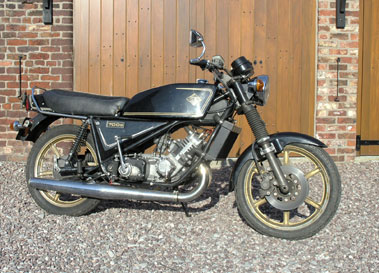
Silk 700

In the mid 1970s the Silk gained a reputation
for being one of the best handling machines of the
day - although its reliability and outright speed
never attracted quite the same eulogies. It might
have been unfair to expect any more, for the Silk,
built by a small specialist engineering company based
in Derbyshire, was a direct descendant of the venerable
Scott two-stroke.
Company founder George Silk, a precision
engineer who rode and tuned vintage Scotts in the
1960s. At the end of the decade, he set up Silk Engineering
and offered a repair and parts service for Scotts
including modifications and improvements. The chief
of which was a frame offering a modern concept much
closer to Alfred Scott's original ideas than anything
in the previous 30 years. The frame, a product of
nearby Spondon Engineering, was light and stiff with
modern suspension at both ends.
Spondon made their own forks and brakes
too - and the whole package could easily be adapted
to the engine that Silk was building. The radiator
was either a Scott-type or borrowed from an LE Velocette,
and the final piece in this most British of jigsaws
was the gearbox - based on the late Velocette four-speed
design, modified to allow it to be a built in unit
with the engine. The 20 Scott-based Silk Specials
constructed by 1975 were just that; specials built
as a blend of many disparate components.
With assistance from some of Britain's
foremost engineering specialists the Scott-based engine
was substantially redesigned, with a patented scavenging
system backed up by specially developed silencers,
resulting in a smooth, powerful engine with good fuel
economy. Other modern features, such as state-of-the-art
electronic ignition, were designed in from the start.
The result of all this was the Silk
700S - a proper production machine with parts manufactured
by Silk or its suppliers. In a time when superbikes
were becoming heavier, the most attractive feature
of the 700S was its very absence of weight. With the
Spondon frame, the handling was superb with good acceleration.
Producing such a machine in small numbers was difficult
and Silk found the going hard at a time when most
of the British motorcycle industry was collapsing.
There was no way in which Silk could have attracted
a mass market or financed volume production . Fewer
than 150 were built.
|