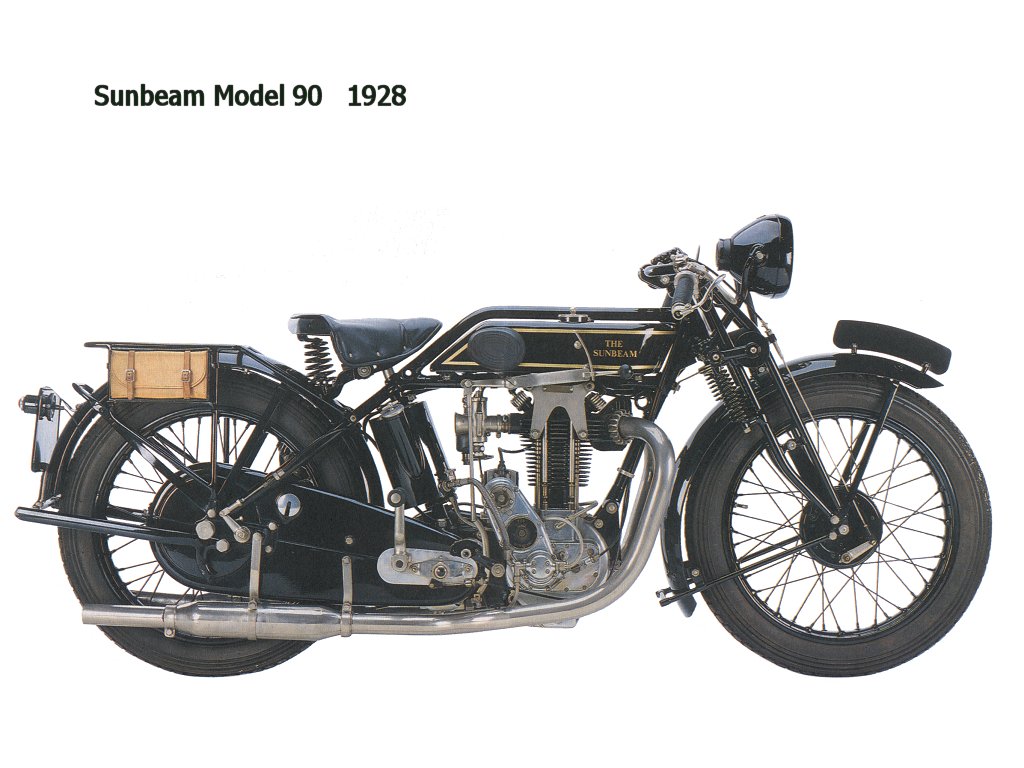
Sunbeam Model 90

Such were the fine qualities of Sunbeam's
roadster models that they were dubbed 'gentleman's
motorcycles' , but the Model 90, Sunbeam's most sporting
bike of the 1920s, was more than capable of holding
its own against allcomers.
John Marston & Company, the firm that built Sunbeams,
was founded in Wolverhampton , as makers of saucepans.
In 1890 they began to make bicycles, which gained
a reputation for fine finish and durability, as well
as a chain enclosure - 'the little oilbath'. Marston's
first motorcycle was built in 1912 and was a sound
design produced almost entirely in-house. The range
expanded and although not cheap, Sunbeams had a reputation
for quality and reliability. After World War 1, during
which Sunbeams were used by the Russians and French,
production of both singles and V-twin models continued.
The firm began entering reliability trials straight
after the war and re-entered racing soon after. Riding
side-valve 500cc bikes, Tommy de la Hay won the 1920
TT with teammate George Dance taking the lap record.
In 1922 Alec Bennett won again on a similar bike.
Sunbeam had to wait until 1928 for another win, but
this time it was their latest overhead-valve model
ridden by the diminutive Charlie Dodson that secured
them the honours. Although the company had experimented
with an overhead-cam design in 1925, the winning bike
was Model 90 works-prepared version. Dodson repeated
the performance in 1929, with Alec Bennett second
on a similar bike.
Early Model 90s followed the classic flat-tank styling
and sported Sunbeam's renowned black and gold finish.
They were distinguished by the workmanship and immaculate
finish, rather than the ingenuity of the design. The
engineering was simple. Large, well-balanced flywheels
and a short, stiff conrod characterised the bottom
end while the high compression piston and combustion
chamber were the only secret of the top end. The Sunbeam
Model 90 was made until 1933 and variants under differing
model numbers until 1935, shortly before the company
was taken over and motorcycle production ceased with
World War 2.
|