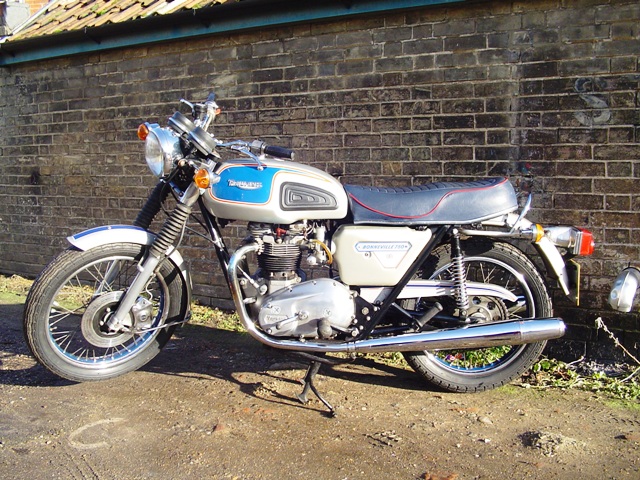
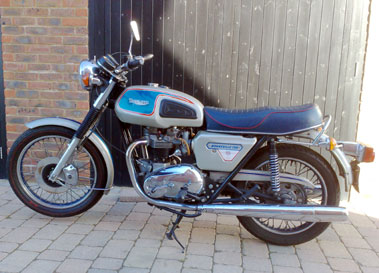
Triumph Bonneville Silver Jubilee
 
To coincide with celebrations in Britain
marking the 25th year of Queen Elizabeth II's reign,
Meriden hit on the idea of a special edition of the
Bonneville. It's distinctive trim featured silver,
as well as patriotic red, white and blue. Originally
it was announced that the Jubilee Bonneville would
be made in a limited edition of 1000 and the first
batch side panel badges bore the legend "One
of a Thousand".
However, demand for the machine was sufficient to
persuade the Cooperative to release a further 1000
T140 J's with the wording altered to read " Limited
Edition ". A further batch, generally agreed
to have been about 400 machines, were produced for
the International market, being Canada, Australia
and New Zealand.
The wording on the side panel badges, again being
altered to read "Limited International Edition".
Each machine was sold with a certificate of authenticity,
which differed between the U.K. and U.S. markets.
(The US. documents were slightly more elaborate than
the UK version, and embossed)
The Jubilee appealed to collectors who wanted a machine
as much for ornament as for riding, or as a sentimental
souvenir of a British motorcycle industry which in
1977 looked set for extinction. As a result, a high
proportion of T140J's have remained in totally original
condition.
Engine numbers on the Jubilee followed the same sequence
as standard T140V models but with a J suffix instead
of the V. For 1977 engine numbers began at GP 75000.All
the Jubilee's variations from standard were cosmetic
and are listed here :
All outer engine cases, primary drive cover, gearbox
outer cover and timing cover were finished in bright
chromium plate, applied on the aluminum alloy.
The Jubilee introduced " upside-down "
girling gas shock absorbers fitted with their pre-load
adjusters uppermost. Like the the standard oil-damped
units, they featured chrome springs. Probably wisely,
the factory opted not to change the black enameled
finish of the Jubilee's frame and swinging arm.
The wheels on the Jubilee were clearly different
in terms of finish. Instead of being in plain chrome,each
wheel rim had a blue central band with white inner
and red outer pinstriping, painted over the plating.
The Jubilee's original tyres were a Dunlop K91, 4.10
x 19in at the front and a 4.10 x 18in at the rear,
with red lining and directional arrows on the sidewalls.
The Jubilee's seat was the first of a design which
would ( apart from the special color's) become standard
on all Bonnevilles for the following year. The familiar
aeration on the seat top had gone, replaced by a narrower
crosshatched panel. On the jubilee the panel was covered
in blue vinyl along with the rest of the seat. Red
piping ran round the top perimeter of the rear portion
before running downwards along the sides and looping
back up towards the front of the seat. The lower rubber
trim was blue with the decorative chrome stripe, the
Triumph logo was displayed in silver as were the words
" Silver Jubilee " on the back of the unit.
Mudguards were painted rather than chromed on the
Jubilee Bonnevilles,and followed the scheme of the
wheel rims. A center stripe of blue flanked by white
inner and red outer pinstriping was applied over a
base coat of silver.
Jubilee fuel tanks were the same as those specified
for their respective market on the standard model,
except for color. While graphics retained the same
layout, the blue and silver theme continued.
A blue side panel was applied over a silver base in
the U.K. while the U.S. version sported blue flashes
- curved back in the usual fashion from the top of
the tank badges - over a silver base.
In all markets, the pinstriping was in white and red,
with the red sandwiched between two white lines.
The side panels were all new, like the seat and rear
shocks, but with changes to finish were destined to
become standard items on all Bonneville models.
They fitted over the existing panels and were plain
silver with a special extended badge.
The top of the the badge was similar to the existing
" Bonneville " badges, but there was a triangular
extension underneath the Bonneville name at the rear.
This enclosed a Union Jack in the center flanked
by the words " Silver Jubilee " and with
either " One of a Thousand ", " Limited
Edition " or " Limited International edition
" underneath. The panels themselves featured
a new mounting system with a single screw just below
the badge, backed up by a concealed spring attached
to a metal lined eyelet on the inside of each panel,
running over the top of the carburetor's and pulling
the two panels together.
On the chainguard, the Jubilee theme continued in
silver with a bluestyling stripe along the upper part
about 1/2 in from the top edge, tapering down to a
point just before the rear end of the guard, the stripe
was double lined in white and red.
The only other detail of finish to mark the Jubilee
apart, was it's chrome plated rear light housing,
now painted black on standard models.
|