Triumph Speed Twin 5T
   
The Triumph Speed Twin changed the face
of motorcycling. Before it, most motorcycles, sporting
or otherwise, were singles. But the Speed Twin was
so successful that almost all other factories jumped
on the bandwagon with their own versions. Its parallel
twin engine configuration was to endure until the
demise of Triumph some four decades later.
One man can take most of the responsibility
for the Speed Twin - Edward Turned, who had been the
man behind Ariel's Square Four. Moving to Triumph,
Turner quickly revitalised the firm's 250, 350 and
500cc singles as the Tiger 70, 80 and 90. Good looks
and exciting performance suggested by their name ensured
the new models' popularity . However, in 1938, Edward
Turner brought out the range leader that would really
establish Triumph as market leaders.
Turner's new Speed Twin was light and
smaller than the Tiger 90, enabling it to slot into
the same frame. Weighing 5lb less than the Tiger 90,
it cost only £5 more at £75. It had better
acceleration, pulled more smoothly and revved more
freely, with valve gear many supposed to have been
influenced by the sporting Riley cars.
The first Speed Twins had a one piece iron cylinder
block with six studs holding the base. This proved
a weakness and was soon changed to eight studs. The
head was also cast iron. Camshafts in front and behind
the crankcase opening drove pushrods between the cylinders,
operating the valve gear in separate alloy boxes bolted
to the cylinder head. Ignition and lighting were by
a Lucas Magdyno behind the cylinders and lubrication
was by double-plunger pump. Transmission was by a
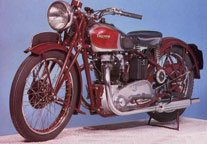
separate four-speed gearbox. The appealing finish
was Amaranth red and chrome with gold lining, the
engine was good for around 90mph. In 1939 the factory
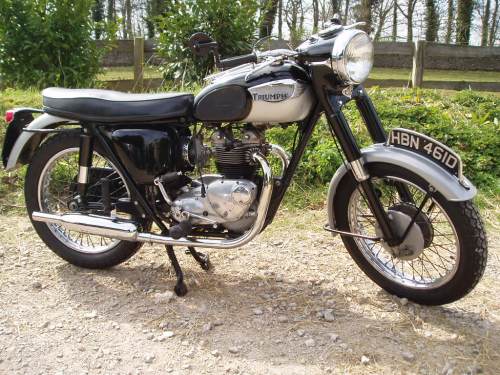
produced a sports model, the Tiger 100. Finished in
black instead of red, this model would top 100mph.
Fitted with a supercharger, it took the Brooklands
500cc lap record to over 118mph.
Had it not been for the war, which interrupted production,
the trend-setting Speed Twin might have dominated
the market even sooner. As it was, it ushered in a
period during the 1950s when BSA, Norton and a host
of marques such as Royal Enfield and Ariel all followed
Triumph down a parallel twin route.
|