Velosolex Solex 4600
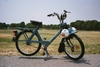 
Since the official beginning of Solex
production in 1946, there have been many different
models produced. New models appeared not only in
France, but also in other countries. Surprisingly,
many of the new models appearing in other countries
were not available in France. For example, a version
of the model 5000 was created for sale exclusively
in Holland that had 12” wheels instead of
the standard 5000 wheels that were 16”.
One model not available in France was the 4600.
It was created as an export model, finding its way
to new homes in countries such as England, Brazil,
Canada, Italy, Denmark, Austria and the United States.
This first version, the V1, was basically a 1974 model
3800 Solex equipped with the handlebars, headlight
and motor lift assembly of the model 5000. Also, it
was available in not only the standard black color,
but also blue, orange and yellow.
Most V1s use the taillight of the 3800, which was
not intended for use as a brake light. However, some
V1s have a crude brake light setup which operates
off of the rear brake assembly and, therefore, only
works when the rear brake is activated. One of these
setups uses a resistor block attached to the inside
of the left frame rail, along with a switch. Power
to the taillight passes through the resistor resulting
in a dimmer bulb. When the rear brake is applied,
the switch is activated allowing full power to get
to the taillight, and the result is a brighter bulb,
giving the appearance of a brake light. The taillight
is a SEIMA item and the headlight is from CIBIE. Another
setup uses a MALY two-lens taillight assembly. Power
is sent to the lower lens whenever the headlight is
on. This lens also has a clear panel in the bottom
to illuminate the license plate. Whenever the rear
brake is activated, power is sent to the upper (brake-light)
lens through a switch mounted on the inside of the
left frame rail. The switch is connected to the rear
brake cable with a chain, rod and clamp.
Standard pedals on this version are from LYOTARD,
white with orange reflectors. In Canada and the USA,
motor serial numbers of this version are in the 7,1xx,xxx
range and frame numbers are in the 8,06x,xxx - 8,07x,xxx
range. In England, motor numbers extend into the 7,2xx,xxx
range and frame numbers get into the 8,08x,xxx range.
In Canada and the USA, this version was sold in 1974
and 1975.
Renault, and then Motobecane, took over VeloSoleX
in 1974.
To conform to the USDOT and Canadian regulations
of the time, requiring such things as a true brake
light, non-inverted brake levers, electric horn, ignition
kill switch and sealed beam headlight, a new 4600
version was created for sale in the US and Canada.
The 4600 V2 was sold in 1975-76 and has motor serial
numbers in the 7,2xx,xxx spectrum. Frame numbers fall
into the range of 8,08x,xxx and up. Electrical parts
on this version, such as the headlight, taillight
and switches, were supplied by CEV, an Italian company.
Like the V1, the V2 was available in black, blue,
orange, and yellow. The standard pedals are white
with orange reflectors, from either UNION or LYOTARD.
A new name came with the new version…it was
to be known as “The Horse”.
For 1977, changes were made to the 4600, the result
being the V3. The taillight is a Motobecane item from
ULO. The headlight and switches are from CEV, and
the pedals are from UNION, black and tapered in shape.
In 1978, UNION black block pedals with a Motobecane
“M”are used. A GE headlight is mounted
in a LUXOR body and bezel, and switches are from APRILIA.
Motor numbers are in the 9,0xx,xxx range and frame
numbers start at 4,600,000. The V3 was only produced
in black, blue and yellow, and was only sold in the
USA.
Both the V2 and V3 have a metal ID tag on the frame
neck. To power the brake-light, horn and large headlight,
they have a third coil, a larger lighting coil, and
more powerful rotor magnets. On the V1 and V2, the
small front fender is painted white on the orange,
yellow and blue bikes, and black on the black bikes.
The center-stand is black on the V1 and V2. On the
V3, the center-stand and the small front fender are
painted the same color as the frame. On the V2 and
V3, an engine crash-guard was standard equipment.
The V2 and early V3s used rectangular reflectors on
the sides of the crash-bar, while round ones are found
on the later V3s.
The carburetor throttle-lever return-spring on the
V2 and V3 is hooked up differently from other Solexes.
Instead of the throttle barrel being held totally
open by the spring, it is held in an idling position.
Twisting the handgrip towards you opens the throttle,
and when the grip is released, the throttle springs
back to the idling position. The V1, on the other
hand, has the same twist-grip and throttle-lever return-spring
setup as the S 3800 and 5000.
All 4600s have motors with “CYCLO MOTEUR 3800”
cast into them, and, as mentioned earlier, some 4600
V1s (as well as some S 3300s, 3800s and 5000s) are
equipped with a taillight assembly from MALY that
includes a conical light on top, a license plate holder,
and a typically-styled red taillight lens with a clear
panel in the bottom for illuminating the plate.
One very common mistake that many Solex owners make
when trying to determine the date of manufacture of
their Solex is thinking that the 14-3-1966 date that
is cast into the motor is the date of manufacture.
It should be noted that this date is cast into the
motor, not stamped, and that this same date is cast
into every 3800-type motor. It is actually the date
of homologation or approval of the 3800-type motor.
|


