Yamaha
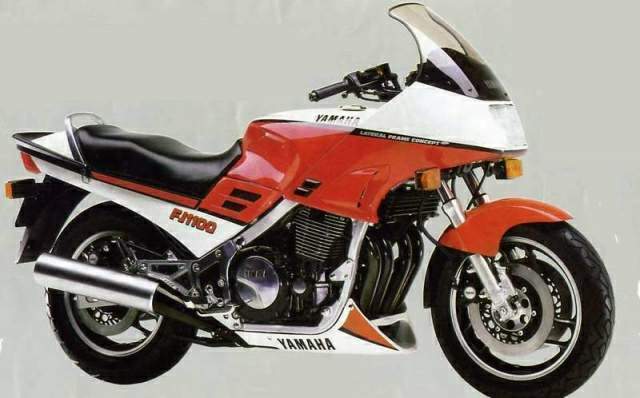
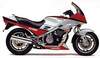
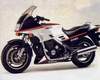
FJ1100
In 1984, Yamaha
reentered the super-bike fray after years of
neutrality. The long-awaited FJ1100 was big,
last and refined - the first open-class street
bike from Yamaha to be taken seriously, an immediate
force to be reckoned with by the other factories.
There were faster, sharper bikes that year,
but none of them had the FJ’s whole-cloth
competence. The Yamaha embodies a classic balance
of comfort and performance that has lengthened
its lifespan far beyond that of the other open-class
soldiers it once fought, which have long since
faded away.
The motor is a
compact, slightly inclined, DOHC, 16 valve transverse
four, remarkable only for the amount of sheer,
outright power it gives - 125bhp at 9,000rpm
-which makes the FJ a king of wheelspin along
its rapid path to a blistering top speed. What
is unusual about the bike is the way the engine
is mounted. Yamaha realized that serious weight-saving
on a bike this big was a futile exercise, so
they concentrated their efforts on keeping the
weight, and indeed the bike, low and compact.
Their 'lateral frame concept' consists of a
high-tensile, box-section steel frame built
along endurance racer lines. There are no top
tubes running above the engine. Instead, two
huge frame tubes laterally hug the motor's sides.
Instead of meeting at the steering head, these
two side tubes join in front of it; the steering
pivot itself is supported by small-diameter
tubing, fully triangulated off these main rails.
The aim is to achieve the greatest possible
steering head rigidity. Certainly it was a first
for a Japanese production bike.
Sitting on 16in
wheels, front and back, the FJ1100 feels remarkably
low on the road. The seat height is a mere 30.7in
yet there is good ground clearance. With a full
tank it weighs 5561b yet the weight is hardly
noticeable on the move. The bike's low and tight
dimensions belie its size and it has none of
the dead, top heavy feel of traditional 1100cc
monster road bikes. It steers quickly and nimbly
as intended. On small wheels with fat tyres,
4.4in of trail, a 30 degree head angle and a
trim 58.3in wheelbase, the FJ was the first
1100 to prove as lively as many a middleweight
motorcycle. It makes smooth and strong power
effortlessly.
The wind-tunnel
designed full fairing deflects the worst of
the wind and the weather and helps the bike
to an impressive top speed. It is so quick and
powerful that it can easily deceive the rider
about what speed he or she is doing.
| Bike |
Image |
Description |
| Yamaha FJ1100 |
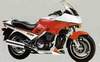 |
The FJ1100 was the first litre-plus motorcycle
to address the problem of all litre-plus
motorcycles - how to make something fundamentally
big and heavy handle responsively. The FJ
is a genuine 150mph superbike, combining
a huge and immensely strong engine with
a low and fairly lightweight chassis. Until
the FJ1200, it was Yamaha's flagship, their
biggest and most powerful four-stroke motorcycle. |
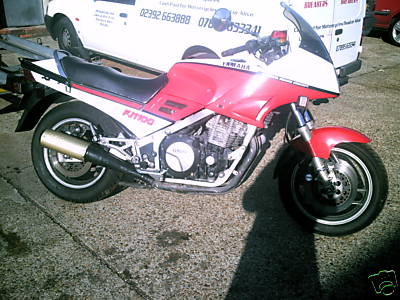
| 1984 Yamaha FJ1100 |
 |
|
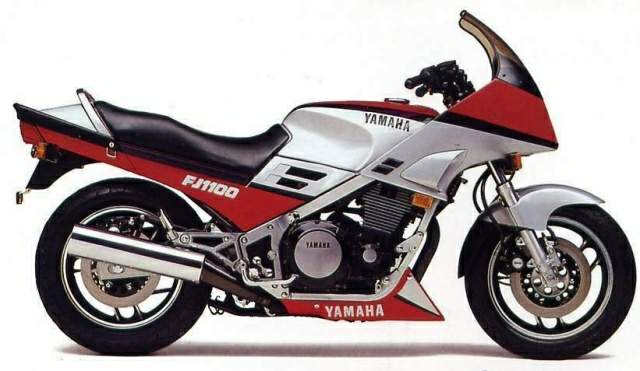
| 1984 Yamaha FJ1100 |
 |
|
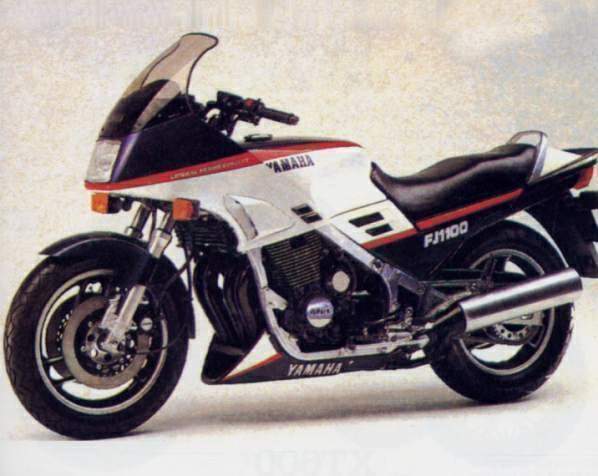
| 1984 Yamaha FJ1100 |
 |
Early in 1986, Yamaha unveiled the FJ1200,
an oversized big bore version with more
power everywhere especially in the midrange.
It is only a few mph faster at the top end.
The chassis spec is virtually identical
and only detail changes have been made.
|
Please e-mail the webmaster if
you have a picture worth adding to our database,
e-mail: webmaster@motorbike-search-engine.co.uk
|