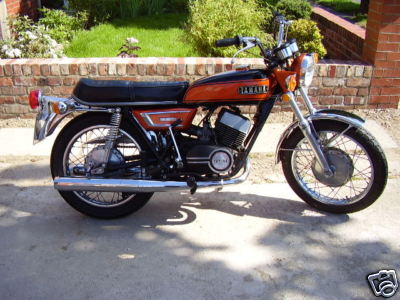
Yamaha
YR5 350cc RoadTest
Motorcyclist Illustrated 1973
That sickly sweet feeling in the gut means
that a 'bike appeals. Totally and to every sense.
Two strokes had missed my personal boat.
Ridden and, to a large extent, enjoyed. But
noise, stench, power delivery and character
had never succeeded in sparking off that certain
sharp delight. A self admitted bias.
The Yamaha CS5E had moved mountains to dispel
the discrimination. An instant rapport.
The hazy notion that family blood runs deep
bolstered up happy anticipation for the
largest of the Yam strokers - the 350. And after
all, what's good enough for Jarno, etc.
The relationship with the R5F didn't start
well. It was hatred at first sight. A yakking,
ringing, obstinate, unreliable, uneconomical,
ineffectual and devious little beast that no
amount of cossetingwould < pursuade to acquiescence.
I knew what the F stood for.
A period had arrived in life when quiek, reliable
transport was not only necessary but essential.
Immovable and resolute, the Vam had quietly
giggled at my undignified fury. Life would
emerge, but only after a pitiful, tormented
half mile run-and-bump. It was obstinate and
slow, being heartily shamed by an accompanying
Kawasaki 250. There was no enjoyment. And so,
coughing, retching, spluttering rider and machine
reached a compromise - a policy of noncooperation.
Mitsui had been fair. This was not one of their
best. The 'bike had been in the hands of a (thankfully)
unnamed constabulary. It had' been ruined as
the hand of the law slapped the 350, potentially
one of the ultimate mid-capacity sportsters,
around a trials course. Raise an eyebrow at
the logic, if you must. Poaching had never been
a paying proposition in North London. But
the result had been premature dotage for
the Yam. It wasn't a happy ship. Our's had been
luckier than others. Mitsui demanded a complete
rebuild.
Now a word from our sponsors. Excusing a substandard
machine on the grounds that it has led an arduous
and ugly previous test life or that it is a
result of an assembly line computer hiccup becomes
an embarrassing occupation after the third or
fourth time. The excuse often has every true
foundation, but after a while leaves nothing
but the joyless contradiction of, on the one
hand, reports of riding acquaintances and other
mags that say "Brand X is good", and
on the other, the disillusion of personal experience.
The benefit of the doubt may fairly suffice
in the first instances that the phenomenon arises.
It could all so easily be true. After that,
seeds of doubt are sown. In other words Brand
X is either rotten or has been subject to lousy
preparation. Despite appearances to the contrary
MC/does harbour various noble sentiments of
responsibility to readers. In gaining the
truest picture of a machine, the coincidence
that we hh a bummer (which we seem to do embarrassingly
often) will in all but the most exceptional
cases, be ignored. Those "exceptional cases"
will, as always, be stated categorically. But
now the motorcycle offered for test must
be taken as representative of the breed to a
far greater extent.
The Yam then, started out a stinker. Too bad
to be just another freak. It was returned to
Mitsui, checked completely, rebuilt and returned
within 72 hours. Which says a lot for their
brisk efficiency - not the sort of service you
can count on getting from your friendly neighbourhood
weasel.
The ailments were revealed. The odd copper,
who will be instantly recognisable by his blushes,
had forgone the niceties of running in. A piston
furrowed like a ploughed field testified to
that. The monumental seizure hadn't been helped
by a carburettor float which didn't, and which
helped in the uncanny ability to wet plugs every
other mile.
With soul refreshed and an initially gossamer
hand at the tiller, the R5 redeemed itself.
It actually started. Was actually quiet. Was
actually quicker. The billowing smoke screen
still billowed, although not to the previous
astounding extent.
But still the hopes, perhaps falsely built
up by reports shouting "the best 350 in
the world", went unfulfilled. It should
have been exceptional. It was merely good. The
reasoning behind this opinion will follow later
in the test, but warnings from Mitsui, that
even in peak health our particular machine wasn't
the brightest had been given with a disarming
honesty.
In appearance the 350 is virtually indistinguishable
from the 250. A different lick of paint - a
dull red instead of candy gold - is the giveaway.
Unless you go to the lengths of squinting at
the side flashes.
Internally the differences are predictable.
Cr. down from 7.1 to 6.8; bore increased from
54 mm to 64 mm (capacity up from 247 to 347);
carburettor throat from 26 mm to 28 mm. While
internal ratios remain identical, primary reduction
changes from 3.238 to 2.869 and final reduction
from 2.666 to 2.500. Differences also exist
in the oiling system. Which all adds up to a
36 bhp kick in the pants at 7000 rpm.
Visually the machine leaves no outstanding
impressions on the eye. Slight, light and wiry
- neat, yes, but no headspinning stylistic innovations.
Essentially a very "ordinary", quiet
piece of motorcycle to the passing world.
Which is mystifying, since the smaller CS5E,
bearing all the family likeness, caught
the eye and the imagination. Cinderella
to the 350's Plain Jane. Typical Japanese in
a way that Honda just avoids, but none the less
missing ugliness. By a tumble of circumstance
and chance the machine has now rested within
MCFs happy portals believed to be "not
a million miles" from my back yard) for
over three months. Unlike many road testers
it is hard for me to enter into the illusion
that test machines are "mine". They
are never even referred to as AfC/'s. Probably
something to do with the hassle of parting with
a much loved machine the moment that a personal
relationship has been struck.
In the Yam's case it was different. Of
the 4500 miles under its Dunlops, three and
a half grand are mine. The mud and rust (sorry)
are mine, as is the patch on the rear tube.
The machine has been used constantly and without
exception for at least the last 70 days. Bin
through a lot, you could weep. A certain insight
into the Yam's finish is only to be expected.
Paintwork, with the exception of certain parts
of the frame, is durable. The only sign of sloppiness
(mass production?) appears on the tank where
colour borders fail to marry by a whisker, and
leave a line of off-white primer peering through.
Paint over frame welds is thin and under the
devastating neglect heaped on the machine,
light rust is already beginning to wheedle through.
If Japanese chromework is the object for traditional
hilarity, Honda, for whose finish I have no
mean respect, have come a long way in stopping
the laughter. Not so the R5, which has suffered.
Wheels, speedo/tacho bodies, upper fork trim
and fork stanchions themselves have all
sheened over with rust, though none yet reaching
the pitting point and all hopefully an easy
match for Sol-vol. More serious is the corrosion
on a small number of nuts and bolts around the
handlebar fixtures, where pitting is already
taking place.
Surprisingly, alloy corrosion has become obvious
on control levers and their fixing clamps though
the light touch of a wire buffer is expected
to restore all former beauty. Again, the thin
paint of the pressed steel brackets mounting
the pillion footpegs and silencers has given
way to the nibbling of the lead oxide treatment.
Before bringing down the collective wrath of
Mitsui and Yamaha it must be emphasised that
the conditions under which the machine has been
kept have been bad. Outright neglect that no
private owner with an ounce of sense would subject
his 'bike to and which were chosen for the specific
intention of gauging weather protection resistance
under the severest of conditions. Throughout
the test period the thing has been cleaned twice
thoroughly, and from then on left naked as nature
intended to the elements, all of which were
miserable. Neither tarpaulin nor plastic
mac. Until an ex-editor cares to lend us a nameless
Teutonic motorcyle (the big one, please Alan)
for a similar extended period the above criticisms
will hardly be of great comparative value, but
must be read as what the Most moronic of owners
can expect.
An aspect which does speak of ill-conceived
design is the seat. Expanded rubber foam nestling
under the standard quilted plastic covering.
From beginning to end the stuffing has remained
in a sodden state, leading to red-faced dribbles
down the side panels and over the battery compartment.
It wouldn't have mattered if it hadn't been
so obvious.
In common with any modern machine save the
Ura! (that's modern?) mudguarding is inadequate,
happily splodging power unit, forks, swing arm
and. unbelievably, tank with the ti: that
the road sweeper missed To the intending owner
we say: get yourself mudflaps back and
front.
Far outweighing any frivolities of weather
protection are the QD wheels. Gloriously, blissfully
QD. To Yamaha^s everlasting credit is the one
nut that stands between you and complete removal.
And that despite the conviction that manufacturers
see riders merely as buyers, not as the wTetched,
misbegotten and very cursing creatures left
deflated in the snow storm somewhere east of
Inverness. You didn't think they made 'em
like that any more?
Electrical controls are a Nip norm of dip/main
beam and on/off sliders crouching above horn
and lateral trafficator control on the left,
with a centrally mounted off/on/parking key
twixt speedo and rev meters. Pilot light, when
the bulb hasn't blown, is governed by a flat
twist-switch on the headlight shell.
Once the Yam had recovered itself, the ritual
of starting simplified. Choke use though,
was always critical, i.e. it was impossible
to start without it, four-stroking became excessive
after 20 yards and disengagement after that
distance resulted in a sogging unhappy motor
reluctant to fire both cylinders unless massive
revs (for a cold unit) were used. Within half
a mile the show began swinging smoothly
- until it had cooled for 10 minutes and demanded
that the entire process be repeated. It was
hardly a deterrent, but merely represented a
characteristic of occasional two strokes that
the four stroke man will find unattractive.
Power delivery belied the relatively small
capacity. Below 2000 rpm it was an impotent,
sagging barbie with little return. Above 2500
top gear could be pulled, tfcovgh gently in
a subdued, half hearted manner, but progress
none the less. Between 3 and 4.5 the torque
increased disproportionately and the exhaust
note look on the deep, hollow moan that marks
the bigger Yams. 5500 rpm was all that was needed
for town pace (well beyond the reach of the
box-bound commuter). Yamaha claim maximum power
output at 7000 rpm. Though a brake may prove
me a liar, the full force of the unit appealed
to the senses some 1300 little ones after that,
taking one abruptly to the red paint. At this
point the R5 is a noisy creature. A sing-song
wail that was utterly delicious, but not society's
greatest friend.
Ultimate performance was a variable thing.
In the lower gears acceleration was strong and
fearsome, nothing lacking. Top speeds were
achieved in fourth gear at engine speeds above
the red line. Which left top as a disappointing,
irritating overdrive, capable of spinning the
machine along at any point between 75 and 85
mph indefinitely providing that the slides
were wrenched against the stops.
Top gear performance, as with the speeds attained
in the lower gears, did remain variable. The
dependence of peak performance upon quirks of
climate, humidity and proximity to Chipping
Sod-bury at 5.00 in the afternoon is yet another
characteristic of so many two strokes and one
which I find intensely annoying. Once more with
feeling - it wouldn't impress a four stroke
man.
Instrumentation could not be expected to help
greatly in determining top speed, the speedometer
appearing to have a mind of its own and acting
entirely independently of the rev meter.
Maximum speed at one downhill point registered
a funny ha ha 110 in fourth at some 8500 rpm.
Optimism at its highest. The change into
top instantly reduced velocity (indicated and
actual) to 85 mph or so at 6.5 to 7 thou.
As motorway transport, the realities of medium
capacity have to be considered. To trample the
thing at maximum effort inevitably persuaded
all but the most ambitious, but in return
it would be a busy, tiring process that could
leave rider and machine puffed, if not exhausted,
after several thousand miles of ownership. The
most comfortable and relaxed pace corresponds
to the maximum capability of the M-way boy racers,
hence hassles in the ensu-ing game of dodgems.
So, with a guestimated max of 94-96 mph the
muscly confidence of a ton-plus cruising machine
ain't going to be yours. Scream the thing if
that be the only way you like to travel, but
neither you nor the machine will last long.
It is the long, serpentine A class roads where
the 350 comes into its clover. Roadholding,
though, was betrayed by the surprisingly bad
Japanese Dunlops. "Surprisingly"
since these covers have proved more than enough
on heavier, faster machines - the two Honda
Fours being cases in point. Quick sweeps introduced
uncertainty, a split second jitter of lost
confidence at speeds above 75 mph. Framing,
bearing in mind the exact similarity to the
racing versions, is beyond suspicion and
can be discounted. Suspension, although distinctly
stiff at the front, giving a pneumatic drill
ride over even mediocre road irregularities
Combines with a set of rear units that vary
between the outright hard and jumpy on the tallest
setting to a happy, though not magnificently
comfortable medium, on the softest of the three
positions. Suspension, like tyring, in the final
analysis revolves around rider weight and preference.
The compromise issued by the factory won't throw
any question marks at the roadholding but
if it's an easy ride you demand think about
a lighter oil in the front. TT100 covers on
the rear and a Dunlop ribbed frontwards (no
- they don't make a 3.00 x 18 TT100) are the
panacea for depression at roundabouts.
A chief delight of the Yam lay in the gearbox.
A gearbox that begged use without any whiff
or sign of clutch. Light but positive, tremendously
satisfying and flattering to flicker through
from ratio to ratio, an instantaneous, unhesitating
change of key from the back-end. So nearly up
to the CS5E's blissful standard only to be removed
to the ranks of the "also rans" by
the unnerving tendency to jump from any ratio
a microsecond after engagement when every
stop has been committed and pulled out. The
fault appeared only on those changes where said
clutch had been abandoned. It tinged the fun
'n' games with a shadow of circumspection.
Braking also did not meet expectations thrown
up after the little 200, a machine that was,
if possible, so nearly outbraked. Sure - initial
impressions were impressive. At urban speeds
a crisp bite and steady deceleration on the
first serious applications. But then it tired
and yawned, and then resignedly faded under
the heaviest loadings. Never as diabolical as
some drums, but still insufficient for the demands
of most riders.
Mitsui have, rather unsuspectingly I think,
offered the long awaited opportunity for an
extended test - to my mind the only type of
true evaluative test. S6 a big thank you, Mitsui.
It can be taken as granted that no other manufacturer/concessionaire
has so far been willing to release a machine,
probably (and dottily) the only one of a particular
model on the test fleet, for press use over
such a long period. The reasons are varied and
doubtless don't need my comment on them.
The Yam R5F is an interesting machine and criticisms
of individual characteristics should not
be confused with disappointment with the entire
motorcycle. Of the three and a half months with
the machine, the last four weeks of incessant
use has seen me become happier with the 'bike.
Now that the initial fracas is sorted out the
thing's unstinting service despite a gross lack
of attention or maintenance has mellowed
my original feelings of hostility. To come down
to mundanities. it has carried me where
I wanted to go, driven furiously for 90 per
cent of the time, without decline in performance
and, indeed, without any protest whatsoever.
There is no reason to think that the prospective
buyer cannotexpect the same.
The unpredictabilitv of top speed, especially
fifth gear performance, my blackest disenchantment,
has now been accepted and allowed for, and in
all fairness will not present the bulk of owners
with any disappointment in their everyday riding.
About London the thing is immensely satisfying
to use. the nimbleness, acceleration and, blow
it, sensuality of the exhaust note have been
enjoyed and become more pronounced in the urban
situation. Over longer runs the ridiculous 2.6
tank capacity (including a very worthy 20 mile
reserve for die light handed), the guzzle-gu:
consumption of some 34 hard ridden miles per
and a staggering oil use in the aby hundreds
per pint have all proved practical nuisances.
Above all reliability has been superb. Perhaps
the modern motorcyclist should take this for
granted. I rather think, though, that he doesn't.
When all is said and done it is a virtue that
most will happily pay a high price for.
Please e-mail the webmaster if you have a picture
worth adding to our database, e-mail: webmaster@motorbike-search-engine.co.uk
|