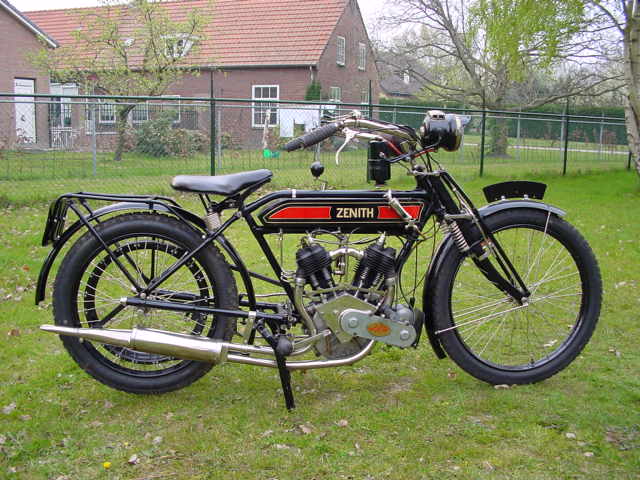
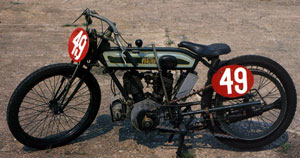
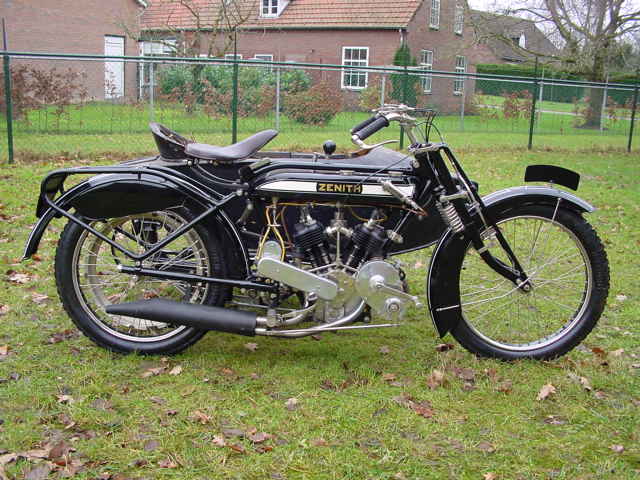
Zenith Gradua
 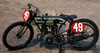 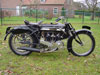
Among the bikes favoured by sporting
riders before World War I, Zenith bikes fitted with
the factory's Gradua gear were among the first to
offer a really practical variable drive ratio. For
a few years they were so successful in hill climbs
and other early events that they were barrer from
single-gear competitions. The company took this as
a compliment and even added the word 'Barred' to their
badge.
The earliest pioneer bikes relied on direct belt
drive to the rear wheel. Although their engines were
designed for maximum flexibility, the fixed gear that
resulted meant that a bike that could start off and
pull up hills easily would have had a severly limited
top speed. The alternative adopted by early sporting
riders was to use an adjustable pulley which could
be opened to give a similar effective diameter and
hence a higher gear. The only problem this posed was
that the belt tension was lost and it had to be shortened
to suit. One early rider's manual devoted two pages
to the process of climbing a hill and a similar amount
to descending at speed afterwards.
Zenith changed all that with a belt drive system,
the ratio of which could be varied on the move. Although
technically limited, it was good enough to ensure
the marque's success in many important competitions
and having demonstrated the virtue of variable gearing
it paved the way for even more practical alternatives.
Zenith was established in 1904 in Stroud Green, North
London. Like many pioneers, they used proprietary
engines, fitted to a bicycle-type frame with direct
belt drive. But in 1908, designer Freddie Barnes developed
the variable engine pulley. This had a pair of flanges
that could be moved in or out by winding a handle
while the bike was on the move. There were a number
of limitations to this device. Unlike the chain drive
that would eventually take over, belts were prone
to slip in the wet, while the limited gear ratios
still needed a large, flexible engine to make the
best use of them. But with the JAP V-twins fitted
to the majority of early Zeniths the theoretical limitations
were overcome.
Improvements to the Gradua system followed including
a variation in which a chain transmitted power to
a gearbox firward of the engine. Transmission from
there on was by Gradua belt drive.
Zenith continued in production from a new site in
South London, making bikes powered by everything from
a lightweight Villiers-powered two-stroke single to
a 1100cc side-valve V-twin. Post-war, they restarted
with a 750cc V-twin but in 1950 ceased production
mainly because of the lack of suitable proprietary
engine makers.
Zenith Gradua
- Years in production - 1908-20
- Engine - single-cylinder or V-twin side-valve
four-strokes
|