Honda Racing History - 2002
Honda
racing 1954-1958 | Honda
racing 1959-1967 | Honda
racing 1977-1982 | Honda
racing 1983-2001
From Two-Stroke To Four-Stroke
  
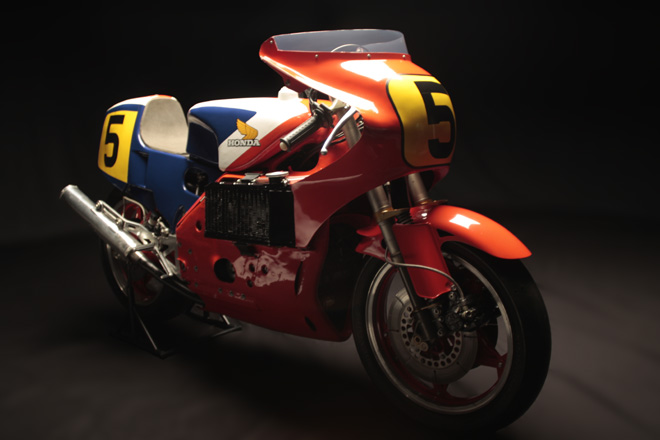
The NR500 was the only four-stroke machine competing
in the 500cc Class of the World GP series back in
the early 1980s – all other motorcycles had
two-stroke engines. It was notable, however, that
society was calling for four-stroke technology for
road bikes. Thus, the link between road and race machines
was once again too weak in the eyes of the GPMA (now
the MSMA) and there were worries about the future
viability of the 500cc category. The manufacturer’s
body therefore put forward a proposal to the FIM to
encourage four-stroke development. Duly accepted,
the new rules, in effect from 2002, stated that the
top racers could have two-stroke engines with a maximum
capacity of 500cc, while four-stroke units could be
bored out to 990cc. At the same time, the World GP
moniker was changed to MotoGP. It was the biggest
event in motorcycle sport since the revolutionary
rule changes of 1969.
For 2002, Honda fielded the 990cc, four-stroke RC211V,
the RC designation reviving memories of Honda’s
golden years in the World GP series in the 1960s.
In keeping with Honda’s policy of pushing the
engineering envelope, the power plant was a revolutionary
V5 unit, made all the more interesting by its use
of ‘big bang’ ignition timing from the
company’s two-stroke era.
Despite a short period of development, the RC211V
quickly showed its potential, even managing to eclipse
the NSR500 on the tracks. Honda duly won both the
rider’s and constructor’s championship
that year, the first to be held under the new MotoGP
rules. It was also symbolic of a new era that the
NSR500, which had previously been the machine to beat,
failed to win all season.
Ironically, the straight-line speed of the 990cc
racers increased to a point where safety issues were
raised. Bikes were now capable of exceeding 330kph,
and very few circuits had gravel traps or other safety
features that could match this level of performance.
The time had come, once again, for a review of the
regulations, prompting the governing body to specify
four-stroke engines with a maximum capacity of 800cc
to be adopted from 2007, along with a limit on tyre
use.
Meanwhile, each manufacturer had refined its machines
for an ultimate showdown in the final year of 990cc
MotoGP racing, with Honda fielding two versions of
the RC211V. One was a regular model, used by five
riders, while the other, a one-off, was provided for
ace rider Nicky Hayden, with a modified engine, frame
and bodywork. This combination created a level of
excitement not seen in the Honda camp since Freddie
Spencer had been given an NSR500 in 1984.
2006 was notable for the emergence of several younger
riders in an eventful season. Hayden scored well in
the early races, but was caught up in the second half
of the season. A fall cost him dearly in the penultimate
race, but he came through to take the flag in the
final meeting and claim the last 990cc MotoGP championship.
During the five years of 990cc MotoGP racing, the
RC211V was the strongest machine of them all, winning
around half of the events held.
For 2007, Honda made a V4 engine for its latest RC212V
machine ready to compete in the new 800cc MotoGP series.
Straight-line speed was reduced by 15kph, but riders
were able to put the power down earlier and brake
later. Tyre technology also improved, and traction
control systems from the 990c era were further refined.
As a result, overall lap times with 800cc bikes were
not that different to those posted by the top 990cc
runners.
2009 brings with it a single tyre supplier for the
MotoGP series, making the roles of the machine and
rider that much more important. This has prompted
more off-season development than ever before, with
computers, data analysts and high-level simulations
coming together to make high-precision bikes capable
of fighting for race honours, and giving birth to
technology that will duly find its way onto Honda
production machines. The spirit of the Isle of Man
TT declaration continues…
|